How Long Should Delivery Drivers Wait for an Order?
Waiting for an order can quickly lower your profit per hour. Learn how to decide when a delayed pickup is still worth completing and when it may be time to reconsider.
By Thomas Staggs · August 30, 2026
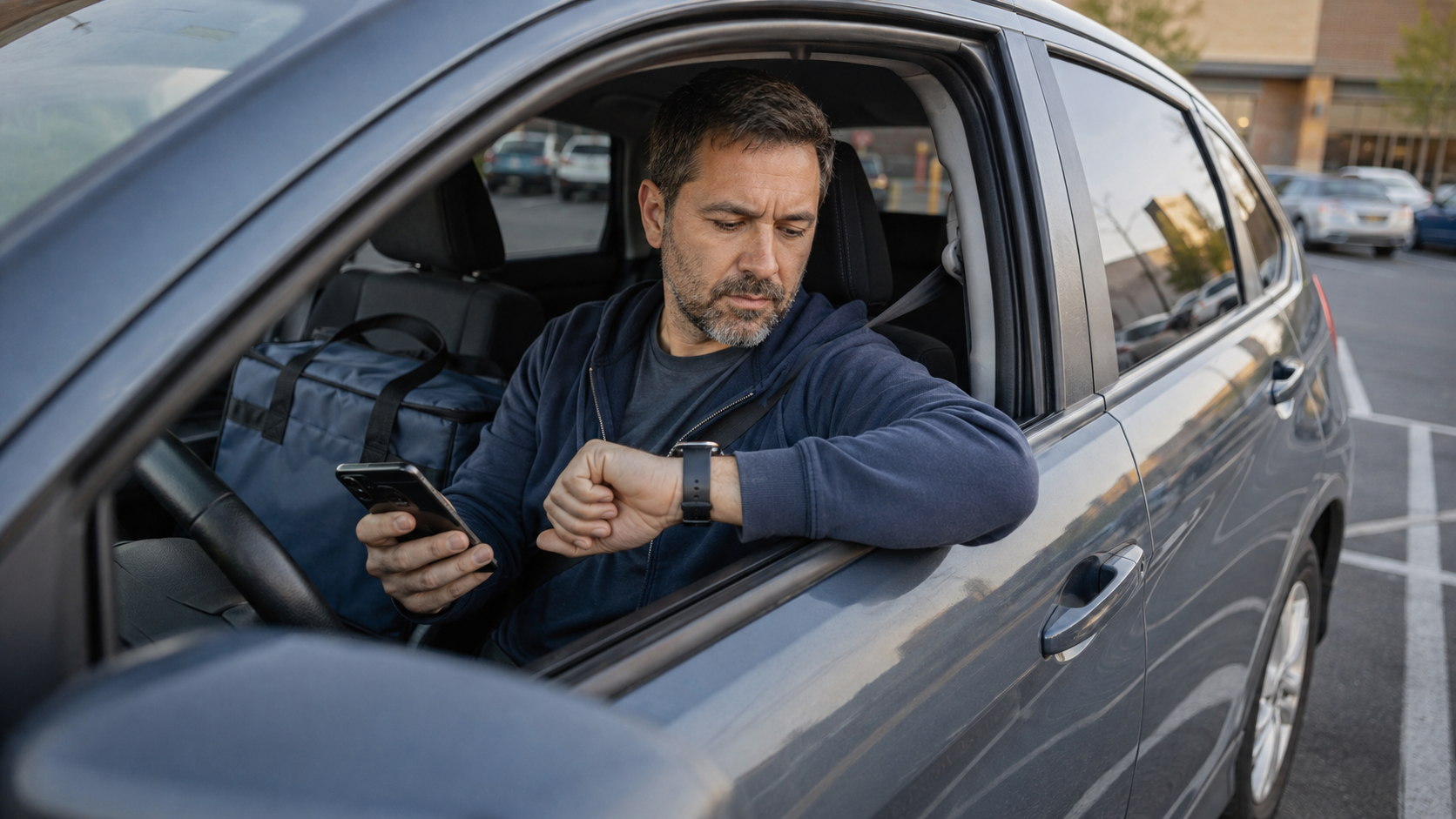
You accept an $18 delivery offer because it looks like it should take about 30 minutes. The mileage is reasonable, the drop-off is not far away, and the payout appears to be worth your time.
Then you arrive at the pickup location and the order is not ready.
Ten minutes pass. Then 20. The payout stays at $18, but the value of the delivery keeps falling.
Waiting does not add miles to your vehicle, but it still has a cost. Every minute spent waiting lowers your potential profit per hour and keeps you from receiving another offer.
How long should a delivery driver wait?
There is no single waiting-time limit that works for every driver or every order.
The right decision depends on:
- The delivery payout
- The remaining mileage
- How long you have already waited
- How much longer the order may take
- Whether the pickup location gives reliable updates
- How busy your delivery area is
- Whether another offer would likely be available
- The platform’s cancellation rules
- How canceling could affect your account or completion metrics
Some drivers set a personal limit of 10 or 15 minutes. That may help them make quicker decisions, but a fixed rule can overlook important differences between orders.
Waiting 15 minutes on a strong $35 offer is different from waiting 15 minutes on a $9 offer. The better question is whether the delivery is still likely to meet your profit and hourly goals.
How waiting changes your hourly rate
Suppose you accept an $18 offer that you expect to complete in 30 minutes.
At that pace, the offer equals $36 per hour before expenses.
If an additional 20-minute delay causes the delivery to take 50 minutes, the hourly rate falls to $21.60 before expenses.
If the entire trip takes one hour, the rate falls to $18 per hour before expenses.
The payout never changed. Your time did.
Vehicle expenses still need to be removed from those amounts. If the trip requires fuel, adds wear to your vehicle, or leaves you with unpaid return miles, your actual profit per hour will be lower.
This is why drivers should consider time along with mileage when deciding whether a delivery offer is really profitable.
Waiting has an opportunity cost
Opportunity cost is what you may be giving up while you wait.
You cannot know for certain which offer would have appeared if you had not accepted the delayed order. You can still recognize that waiting prevents you from completing other deliveries.
During a busy part of the day, a 30-minute delay could cause you to miss another profitable offer. During a slow period, canceling may leave you sitting in the parking lot without another order.
Your delivery area matters.
In a busy area with several pickup locations, leaving a delayed order may give you another opportunity quickly. In a small town with one main store, the next worthwhile offer may not arrive for some time.
Do not assume another offer will appear immediately. Base the decision on what usually happens where you work.
Ask for a realistic update
Before deciding what to do, try to find out why the order is delayed.
A general answer such as “It will be out soon” does not give you much information. If possible, politely ask whether the order is being prepared, waiting to be loaded, or experiencing a larger problem.
The answer may help you estimate the remaining wait.
If the order is finished and only needs to be brought out, waiting a few more minutes may make sense. If the store has not started preparing it, the delivery may take much longer than expected.
Employees may not always know the exact time. Stay respectful. They may be dealing with staffing problems, equipment issues, or a large number of orders.
The goal is not to pressure anyone. You are trying to get enough information to make a reasonable business decision.
Do not focus only on time already spent
After waiting 20 minutes, it is natural to think, “I have already waited this long, so I might as well stay.”
That is not always the best reason to continue.
The time you have already spent cannot be recovered. What matters now is how much longer the order may take and what you are likely to earn by completing it.
At the same time, canceling only because you are frustrated can also be a mistake.
If the order is likely to arrive in two minutes, leaving may waste the waiting time without saving much additional time. If the order may take another 30 minutes, continuing could make the result worse.
Ask yourself:
- How much time is probably left?
- How much driving remains?
- What will the delivery pay after my vehicle costs?
- Where will the trip leave me?
- Is another worthwhile offer realistically available?
- Can I cancel without violating the platform’s rules or damaging my account?
Make the decision based on what happens next, not only on what has already happened.
The payout still matters
A higher-paying order can usually absorb more waiting time than a low-paying order.
Suppose one order pays $30 and another pays $10. Both experience the same 15-minute delay.
The delay lowers the value of both offers, but the $10 order may fall below your minimum acceptable hourly rate much faster.
Mileage also matters. A high-paying order with a long drive and expensive return trip may not have as much room for delay as it first appears.
Before continuing to wait, reconsider the entire delivery:
- Total payout
- Estimated tip
- Remaining miles
- Expected return miles
- Fuel cost
- Vehicle wear
- Time already spent
- Estimated time remaining
Your delivery expenses do not stop counting just because the pickup was delayed.
Return miles can make a delayed order worse
A delayed order may still be worth completing if the customer is nearby and the drop-off leaves you in a useful area.
The same delay becomes more costly when the delivery requires a long drive and leaves you far from the next pickup opportunity.
For example, imagine waiting 25 minutes for an order and then driving 12 miles to a rural customer. If you must drive several unpaid miles back toward town, the delivery could use much more time than the offer screen suggested.
Those return miles affect fuel, vehicle wear, profit per mile, and profit per hour.
When an order is delayed, do not evaluate the waiting time by itself. Look at everything that still has to happen after the order reaches your vehicle.
Consider platform rules before canceling
Every delivery platform has its own cancellation procedures, completion requirements, and account standards. These rules may also change over time.
Before canceling a delayed order, check the current instructions inside the platform’s driver app or support information.
Use the correct reason for the delay. Follow any required steps, such as contacting support or waiting until the cancellation option becomes available.
Do not cancel in a way that violates the platform’s rules or creates unnecessary risk for your driver account.
Protecting your time matters. Protecting your ability to continue working matters too.
Track which locations regularly cause delays
One late order may be unusual. Repeated delays from the same pickup location can become a pattern.
Keep private notes about:
- The pickup location
- Day of the week
- Time of day
- Expected pickup time
- Actual wait time
- Whether employees provided useful updates
- Final delivery time
- Final profit per hour
After several visits, you may notice that a location runs behind during certain hours but performs well at other times.
This information can help you make better decisions when future offers appear. A $15 offer from a fast location is not always the same as a $15 offer from a location where you regularly wait 30 minutes.
Use your own records instead of relying only on memory or one frustrating experience.
Set a personal waiting standard
A personal waiting standard can make decisions easier when you are tired, busy, or frustrated.
Your standard might include:
- A minimum acceptable profit per hour
- A time when you check for an update
- A time when you recalculate the delivery
- A maximum wait for low-paying orders
- Different limits for busy and slow periods
- A rule to check platform cancellation requirements before leaving
Your standard does not have to be the same for every order. It should give you a starting point.
For example, you might review every delayed order after 10 minutes instead of automatically canceling at 10 minutes. At that point, you recalculate the likely completion time and decide whether the offer still works for you.
That creates a decision point without locking you into a rule that may not fit every situation.
Know when the offer has changed
A delivery offer is based partly on what you believe will happen. You estimate the mileage, time, difficulty, and final location before accepting it.
When the order is delayed, one of those important factors changes.
The fact that you already accepted the offer does not mean you should stop evaluating it. It means you now have better information than you had when the offer first appeared.
After four years of gig delivery work, I have learned that time can change the value of an order just as quickly as mileage can.
TRUE Driver Profit helps drivers compare payout, mileage, vehicle costs, return miles, and total time. When a wait becomes longer than expected, updating the time gives you a clearer estimate of the trip’s TRUE profit and profit per hour.
Waiting may not cost another mile, but it still costs part of your working day. The decision is not simply whether you are willing to wait. It is whether the delivery is still worth the time it will take to finish.