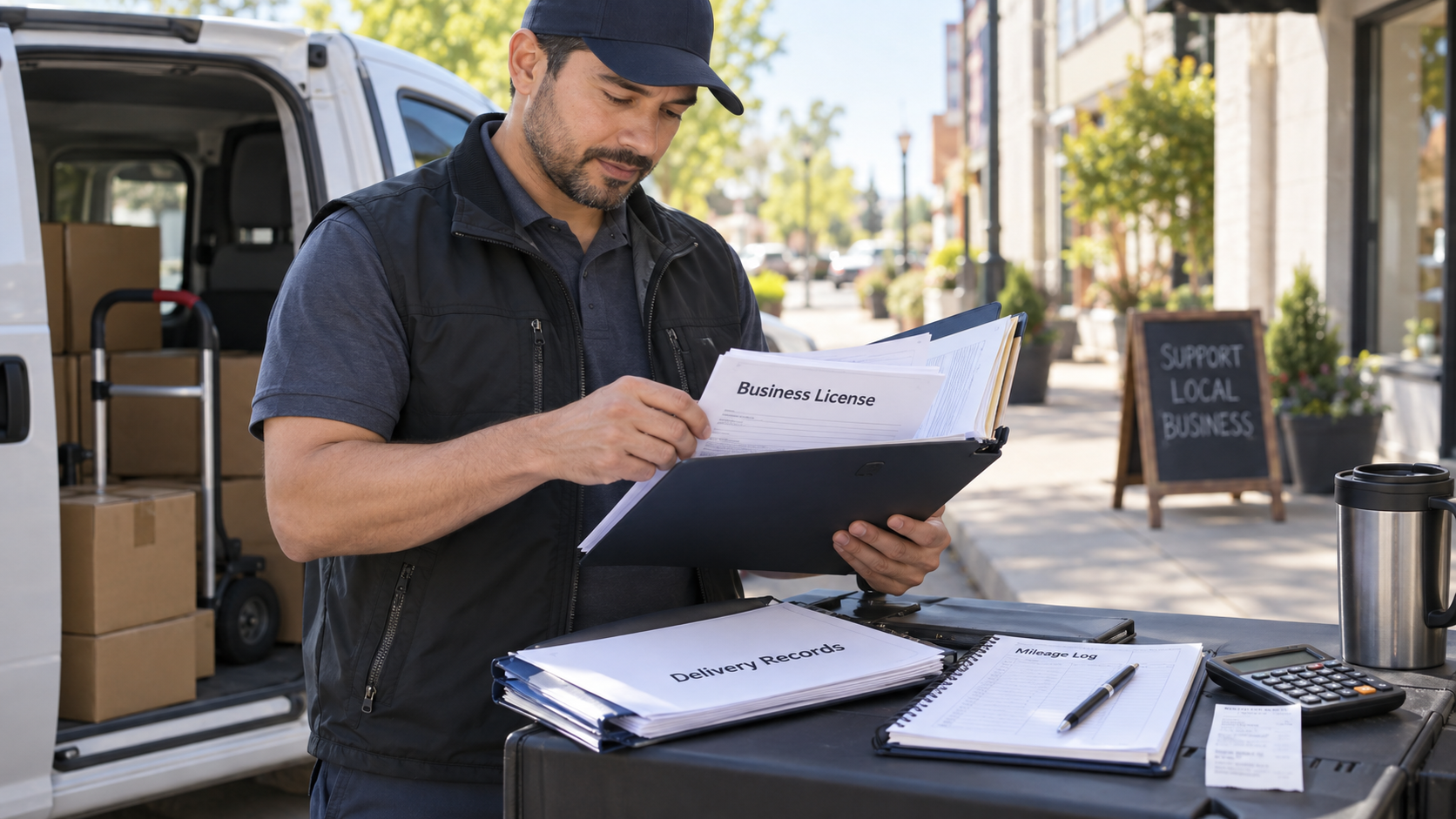
Delivery drivers often hear conflicting advice about business licenses.
One driver may say you need one immediately.
Another may have driven for years without ever applying for one.
The reason for the confusion is simple: there is no single nationwide business-license rule that applies to every delivery driver.
Requirements can depend on where you live, where your business is considered located, how you operate, and the rules set by your state, county, or city.
Do delivery drivers need a business license?
Some delivery drivers may need a business license.
Others may not.
Business licensing is often handled at the state or local level, which means the answer can change from one place to another.
That is why you should not assume that another driver’s answer applies to you.
Your location matters
A driver in one city may have completely different requirements from a driver in another city.
Your state may have one set of rules.
Your county may have another.
Your city may have additional registration or licensing requirements.
The safest approach is to check the official government sources for the place where your business is based.
Is gig delivery considered a business?
If you perform delivery work as an independent contractor, you are generally operating as a self-employed worker.
That does not automatically mean you need every type of business license.
But it does mean you are earning business income rather than receiving a traditional employee paycheck.
Self-employed does not automatically mean licensed
Being self-employed and having a business license are two different things.
A driver can be self-employed without necessarily needing a local business license.
Whether a license is required depends on the rules where the business operates.
Who decides whether you need a business license?
Different government agencies may be involved.
Depending on where you live, requirements may come from:
- Your state
- Your county
- Your city
- A local tax or licensing office
- A professional or industry agency
That is why online advice can become confusing very quickly.
Local rules are often the most important
Many business licenses are handled by local governments.
A city may require businesses operating within city limits to register.
A county may have its own requirements.
Another location may have no general business-license requirement for a solo delivery driver at all.
You need to check the rules that apply to your actual location.
Does an LLC mean you need a business license?
Not necessarily.
An LLC and a business license serve different purposes.
An LLC is a legal business structure.
A business license is permission or registration required by a government agency for certain business activities.
Forming an LLC does not automatically tell you whether you need a local license.
Business structure and licensing are separate questions
You might operate as:
- A sole proprietor
- A single-member LLC
- A partnership
- Another business structure
The licensing rules can still depend on where you operate and what you do.
That is why forming an LLC should not be treated as the same thing as becoming licensed.
Does an EIN mean you have a business license?
No.
An EIN is a federal tax identification number.
It does not function as a state or local business license.
Getting an EIN does not automatically satisfy local registration or licensing requirements.
Each document has a different purpose
It helps to think of them separately.
An EIN identifies a business for certain federal tax purposes.
An LLC is a business entity formed under state law.
A business license or permit may give you permission to conduct certain activities in a particular location.
They may all be part of a business setup, but they are not interchangeable.
Do delivery apps require drivers to have a business license?
Requirements can vary by platform, location, and type of delivery work.
Some platforms may only require the documents needed to qualify as an independent contractor.
That does not necessarily mean local licensing rules disappear.
Platform approval is not the same as government compliance
Being approved by a delivery platform does not automatically prove that you meet every business requirement where you live.
The platform and the government may have completely different responsibilities.
Drivers should still check local rules independently.
What should delivery drivers check?
If you want to know whether you need a business license, start with official sources.
Look at your state, county, and city government websites.
Search for terms such as:
- Business license
- Business registration
- Sole proprietor registration
- Home-based business
- Independent contractor
- Occupational license
- Business tax certificate
Do not rely only on social media
Other drivers can be helpful, but their situation may not match yours.
Someone in another state may have entirely different requirements.
Even someone in the same state may live in a different city with different rules.
Official local information should be your starting point.
What about home-based business rules?
Some local governments have rules for businesses that are considered home-based.
A delivery driver may not have customers coming to the house, but the home address may still be used as the business address.
That can matter in some locations.
Zoning and registration can still apply
Local rules can involve:
- Business registration
- Zoning
- Home occupation permits
- Local business taxes
- Address requirements
Not every driver will face these requirements, but it is worth checking before assuming they do not apply.
How much does a business license cost?
The cost varies widely.
Some locations charge little or nothing.
Others may charge annual fees, renewal fees, or taxes based on business activity.
That is another reason drivers should check before paying for anything.
Avoid unnecessary third-party fees
Some private websites make business licensing look more complicated than it is.
Whenever possible, start with the official government website.
That can help you avoid paying a company for something you may be able to handle yourself.
Does a business license change your taxes?
Usually, the license itself does not determine how your federal income taxes are calculated.
Your tax responsibilities are based on your income, expenses, business structure, and tax classification.
A local business license may create separate local fees or tax obligations depending on the jurisdiction.
Licensing and taxes can overlap without being the same
You may have:
- Federal income tax
- Self-employment tax
- State income tax
- Local business taxes
- Licensing fees
Those are separate obligations even though they may all be part of operating a business.
Should every delivery driver get a business license just to be safe?
No.
Do not buy a license simply because you think every business must have one.
First determine whether your location actually requires it.
Paying for unnecessary registrations can add costs without providing any real benefit.
Check before you pay
A few minutes on your official state, county, and city websites can save you time and money.
If the rules are unclear, contact the local licensing office directly.
That is much better than guessing.
Keep your business setup practical
It is easy for a delivery driver to get buried in paperwork.
LLCs, EINs, licenses, taxes, insurance, mileage, and expenses can make a simple side job feel complicated.
The goal should be to handle the requirements that actually apply to you.
Keep good records.
Check your local rules.
Avoid unnecessary fees.
And stay focused on what matters most in the business itself: knowing what it costs you to work and how much TRUE profit you actually keep.
Related reading
Do Delivery Drivers Need an EIN?
Do Delivery Drivers Need an LLC?
Do Delivery Drivers Have to Pay Self-Employment Tax?
How Much Should Delivery Drivers Set Aside for Taxes?
Delivery Driver Profit Guide
This article is for general educational information and is not legal or tax advice. Business-license and registration requirements vary by state, county, city, business activity, and individual circumstances. Check your official state and local government requirements before deciding what applies to you.