How Many Miles Is Too Many for a Delivery Offer?
There is no single mileage limit that makes a delivery offer bad. Learn how payout, return miles, fuel, vehicle costs, time, and destination affect whether a longer trip is still worth taking.
By TRUE Driver Profit · September 12, 2026
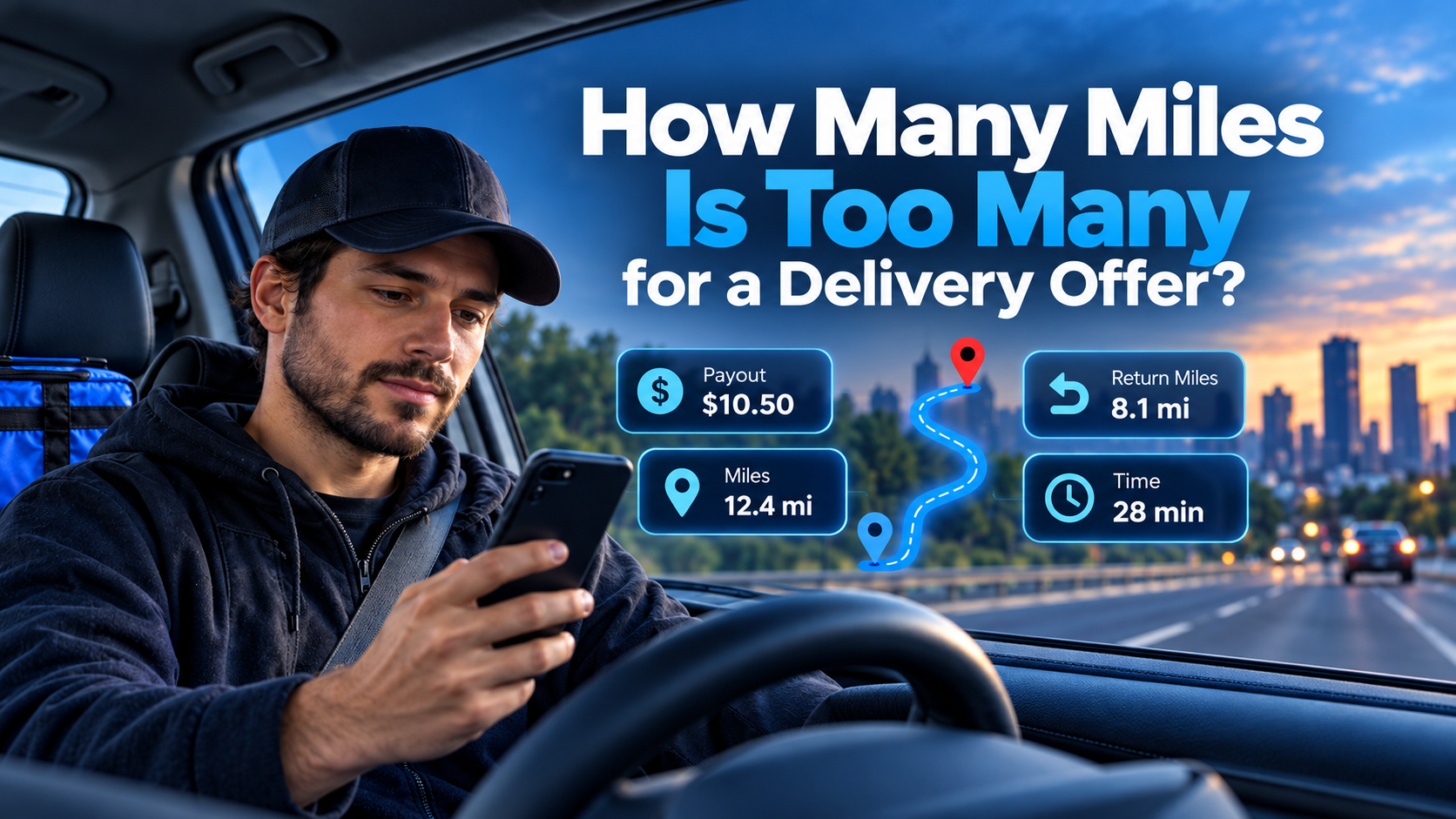
How Many Miles Is Too Many for a Delivery Offer?
There is no single number of miles that automatically makes a delivery offer bad.
A 12-mile delivery can be profitable.
A 5-mile delivery can be a poor choice.
What matters is what those miles cost you, how long they take, what happens after the drop-off, and how much of the payout remains as profit.
That is why delivery drivers should look at more than distance alone.
More miles generally mean more:
Fuel
Vehicle wear
Maintenance
Time on the road
Potential return driving
That means a longer delivery needs enough payout to cover the additional cost and still leave worthwhile profit.
The number shown on the offer is only the starting point.
After delivery, you may be near another good pickup area and immediately receive another order.
In that situation, the original 10 miles may represent most of the useful driving involved.
But another 10-mile delivery may take you far outside your normal delivery area.
If you need to drive 8 miles back before receiving another useful offer, the delivery may really affect 18 miles of your workday.
The offer still showed 10 miles.
Your vehicle experienced 18.
That difference can completely change the result.
Imagine this offer:
Payout: $28
Offer mileage: 14 miles
Expected return miles: 2 miles
Total realistic mileage: 16 miles
If the trip moves quickly, costs are reasonable, and the payout leaves strong profit after expenses, the offer may still work well.
Now compare it with:
Payout: $18
Offer mileage: 14 miles
Expected return miles: 10 miles
Total realistic mileage: 24 miles
The original mileage looks the same.
The full trip does not.
That is why asking how many miles is too many requires more than looking at the offer screen.
Payout has to keep up with distance
As mileage increases, the payout generally needs to increase with it.
A $15 payout may look reasonable for a short trip.
The same $15 payout can look very different when the delivery requires 15 or 20 miles.
Those additional miles create more operating cost.
They also keep you occupied longer.
Even if the payout remains positive after expenses, the trip may not meet your profit-per-mile or profit-per-hour goals.
Fuel is only one cost of longer mileage
Drivers often notice fuel first.
But longer mileage affects much more than the amount of gas you use.
Every additional mile contributes to:
Tire wear
Oil and fluid use
Brakes
Maintenance
Repairs
Depreciation
Those costs may not appear immediately.
You may drive hundreds or thousands of miles before paying the next maintenance bill.
But the mileage creating that future expense is happening today.
Time can make long-distance offers worse
A 15-mile delivery on an open highway is very different from a 15-mile delivery through heavy traffic.
Distance alone does not tell you how long the trip will take.
A longer offer may also involve:
Traffic
Construction
Slow roads
Parking
Apartment complexes
Long driveways
Pickup delays
If a delivery requires too much time, its profit per hour can fall even when its profit per mile looks acceptable.
That is why mileage and time should be considered together.
A delivery that ends near restaurants, stores, or another active pickup area may leave you in a useful position.
A delivery that ends far outside your normal working area may create unpaid driving afterward.
For example:
Offer mileage: 11 miles
Return driving: 9 miles
Realistic workday impact: 20 miles
Those 9 return miles do not come with another payout.
But they still cost money and consume time.
This is one reason long-distance offers can become less attractive very quickly.
A fuel-efficient car may handle longer trips more economically than a larger vehicle with lower fuel economy.
Drivers may also have different:
Gas prices
Wear & Tear costs
Maintenance expenses
Profit goals
Return-mile patterns
Time goals
That means one driver might reasonably accept an offer that another driver should skip.
The correct mileage limit depends on your numbers.
A simple comparison
Consider two offers.
Offer A
Payout: $16
Total realistic mileage: 7 miles
Estimated fuel and vehicle cost: $3.50
Estimated completion time: 25 minutes
Offer B
Payout: $25
Total realistic mileage: 22 miles
Estimated fuel and vehicle cost: $10.50
Estimated completion time: 60 minutes
Offer B pays $9 more.
But it also requires significantly more mileage, more cost, and more time.
The larger payout does not automatically make it the better offer.
Comparing TRUE profit, profit per mile, and profit per hour gives you a clearer picture.
Watch for miles that do not produce earnings
Not every mile in a delivery workday produces revenue.
You may drive:
Back toward a pickup area
Between stores
Away from a poor delivery area
To reposition after a drop-off
Those miles matter because they increase total workday mileage without directly increasing payout.
The more unpaid driving a long-distance offer creates, the harder it becomes for the original payout to support the full trip.
Too many miles is the point where the full trip no longer meets your profit goals.
That point may be 8 miles for one offer and 18 miles for another.
Instead of using one universal mileage cutoff, consider:
Payout
Full-trip mileage
Return miles
Fuel cost
Vehicle cost
Total time
Profit per mile
Profit per hour
Those numbers give you a better answer than mileage alone.
Create your own distance limits
Over time, you may notice that certain types of long-distance offers rarely work well for you.
For example, you might discover that:
Deliveries beyond a certain area usually require too much return driving
Long highway trips work better than shorter city trips
Certain destinations leave you positioned for another order
Some mileage ranges consistently miss your profit goals
Those patterns can help you make faster decisions when new offers appear.
TRUE Driver Profit helps you evaluate the full trip
TRUE Driver Profit is designed to help delivery drivers evaluate more than the mileage shown on the offer.
It can account for:
Payout
Mileage
Return miles
Fuel
Vehicle costs
Time
Then you can see:
TRUE profit
Profit per mile
Profit per hour
There is no perfect maximum mileage that works for every driver.
The better question is whether the full trip still produces enough profit for the miles and time it requires.
There is no single number of miles that automatically makes a delivery offer bad.
A 12-mile delivery can be profitable.
A 5-mile delivery can be a poor choice.
What matters is what those miles cost you, how long they take, what happens after the drop-off, and how much of the payout remains as profit.
That is why delivery drivers should look at more than distance alone.
Why mileage matters so much
Every mile you drive affects the cost of completing a delivery.More miles generally mean more:
Fuel
Vehicle wear
Maintenance
Time on the road
Potential return driving
That means a longer delivery needs enough payout to cover the additional cost and still leave worthwhile profit.
The number shown on the offer is only the starting point.
Ten miles does not always mean ten miles
Suppose an offer shows 10 miles.After delivery, you may be near another good pickup area and immediately receive another order.
In that situation, the original 10 miles may represent most of the useful driving involved.
But another 10-mile delivery may take you far outside your normal delivery area.
If you need to drive 8 miles back before receiving another useful offer, the delivery may really affect 18 miles of your workday.
The offer still showed 10 miles.
Your vehicle experienced 18.
That difference can completely change the result.
A longer delivery can still work
Distance alone should not automatically disqualify an offer.Imagine this offer:
Payout: $28
Offer mileage: 14 miles
Expected return miles: 2 miles
Total realistic mileage: 16 miles
If the trip moves quickly, costs are reasonable, and the payout leaves strong profit after expenses, the offer may still work well.
Now compare it with:
Payout: $18
Offer mileage: 14 miles
Expected return miles: 10 miles
Total realistic mileage: 24 miles
The original mileage looks the same.
The full trip does not.
That is why asking how many miles is too many requires more than looking at the offer screen.
Payout has to keep up with distance
As mileage increases, the payout generally needs to increase with it.
A $15 payout may look reasonable for a short trip.
The same $15 payout can look very different when the delivery requires 15 or 20 miles.
Those additional miles create more operating cost.
They also keep you occupied longer.
Even if the payout remains positive after expenses, the trip may not meet your profit-per-mile or profit-per-hour goals.
Fuel is only one cost of longer mileage
Drivers often notice fuel first.
But longer mileage affects much more than the amount of gas you use.
Every additional mile contributes to:
Tire wear
Oil and fluid use
Brakes
Maintenance
Repairs
Depreciation
Those costs may not appear immediately.
You may drive hundreds or thousands of miles before paying the next maintenance bill.
But the mileage creating that future expense is happening today.
Time can make long-distance offers worse
A 15-mile delivery on an open highway is very different from a 15-mile delivery through heavy traffic.
Distance alone does not tell you how long the trip will take.
A longer offer may also involve:
Traffic
Construction
Slow roads
Parking
Apartment complexes
Long driveways
Pickup delays
If a delivery requires too much time, its profit per hour can fall even when its profit per mile looks acceptable.
That is why mileage and time should be considered together.
Think about where the delivery ends
The destination can be just as important as the mileage.A delivery that ends near restaurants, stores, or another active pickup area may leave you in a useful position.
A delivery that ends far outside your normal working area may create unpaid driving afterward.
For example:
Offer mileage: 11 miles
Return driving: 9 miles
Realistic workday impact: 20 miles
Those 9 return miles do not come with another payout.
But they still cost money and consume time.
This is one reason long-distance offers can become less attractive very quickly.
Your vehicle changes the answer
There is no universal mileage limit because every driver has different operating costs.A fuel-efficient car may handle longer trips more economically than a larger vehicle with lower fuel economy.
Drivers may also have different:
Gas prices
Wear & Tear costs
Maintenance expenses
Profit goals
Return-mile patterns
Time goals
That means one driver might reasonably accept an offer that another driver should skip.
The correct mileage limit depends on your numbers.
A simple comparison
Consider two offers.
Offer A
Payout: $16
Total realistic mileage: 7 miles
Estimated fuel and vehicle cost: $3.50
Estimated completion time: 25 minutes
Offer B
Payout: $25
Total realistic mileage: 22 miles
Estimated fuel and vehicle cost: $10.50
Estimated completion time: 60 minutes
Offer B pays $9 more.
But it also requires significantly more mileage, more cost, and more time.
The larger payout does not automatically make it the better offer.
Comparing TRUE profit, profit per mile, and profit per hour gives you a clearer picture.
Watch for miles that do not produce earnings
Not every mile in a delivery workday produces revenue.
You may drive:
Back toward a pickup area
Between stores
Away from a poor delivery area
To reposition after a drop-off
Those miles matter because they increase total workday mileage without directly increasing payout.
The more unpaid driving a long-distance offer creates, the harder it becomes for the original payout to support the full trip.
So how many miles is too many?
The answer is:Too many miles is the point where the full trip no longer meets your profit goals.
That point may be 8 miles for one offer and 18 miles for another.
Instead of using one universal mileage cutoff, consider:
Payout
Full-trip mileage
Return miles
Fuel cost
Vehicle cost
Total time
Profit per mile
Profit per hour
Those numbers give you a better answer than mileage alone.
Create your own distance limits
Over time, you may notice that certain types of long-distance offers rarely work well for you.
For example, you might discover that:
Deliveries beyond a certain area usually require too much return driving
Long highway trips work better than shorter city trips
Certain destinations leave you positioned for another order
Some mileage ranges consistently miss your profit goals
Those patterns can help you make faster decisions when new offers appear.
TRUE Driver Profit helps you evaluate the full trip
TRUE Driver Profit is designed to help delivery drivers evaluate more than the mileage shown on the offer.
It can account for:
Payout
Mileage
Return miles
Fuel
Vehicle costs
Time
Then you can see:
TRUE profit
Profit per mile
Profit per hour
There is no perfect maximum mileage that works for every driver.
The better question is whether the full trip still produces enough profit for the miles and time it requires.