Why Gross Earnings Can Be Misleading for Gig Drivers
Gross earnings can make a delivery shift look better than it really was. Learn how mileage, fuel, vehicle costs, return miles, and time can change what you actually keep.
By TRUE Driver Profit · September 12, 2026
Why Gross Earnings Can Be Misleading for Gig Drivers
Gross earnings are one of the easiest numbers for delivery drivers to notice.
You finish a shift, look at the total, and see how much money came in.
That number matters.
But it does not tell you how much you actually kept.
Two drivers can earn the same gross amount and finish the day with very different profit.
That is because gross earnings do not account for the cost of doing the work.
For example, if you complete several deliveries and earn $180, your gross earnings are $180.
That number does not automatically account for:
Fuel
Vehicle wear
Maintenance
Return miles
Time
Other delivery-related costs
Gross earnings tell you what came in.
They do not tell you what stayed.
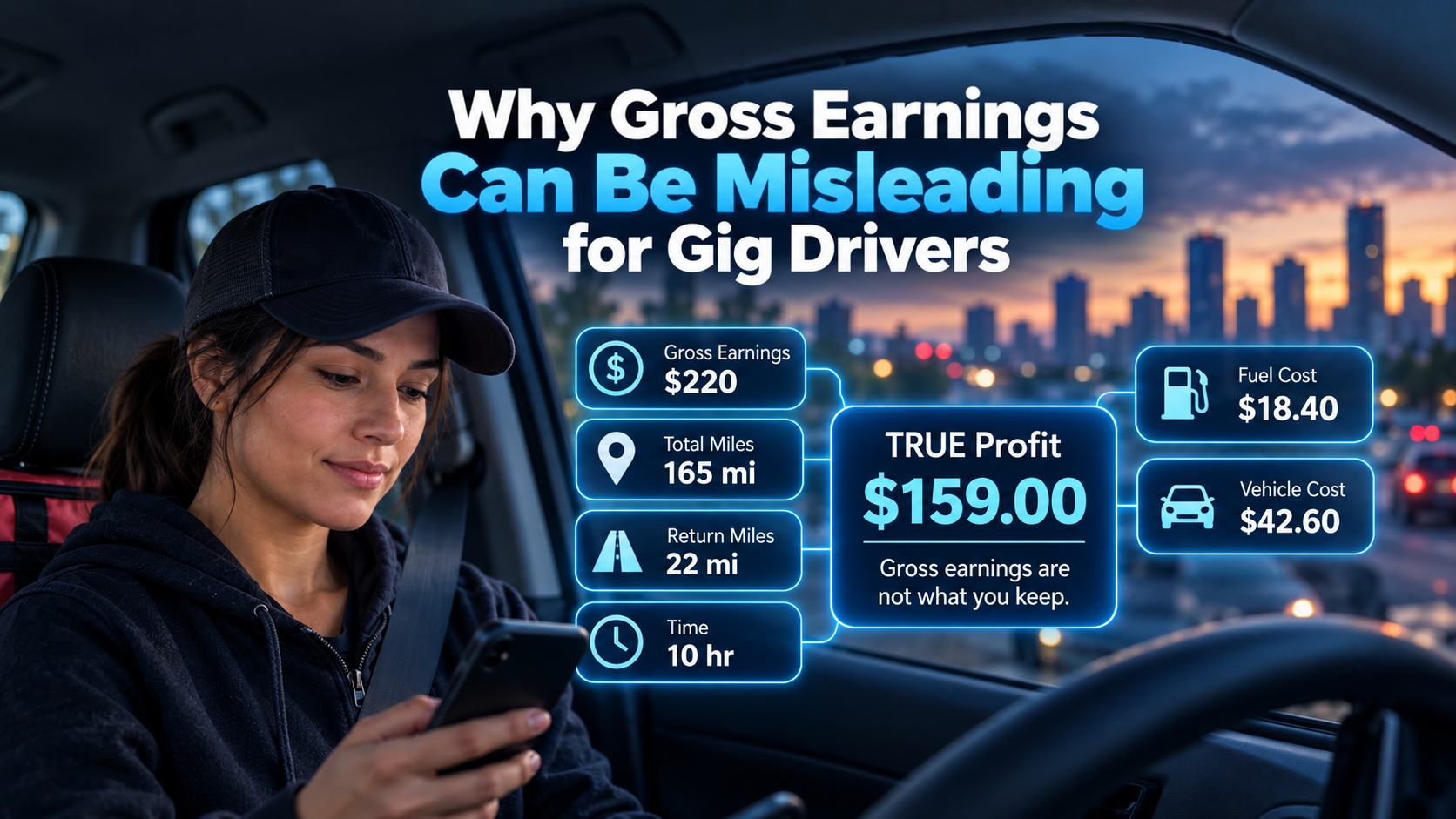
Day A:
Gross earnings: $220
Total miles: 165
Time worked: 10 hours
Day B:
Gross earnings: $185
Total miles: 95
Time worked: 7 hours
Day A brought in $35 more.
At first glance, it looks like the better day.
But Day A also required 70 more miles and 3 additional hours.
Those extra miles create more fuel use and more vehicle wear.
Those extra hours also reduce how strong the earnings look on an hourly basis.
The higher gross total does not automatically mean the day produced more useful profit.
Suppose you earn $200 during one shift while driving 150 miles.
On another shift, you earn $170 while driving 80 miles.
The first shift earned $30 more.
But it required 70 additional miles.
Those miles cost money.
They also take time.
Once fuel and vehicle costs are included, the difference between the two days may be much smaller than the gross earnings suggest.
Fuel is only one expense
Gas is usually the easiest vehicle expense to notice.
Drivers see the price every time they fill up.
But your vehicle has other costs too.
Delivery mileage contributes to:
Oil changes
Tires
Brakes
Maintenance
Repairs
Depreciation
Those costs may not appear on the same day you complete the delivery.
But the mileage that creates those future expenses is happening every shift.
That means gross earnings can look strong while vehicle costs quietly reduce what you actually keep.
But that may not be the end of the trip.
After delivery, you may need to drive back toward a store, restaurant, or another pickup area.
Those return miles usually do not come with another payout.
They still use fuel.
They still add vehicle wear.
They still take time.
For example:
Offer mileage: 9 miles
Return miles: 7 miles
Total realistic mileage: 16 miles
The payout may only reflect the original delivery.
Your costs reflect the full trip.
That is one reason gross earnings alone can give an incomplete picture.
Time matters too
A driver can earn a decent gross total while spending far more time than expected.
Suppose you earn $180 in 6 hours.
That is $30 in gross earnings per hour before expenses.
Now suppose you earn the same $180 in 10 hours.
That is $18 in gross earnings per hour before expenses.
The gross total is identical.
The use of your time is not.
Waiting at pickup, traffic, difficult drop-offs, and long return drives can all reduce how efficiently you earn.
That is why profit per hour can be more useful than gross earnings alone.
Driver A:
90 total miles
Lower fuel cost
Short return trips
7 hours worked
Driver B:
145 total miles
Higher fuel cost
Long return trips
9 hours worked
Both drivers can say they earned $150.
But the amount each driver keeps after costs can be very different.
Gross earnings make them look equal.
Their actual results are not.
Big payouts can hide weak trips
A high-paying delivery can attract attention quickly.
An offer paying $30 may look much better than one paying $18.
But the larger offer may also require:
Long mileage
A long return trip
More fuel
More vehicle wear
More time
Heavy traffic
A long pickup wait
The payout is important.
The cost of producing that payout is just as important.
A smaller offer with fewer miles and less time may sometimes produce stronger profit per mile or profit per hour.
Gross earnings are still useful
Gross earnings should not be ignored.
They are an important part of understanding your work.
The problem comes when gross earnings are treated as the final answer.
A better picture includes:
Gross earnings
Total mileage
Return miles
Fuel cost
Vehicle cost
Total time
TRUE profit
Profit per mile
Profit per hour
Together, those numbers show much more than the earnings total by itself.
Compare days by what they actually produced
Looking beyond gross earnings can also help you compare workdays more accurately.
You may notice that:
Your highest-grossing day required too many miles
Certain hours produce better profit per hour
Some delivery areas create too much return driving
Shorter shifts sometimes produce better efficiency
Large payouts are not always your most profitable orders
These patterns can help you understand what types of work are actually helping your bottom line.
Gross pay is what you earned before expenses.
Profit is what remains after the costs of doing the work are considered.
If you earn $200 but spend a significant amount completing the deliveries, the $200 does not represent what you actually made.
The difference between those two numbers is where many drivers can get a clearer picture of their work.
TRUE Driver Profit helps show what you actually keep
TRUE Driver Profit is designed to help delivery drivers look beyond gross earnings.
It can account for factors such as:
Fuel
Vehicle costs
Mileage
Return miles
Time
From there, drivers can see:
TRUE profit
Profit per mile
Profit per hour
Gross earnings tell you how much money came in.
Understanding your costs helps show how much of that money was actually yours to keep.
Gross earnings are one of the easiest numbers for delivery drivers to notice.
You finish a shift, look at the total, and see how much money came in.
That number matters.
But it does not tell you how much you actually kept.
Two drivers can earn the same gross amount and finish the day with very different profit.
That is because gross earnings do not account for the cost of doing the work.
What are gross earnings?
Gross earnings are the total amount you earn before subtracting expenses.For example, if you complete several deliveries and earn $180, your gross earnings are $180.
That number does not automatically account for:
Fuel
Vehicle wear
Maintenance
Return miles
Time
Other delivery-related costs
Gross earnings tell you what came in.
They do not tell you what stayed.
A high-earning day can still be expensive
Imagine two workdays.Day A:
Gross earnings: $220
Total miles: 165
Time worked: 10 hours
Day B:
Gross earnings: $185
Total miles: 95
Time worked: 7 hours
Day A brought in $35 more.
At first glance, it looks like the better day.
But Day A also required 70 more miles and 3 additional hours.
Those extra miles create more fuel use and more vehicle wear.
Those extra hours also reduce how strong the earnings look on an hourly basis.
The higher gross total does not automatically mean the day produced more useful profit.
Mileage can change the picture quickly
Mileage is one of the biggest reasons gross earnings can be misleading.Suppose you earn $200 during one shift while driving 150 miles.
On another shift, you earn $170 while driving 80 miles.
The first shift earned $30 more.
But it required 70 additional miles.
Those miles cost money.
They also take time.
Once fuel and vehicle costs are included, the difference between the two days may be much smaller than the gross earnings suggest.
Fuel is only one expense
Gas is usually the easiest vehicle expense to notice.
Drivers see the price every time they fill up.
But your vehicle has other costs too.
Delivery mileage contributes to:
Oil changes
Tires
Brakes
Maintenance
Repairs
Depreciation
Those costs may not appear on the same day you complete the delivery.
But the mileage that creates those future expenses is happening every shift.
That means gross earnings can look strong while vehicle costs quietly reduce what you actually keep.
Return miles can make a big difference
An offer may show the mileage from pickup to drop-off.But that may not be the end of the trip.
After delivery, you may need to drive back toward a store, restaurant, or another pickup area.
Those return miles usually do not come with another payout.
They still use fuel.
They still add vehicle wear.
They still take time.
For example:
Offer mileage: 9 miles
Return miles: 7 miles
Total realistic mileage: 16 miles
The payout may only reflect the original delivery.
Your costs reflect the full trip.
That is one reason gross earnings alone can give an incomplete picture.
Time matters too
A driver can earn a decent gross total while spending far more time than expected.
Suppose you earn $180 in 6 hours.
That is $30 in gross earnings per hour before expenses.
Now suppose you earn the same $180 in 10 hours.
That is $18 in gross earnings per hour before expenses.
The gross total is identical.
The use of your time is not.
Waiting at pickup, traffic, difficult drop-offs, and long return drives can all reduce how efficiently you earn.
That is why profit per hour can be more useful than gross earnings alone.
The same gross earnings can produce different profit
Consider two drivers who each earn $150.Driver A:
90 total miles
Lower fuel cost
Short return trips
7 hours worked
Driver B:
145 total miles
Higher fuel cost
Long return trips
9 hours worked
Both drivers can say they earned $150.
But the amount each driver keeps after costs can be very different.
Gross earnings make them look equal.
Their actual results are not.
Big payouts can hide weak trips
A high-paying delivery can attract attention quickly.
An offer paying $30 may look much better than one paying $18.
But the larger offer may also require:
Long mileage
A long return trip
More fuel
More vehicle wear
More time
Heavy traffic
A long pickup wait
The payout is important.
The cost of producing that payout is just as important.
A smaller offer with fewer miles and less time may sometimes produce stronger profit per mile or profit per hour.
Gross earnings are still useful
Gross earnings should not be ignored.
They are an important part of understanding your work.
The problem comes when gross earnings are treated as the final answer.
A better picture includes:
Gross earnings
Total mileage
Return miles
Fuel cost
Vehicle cost
Total time
TRUE profit
Profit per mile
Profit per hour
Together, those numbers show much more than the earnings total by itself.
Compare days by what they actually produced
Looking beyond gross earnings can also help you compare workdays more accurately.
You may notice that:
Your highest-grossing day required too many miles
Certain hours produce better profit per hour
Some delivery areas create too much return driving
Shorter shifts sometimes produce better efficiency
Large payouts are not always your most profitable orders
These patterns can help you understand what types of work are actually helping your bottom line.
Gross pay and profit are not the same thing
This is one of the most important distinctions for delivery drivers.Gross pay is what you earned before expenses.
Profit is what remains after the costs of doing the work are considered.
If you earn $200 but spend a significant amount completing the deliveries, the $200 does not represent what you actually made.
The difference between those two numbers is where many drivers can get a clearer picture of their work.
TRUE Driver Profit helps show what you actually keep
TRUE Driver Profit is designed to help delivery drivers look beyond gross earnings.
It can account for factors such as:
Fuel
Vehicle costs
Mileage
Return miles
Time
From there, drivers can see:
TRUE profit
Profit per mile
Profit per hour
Gross earnings tell you how much money came in.
Understanding your costs helps show how much of that money was actually yours to keep.