How to Calculate Your Real Profit on a Delivery Offer
A delivery offer can look good at first glance, but the payout is only part of the story. Learn how to factor in miles, return driving, time, fuel, and vehicle costs so you can see what the offer is really worth.
By TRUE Driver Profit · September 10, 2026
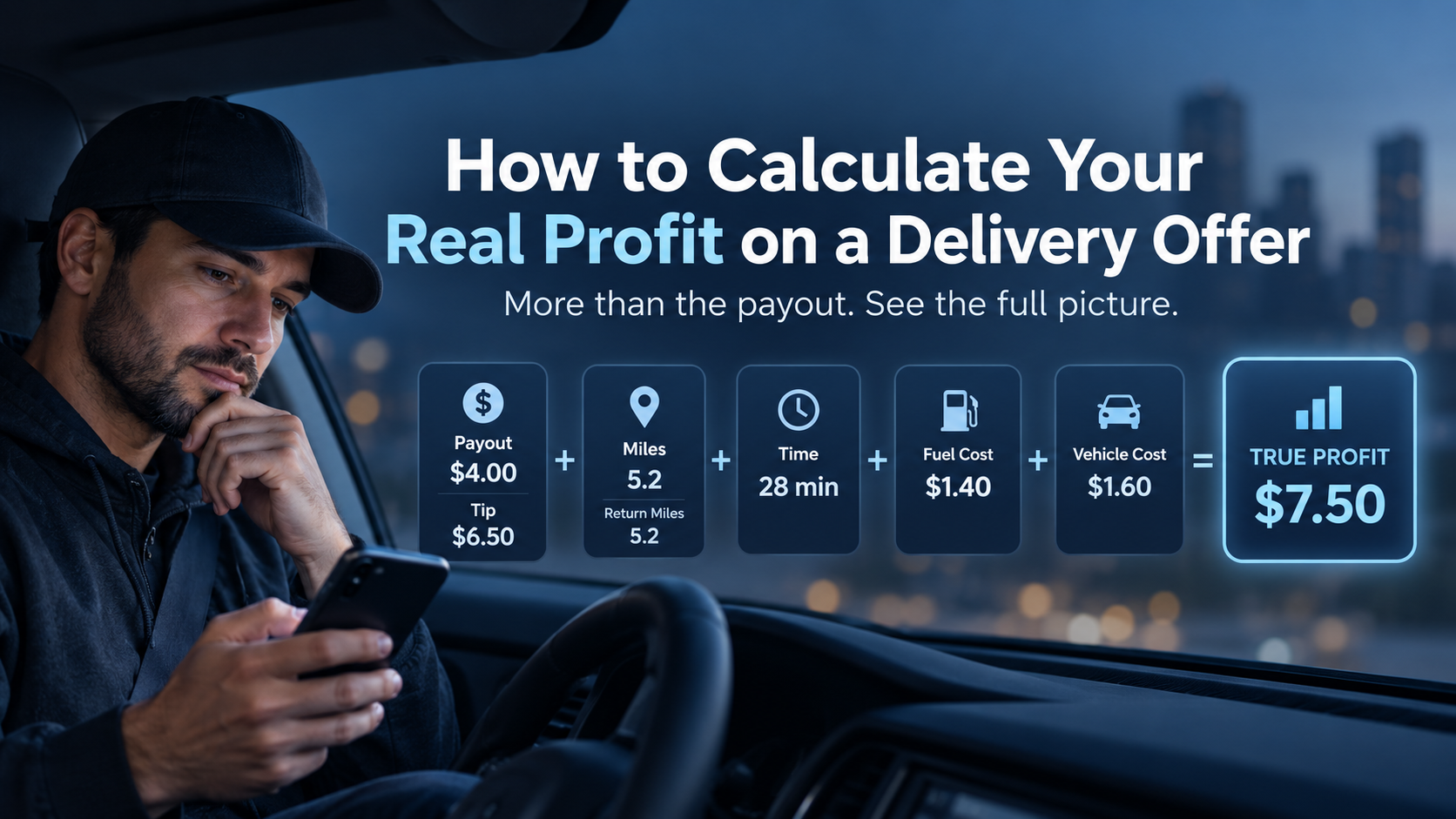
How to Calculate Your Real Profit on a Delivery Offer
A delivery offer might show $10, $15, or $25 and look like an easy decision.
But the payout is not the same thing as profit.
What matters is how much of that money is actually left after the miles, time, fuel, and vehicle costs are taken into account.
That is where a lot of delivery offers start to look very different.
Start with the total payout
The first number to look at is the full amount you expect to receive.
That may include:
- Base pay
- Tip
- Incentive or bonus pay tied to the offer
For example, if an offer pays $7 in base pay and includes a $3.50 tip, the total payout is $10.50.
That is your starting point, not your profit.
Count the full mileage
Miles can change the value of an offer very quickly.
Do not look only at the miles shown on the offer screen.
Think about the full driving involved.
That can include:
- Driving to the pickup
- Driving from the pickup to the customer
- Driving back toward your normal pickup area
- Extra miles caused by the location of the delivery
A five-mile delivery may really turn into ten miles of driving if you have to return to the same area before you can get another good offer.
Those return miles still cost money.
Include the time
Time matters just as much as mileage.
A short-mile offer can still be a poor choice if it takes too long.
Look at the full time involved, including:
- Driving to pickup
- Waiting at pickup
- Loading or receiving the order
- Driving to the customer
- Completing the delivery
- Driving back toward another pickup area
An offer that pays $15 but takes an hour is very different from one that pays $15 and takes 25 minutes.
That is why profit per hour matters.
Subtract fuel cost
Fuel is one of the easiest costs to notice because you pay for it regularly.
But it still needs to be included every time you evaluate an offer.
Your fuel cost depends on:
- Your vehicle’s fuel economy
- Current fuel price
- Total miles driven
The farther you drive, the more the offer has to pay just to cover fuel.
Include vehicle costs beyond gas
Gas is not the only cost of using your vehicle.
Every delivery also adds wear.
Over time, delivery driving contributes to costs such as:
- Oil changes
- Tires
- Brakes
- Repairs
- Maintenance
- Depreciation
- Other vehicle wear
These costs may not come out of your pocket today, but they are still part of what it costs to earn that delivery income.
Ignoring them can make an offer look more profitable than it really is.
Calculate what is actually left
A simple way to think about real profit is:
Payout minus fuel cost minus vehicle cost equals profit before considering the value of your time.
Then look at that result together with:
- Profit per mile
- Profit per hour
- Total time
- Total mileage
That gives you a much better picture than payout alone.
Example
Suppose an offer pays:
- $7 base pay
- $3.50 tip
- $10.50 total payout
The offer shows 5.2 miles and takes about 24 minutes.
But if the delivery leaves you 5.2 miles away from your normal pickup area, your total driving may be closer to 10.4 miles.
Now add fuel and vehicle cost.
The offer may still be profitable, but the real number left over can be much lower than the $10.50 displayed on the offer.
That difference is what drivers need to see before deciding whether an order is worth taking.
Profit per mile helps compare distance
Profit per mile can help you compare offers that require different amounts of driving.
Two offers may pay the same amount but require very different mileage.
For example:
- Offer A pays $15 and requires 6 total miles
- Offer B pays $15 and requires 15 total miles
The payout is identical.
The cost and wear are not.
Profit per mile makes that difference easier to see.
Profit per hour helps compare time
Profit per hour helps you understand what an offer does to your overall day.
An offer can have good mileage but still take too long.
Long waits, difficult drop-off locations, traffic, and return driving can all reduce what you earn for the time you put in.
Looking at both profit per mile and profit per hour helps avoid making a decision based on only one number.
Return miles can change everything
Return miles are one of the easiest costs to underestimate.
A delivery may take you far outside the area where you normally receive offers.
If you have to drive several miles back before the next opportunity, that return trip is part of the real cost of the delivery.
A $20 offer going far out of town is not automatically better than a $14 offer that keeps you close to your pickup area.
The full trip matters.
The goal is not to reject every expensive offer
Every driver has different goals.
Some drivers care more about hourly earnings.
Others focus heavily on mileage.
Some areas have long waits. Others have long distances between customers.
The point is not to create one perfect rule for every driver.
The point is to see the real numbers before making the decision.
TRUE Driver Profit helps show the full picture
TRUE Driver Profit is built to help delivery drivers look beyond the payout.
It can help you evaluate:
- Payout
- Tip
- Miles
- Return miles
- Time
- Fuel cost
- Vehicle cost
- TRUE profit
- Profit per mile
- Profit per hour
That gives you a clearer picture of what an offer could really contribute to your day.
You can try an offer on TRUE Driver Profit before creating an account, and Free users can continue using the core offer evaluation tools.
The goal is simple:
Know what the offer is really worth before you commit your time and your vehicle to it.
Meta title
How to Calculate Real Profit on a Delivery Offer | TRUE Driver Profit
Meta description
Learn how delivery drivers can calculate real profit by accounting for payout, miles, return miles, time, fuel, and vehicle costs before accepting an offer.