How to Calculate Your Break-Even Point as a Delivery Driver
Your break-even point shows the minimum a delivery needs to earn before it starts producing real profit. Learn how mileage, fuel, vehicle costs, return miles, and time affect that number.
By TRUE Driver Profit · September 12, 2026
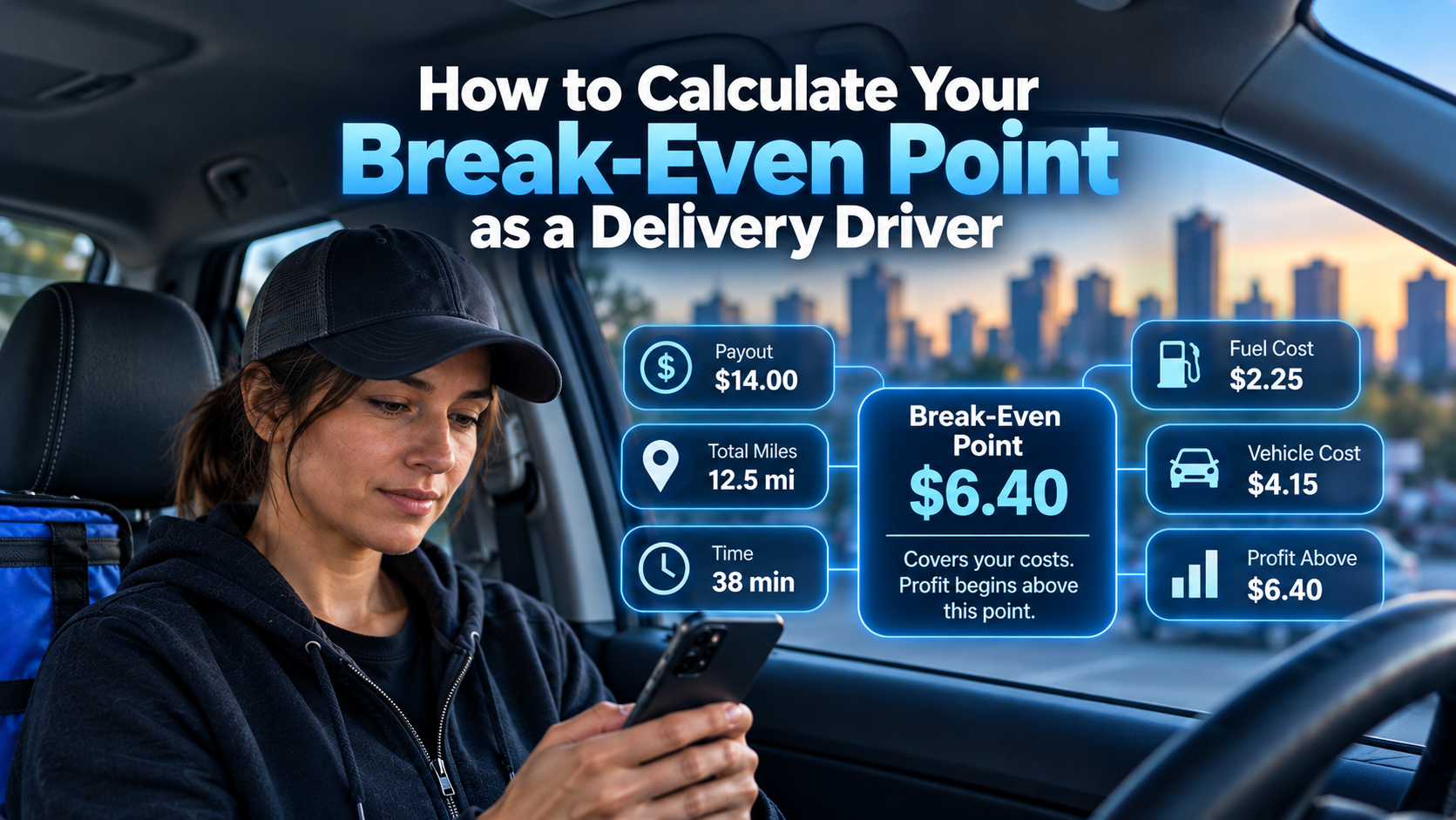
How to Calculate Your Break-Even Point as a Delivery Driver
A delivery offer can pay more than your immediate fuel cost and still leave you with very little profit.
That is why delivery drivers should understand their break-even point.
Your break-even point is the point where the money you earn from a delivery covers the costs of completing it, but does not leave you with meaningful profit yet.
Knowing that number can help you recognize offers that look acceptable on the screen but may not be worth your time once the full trip is considered.
What does break-even mean for a delivery driver?
In simple terms, break-even means:
Your earnings equal your costs.
If a delivery costs you $7 to complete and pays $7, you broke even.
You did not lose money on the trip, but you did not make any profit either.
If the same trip pays $12, the difference between the payout and your costs is your profit before considering any additional costs you may track.
The challenge is knowing what should be included in those costs.
Fuel is only part of your break-even point
Many drivers start by thinking about gas.
Fuel absolutely matters, but it is only one part of the cost of using your vehicle for delivery work.
Your vehicle also experiences ongoing costs from:
Oil changes
Tires
Brakes
Maintenance
Repairs
Depreciation
Other wear caused by additional mileage
A delivery that uses $2 in fuel may cost considerably more than $2 to complete once vehicle wear is included.
That is why looking only at gas can make an offer appear more profitable than it really is.
Mileage changes your break-even point
The farther you drive, the more the delivery generally costs.
Suppose you receive a $15 offer.
If the full trip requires only 5 miles, your costs may be relatively low.
If the same $15 offer requires 18 miles, your fuel and vehicle costs will be much higher.
The payout did not change.
Your break-even point did.
This is one reason the number of miles attached to an offer matters so much.
Do not forget return miles
The mileage shown on an offer may not represent all of the driving required.
After dropping off the order, you may need to drive back toward a pickup area before you are in position to receive another useful offer.
Those return miles still use fuel.
They still add vehicle wear.
They still take time.
If you drive 8 miles to the customer and then 6 miles back toward your normal pickup area, the delivery affected 14 miles of your workday, not just the original 8.
Using the full realistic mileage gives you a much better estimate of where your break-even point actually sits.
A simple break-even example
Imagine an offer with these numbers:
Payout: $18
Total realistic mileage: 12 miles
Estimated fuel cost: $2.25
Estimated vehicle cost: $3.60
Your estimated driving costs would be:
$2.25 fuel
plus
$3.60 vehicle cost
for a total estimated cost of $5.85.
At $5.85 in earnings, you would be around your driving-cost break-even point.
At an $18 payout, you would have:
$18 minus $5.85 = $12.15 remaining
That remaining amount is much more useful than simply looking at the original $18 payout.
But there is another factor to consider.
Your time.
Breaking even on expenses is not the same as earning enough for your time
A delivery can technically cover its vehicle costs and still be a poor use of your time.
Suppose the $18 delivery above takes 75 minutes from acceptance until you are ready for another order.
You may still have positive profit after vehicle expenses.
But your profit per hour may be much lower than you want.
That is why there are really two questions worth asking:
Does this offer cover my costs?
And:
Does the remaining profit justify my time?
The first question tells you whether you are above break-even.
The second helps you decide whether the offer actually meets your goals.
Your break-even point is personal
There is no single break-even number that applies to every delivery driver.
Two drivers can accept the same offer and have different costs.
One driver may have:
Better fuel economy
Lower fuel prices
Lower vehicle operating costs
A shorter return trip
Another driver may have:
A larger vehicle
Higher fuel use
Higher maintenance costs
A longer drive back after delivery
The offer can be identical while the actual profit is different.
That is why generic rules can only go so far.
Your own numbers matter more.
Break-even per mile can also be useful
Drivers can also think about break-even in terms of cost per mile.
For example, suppose your combined estimated fuel and vehicle cost is $0.48 per mile.
A 10-mile trip would create approximately:
10 × $0.48 = $4.80 in driving costs
That means the first $4.80 of the payout is essentially covering the cost of putting those miles on your vehicle.
Anything above that begins contributing toward your profit and compensation for your time.
If return mileage increases the trip to 16 miles, the estimated driving cost becomes:
16 × $0.48 = $7.68
The same delivery now has a much higher break-even point.
That is why full-trip mileage matters.
Break-even should be a floor, not your goal
Breaking even is not the objective of delivery work.
It is the minimum point where you stop losing money on the costs included in your calculation.
A profitable offer should do more than simply cover fuel and vehicle wear.
Ideally, it should also produce enough profit to justify:
Your time
The miles placed on your vehicle
Waiting at pickup
Traffic
Parking
Return driving
The opportunity cost of being tied up on that order
Think of break-even as the floor.
Your actual profit goals should sit above it.
Why high payouts can still be misleading
A high payout can grab your attention quickly.
But payout alone does not tell you how expensive the delivery will be to complete.
A $30 offer may involve:
Long mileage
A long return trip
Heavy traffic
Significant waiting
Higher fuel use
More vehicle wear
Meanwhile, a $17 offer with short mileage and quick completion could leave you with stronger profit per mile or profit per hour.
The larger payout is not automatically the better offer.
What matters is what remains after the trip is completed.
Knowing your break-even point helps you make faster decisions
Delivery drivers often have only a short amount of time to evaluate an offer.
You may not have time to perform a detailed calculation every time.
But once you understand your typical fuel cost, vehicle cost, and realistic mileage, you begin to recognize where your break-even point usually falls.
That gives you a stronger starting point when evaluating offers.
Instead of asking:
“Does this payout look good?”
you can ask:
“After the cost of completing this trip, how much will actually be left?”
That is a much more useful question.
TRUE Driver Profit helps put the full trip into the calculation
TRUE Driver Profit is designed to help delivery drivers look beyond the payout.
It can account for factors such as:
Fuel
Vehicle costs
Mileage
Return miles
Time
From there, you can see metrics including:
TRUE profit
Profit per mile
Profit per hour
The goal is not simply to determine whether an offer covers your costs.
It is to help you understand whether the offer is actually worth taking for your situation.
Because breaking even may keep you from losing money.
But knowing your TRUE profit helps you decide whether the delivery is worth the miles and the time.