How to Set Your Own Minimum for a Delivery Offer
There is no perfect dollar-per-mile rule for every driver. Learn how your vehicle costs, time, mileage, return driving, and goals can help you set a personal minimum.
By TRUE Driver Profit · September 10, 2026
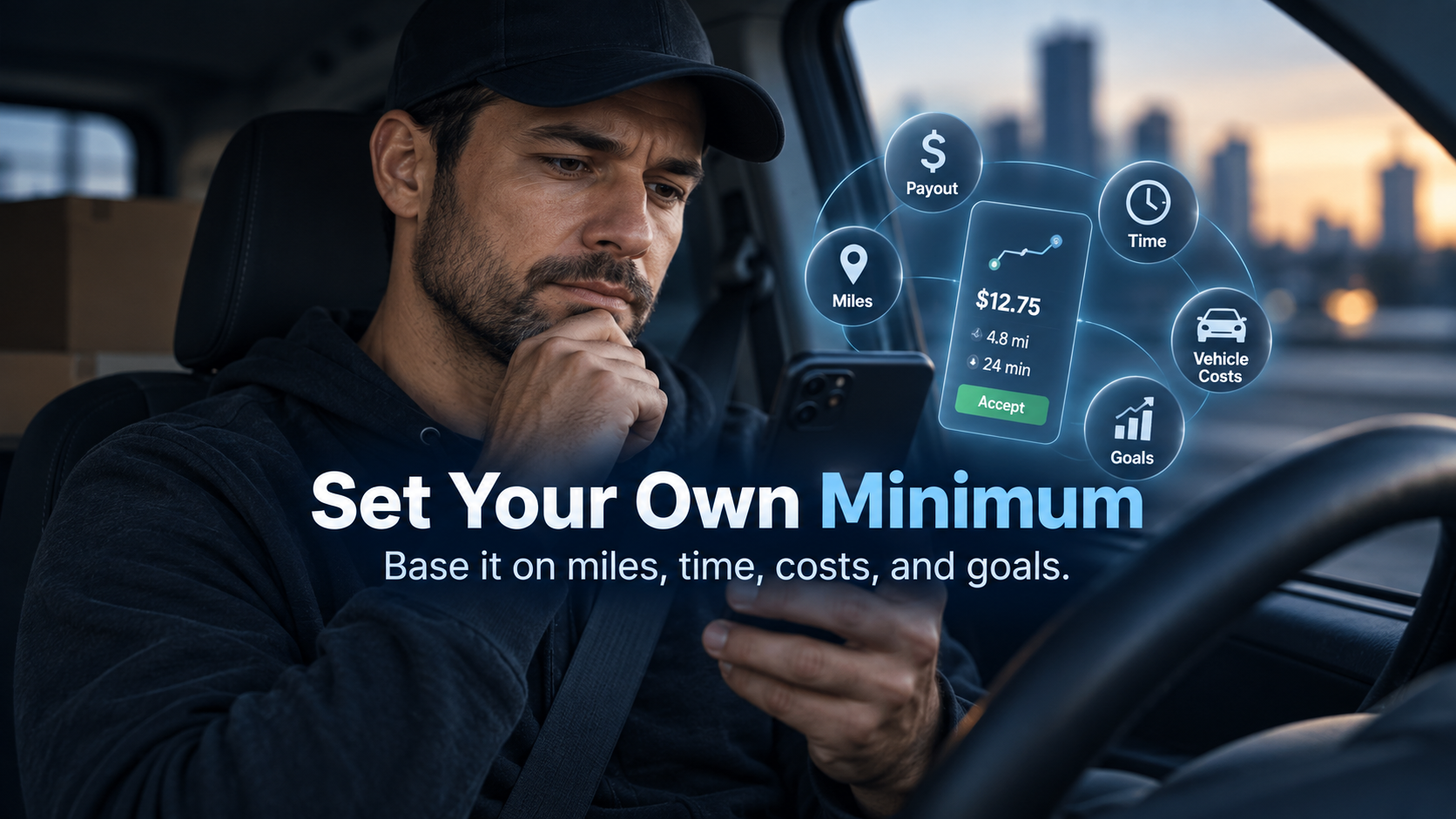
How to Set Your Own Minimum for a Delivery Offer
Delivery drivers hear a lot of rules.
Never take less than a certain amount per mile.
Never accept anything below a certain payout.
Only take orders that meet a specific hourly number.
Those rules can be useful as quick guidelines.
But they cannot know your vehicle, your fuel cost, your driving area, or your goals.
That is why your minimum should be based on your own numbers.
One may drive a fuel-efficient car.
Another may drive an SUV.
One may live close to the delivery area.
Another may need to drive several miles back.
One may be trying to maximize profit per hour.
Another may care more about keeping mileage low.
The offer is the same.
The situation is not.
That is why a universal minimum does not always work.
Consider:
Fuel economy
Gas price
Tires
Brakes
Oil changes
Maintenance
Repairs
Vehicle wear
A driver with lower operating costs may be able to profit from an offer that another driver should skip.
Your minimum should reflect what it actually costs you to drive.
Time matters too.
Ask yourself how much profit you want your working time to produce.
That does not mean every individual order has to hit the exact same hourly number.
Some will be stronger.
Some will be weaker.
But having a target gives you something to compare against.
If an offer regularly pulls your profit per hour far below your goal, that is useful information.
Look at total miles, not just offer miles
The mileage shown on the offer may not represent the full trip.
You may need to include:
Driving to pickup
Driving to the customer
Return miles
Repositioning afterward
If an eight-mile delivery regularly creates another six miles of unpaid driving, your real decision should consider the larger number.
Your minimum needs to work for the whole trip.
Return driving can change your minimum
Some delivery areas require more return driving than others.
A customer five miles outside town may create a nearly ten-mile round trip.
A customer five miles across town may leave you near another pickup location.
Those two orders may show similar mileage.
They can have very different effects on your shift.
This means your minimum may change depending on where the order leaves you.
Wait time should influence the decision
A pickup location that regularly takes 20 minutes changes the value of an offer.
A $12 order from a fast pickup is not necessarily the same as a $12 order from a slow one.
Long waits reduce the amount of your day available for other orders.
If a pickup is consistently slow, you may decide you need a higher payout before the offer becomes worth taking.
That is part of having a personal minimum.
A minimum payout might be something like:
“I do not want to take anything under $10.”
A minimum profit asks a different question:
“How much will I actually keep after the cost of doing this delivery?”
Those are not the same thing.
A $10 short-distance order may produce better profit than a $20 order with long mileage and a long return trip.
Payout is the starting number.
Profit is what remains.
Profit per mile can help set a boundary
Profit per mile can help you understand how efficiently you are using your vehicle.
Suppose one offer leaves you with $1.40 in profit per mile.
Another leaves you with $0.55.
That difference may matter greatly over a full week of driving.
You may decide that offers below a certain profit-per-mile level usually do not fit your goals.
That number should come from your own vehicle and experience.
Profit per hour can provide another boundary
You can do the same thing with time.
Maybe you notice that orders producing less than a certain profit per hour consistently make your shifts feel unproductive.
That can become another part of your decision.
The strongest minimum is not just one number.
It is a combination of mileage, time, cost, and profit.
Your minimum can change during the day
Your decision does not have to be identical at every hour.
During a strong time period, you may be more selective because better opportunities are appearing frequently.
During a slower period, you may accept an offer that is still profitable but slightly below your usual target.
That does not mean abandoning your standards.
It means understanding the situation.
The important line is whether the offer still works for you.
Your vehicle gets older.
Maintenance costs change.
Your driving area may change.
Your goals may change.
That means a minimum you used six months ago may not make sense today.
It is worth reviewing your numbers occasionally.
A personal rule should stay connected to reality.
Avoid copying someone else's minimum blindly
Drivers share strategies online all the time.
That can be useful.
But another driver's rule may be based on:
A different vehicle
Different fuel prices
Different roads
Different traffic
Different pickup times
Different return mileage
Different goals
Their rule may work perfectly for them.
That does not make it right for you.
Your own history is more valuable
Over time, your completed orders can help you see what works.
Look for patterns.
Which offers produced strong profit?
Which ones looked good but took too long?
Which ones created too many return miles?
Which payouts consistently worked well with your vehicle costs?
That information can help you develop a minimum based on experience rather than guesswork.
It should not require a complicated calculation every time an offer appears.
You might think in terms of a few questions:
Does the payout justify the mileage?
Where will the delivery leave me?
How long will it probably take?
Will I need significant return driving?
Does this meet my profit goals?
If the answers work for you, the offer may deserve consideration.
If several answers are weak, the payout may not be enough.
Your minimum is a filter, not a command
No rule can predict every delivery perfectly.
There will be times when you make an exception.
A certain order may take you where you already wanted to go.
A slow period may change your decision.
A familiar customer location may be easier than the mileage suggests.
Your minimum is there to help you think.
It does not have to make the decision for you.
TRUE Driver Profit helps you build the rule around your numbers
TRUE Driver Profit is designed to help drivers evaluate offers using their own costs and goals.
By looking at:
Payout
Miles
Return miles
Time
Fuel cost
Vehicle cost
TRUE profit
Profit per mile
Profit per hour
you can begin to see what a worthwhile offer looks like for you.
There is no single perfect minimum for every delivery driver.
The better question is:
What does this offer need to pay for your time, your vehicle, and your goals?
Once you know that, your decisions can become faster and much more consistent.
Delivery drivers hear a lot of rules.
Never take less than a certain amount per mile.
Never accept anything below a certain payout.
Only take orders that meet a specific hourly number.
Those rules can be useful as quick guidelines.
But they cannot know your vehicle, your fuel cost, your driving area, or your goals.
That is why your minimum should be based on your own numbers.
There is no perfect rule for every driver
Two drivers can look at the same offer and make different decisions.One may drive a fuel-efficient car.
Another may drive an SUV.
One may live close to the delivery area.
Another may need to drive several miles back.
One may be trying to maximize profit per hour.
Another may care more about keeping mileage low.
The offer is the same.
The situation is not.
That is why a universal minimum does not always work.
Start with your vehicle cost
Your vehicle is one of the biggest factors in determining whether an offer works for you.Consider:
Fuel economy
Gas price
Tires
Brakes
Oil changes
Maintenance
Repairs
Vehicle wear
A driver with lower operating costs may be able to profit from an offer that another driver should skip.
Your minimum should reflect what it actually costs you to drive.
Know what your time is worth
Mileage is only part of the decision.Time matters too.
Ask yourself how much profit you want your working time to produce.
That does not mean every individual order has to hit the exact same hourly number.
Some will be stronger.
Some will be weaker.
But having a target gives you something to compare against.
If an offer regularly pulls your profit per hour far below your goal, that is useful information.
Look at total miles, not just offer miles
The mileage shown on the offer may not represent the full trip.
You may need to include:
Driving to pickup
Driving to the customer
Return miles
Repositioning afterward
If an eight-mile delivery regularly creates another six miles of unpaid driving, your real decision should consider the larger number.
Your minimum needs to work for the whole trip.
Return driving can change your minimum
Some delivery areas require more return driving than others.
A customer five miles outside town may create a nearly ten-mile round trip.
A customer five miles across town may leave you near another pickup location.
Those two orders may show similar mileage.
They can have very different effects on your shift.
This means your minimum may change depending on where the order leaves you.
Wait time should influence the decision
A pickup location that regularly takes 20 minutes changes the value of an offer.
A $12 order from a fast pickup is not necessarily the same as a $12 order from a slow one.
Long waits reduce the amount of your day available for other orders.
If a pickup is consistently slow, you may decide you need a higher payout before the offer becomes worth taking.
That is part of having a personal minimum.
Do not confuse minimum payout with minimum profit
This is important.A minimum payout might be something like:
“I do not want to take anything under $10.”
A minimum profit asks a different question:
“How much will I actually keep after the cost of doing this delivery?”
Those are not the same thing.
A $10 short-distance order may produce better profit than a $20 order with long mileage and a long return trip.
Payout is the starting number.
Profit is what remains.
Profit per mile can help set a boundary
Profit per mile can help you understand how efficiently you are using your vehicle.
Suppose one offer leaves you with $1.40 in profit per mile.
Another leaves you with $0.55.
That difference may matter greatly over a full week of driving.
You may decide that offers below a certain profit-per-mile level usually do not fit your goals.
That number should come from your own vehicle and experience.
Profit per hour can provide another boundary
You can do the same thing with time.
Maybe you notice that orders producing less than a certain profit per hour consistently make your shifts feel unproductive.
That can become another part of your decision.
The strongest minimum is not just one number.
It is a combination of mileage, time, cost, and profit.
Your minimum can change during the day
Your decision does not have to be identical at every hour.
During a strong time period, you may be more selective because better opportunities are appearing frequently.
During a slower period, you may accept an offer that is still profitable but slightly below your usual target.
That does not mean abandoning your standards.
It means understanding the situation.
The important line is whether the offer still works for you.
Your minimum can change when costs change
Fuel prices move.Your vehicle gets older.
Maintenance costs change.
Your driving area may change.
Your goals may change.
That means a minimum you used six months ago may not make sense today.
It is worth reviewing your numbers occasionally.
A personal rule should stay connected to reality.
Avoid copying someone else's minimum blindly
Drivers share strategies online all the time.
That can be useful.
But another driver's rule may be based on:
A different vehicle
Different fuel prices
Different roads
Different traffic
Different pickup times
Different return mileage
Different goals
Their rule may work perfectly for them.
That does not make it right for you.
Your own history is more valuable
Over time, your completed orders can help you see what works.
Look for patterns.
Which offers produced strong profit?
Which ones looked good but took too long?
Which ones created too many return miles?
Which payouts consistently worked well with your vehicle costs?
That information can help you develop a minimum based on experience rather than guesswork.
Keep the rule simple enough to use
Your minimum should help you make decisions quickly.It should not require a complicated calculation every time an offer appears.
You might think in terms of a few questions:
Does the payout justify the mileage?
Where will the delivery leave me?
How long will it probably take?
Will I need significant return driving?
Does this meet my profit goals?
If the answers work for you, the offer may deserve consideration.
If several answers are weak, the payout may not be enough.
Your minimum is a filter, not a command
No rule can predict every delivery perfectly.
There will be times when you make an exception.
A certain order may take you where you already wanted to go.
A slow period may change your decision.
A familiar customer location may be easier than the mileage suggests.
Your minimum is there to help you think.
It does not have to make the decision for you.
TRUE Driver Profit helps you build the rule around your numbers
TRUE Driver Profit is designed to help drivers evaluate offers using their own costs and goals.
By looking at:
Payout
Miles
Return miles
Time
Fuel cost
Vehicle cost
TRUE profit
Profit per mile
Profit per hour
you can begin to see what a worthwhile offer looks like for you.
There is no single perfect minimum for every delivery driver.
The better question is:
What does this offer need to pay for your time, your vehicle, and your goals?
Once you know that, your decisions can become faster and much more consistent.
Want to compare strategies with other delivery drivers? Join the conversation in our Facebook group.