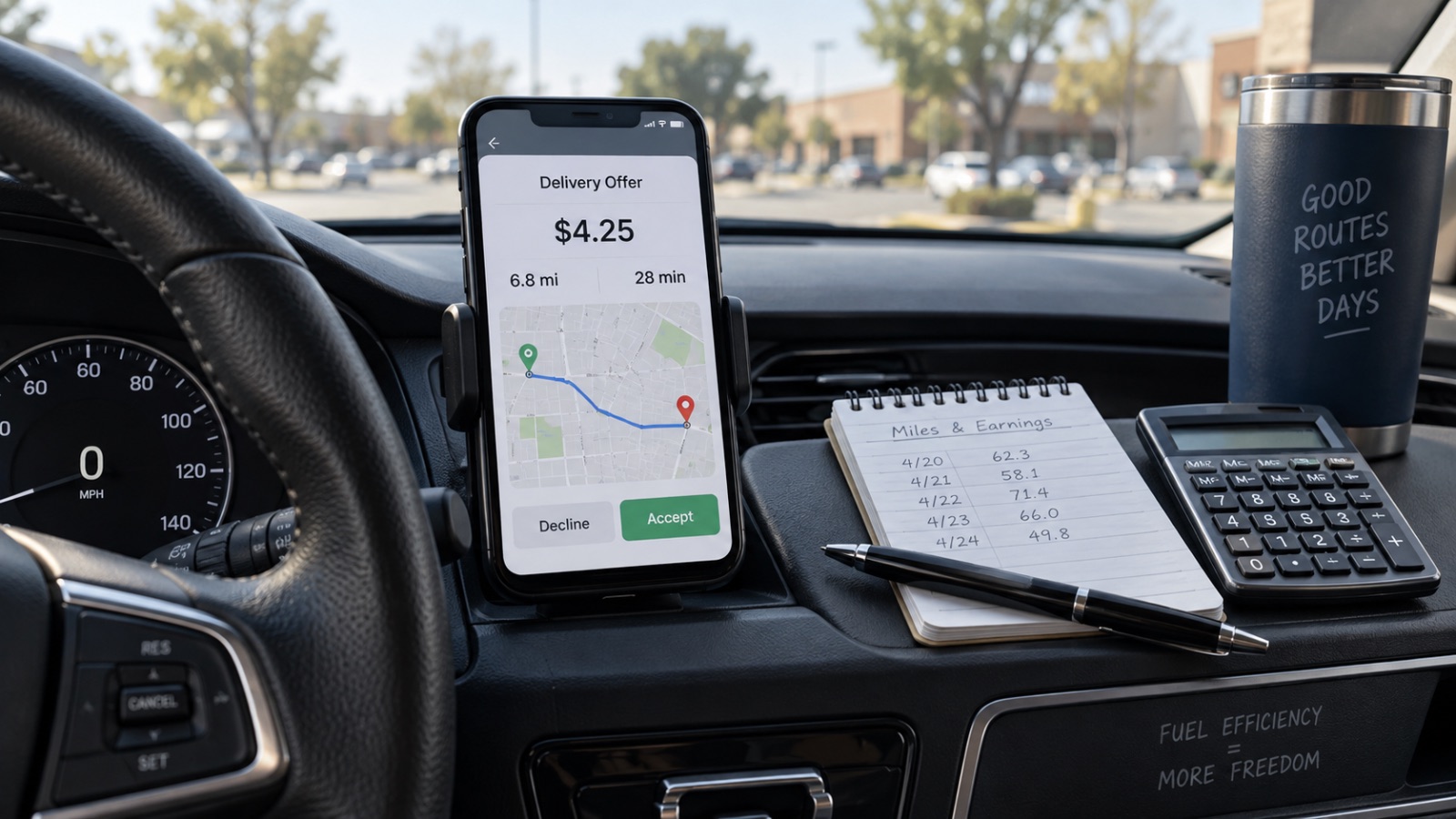
Delivery drivers make dozens of decisions during a shift.
Some offers are easy to reject.
Others look good at first and turn out to be much worse once you consider the miles, time, pickup, drop-off, and return trip.
So when should a delivery driver reject an offer?
The answer should not come from one number alone.
A strong decision looks at the entire trip.
When should delivery drivers reject an offer?
A delivery offer may be worth rejecting when the payout is too low for the total mileage, time, vehicle cost, and likely difficulty involved.
The important word is total.
Do not look only at the payout.
Do not look only at the miles shown on the offer.
Look at what completing the order will actually require from you.
A bad offer usually has more than one problem
An offer may become unattractive because of:
- Low payout
- Too many miles
- Long pickup distance
- Long wait risk
- Difficult drop-off
- Too many stops
- Poor ending location
- Heavy traffic
- Unpaid return miles
One problem may be manageable.
Several together can turn an offer into an easy rejection.
Reject offers that do not cover your real costs
Every delivery creates expenses.
Fuel is only one of them.
Your vehicle also has costs from:
- Maintenance
- Tires
- Repairs
- Depreciation
- Insurance
- Phone use
- Supplies
If an offer does not leave enough money after those costs, the payout may not be worth it.
Gross payout is not TRUE profit
An offer showing $15 does not mean you are making $15.
You still have to complete the work.
If fuel, vehicle wear, and unpaid miles consume a large part of that payout, your TRUE profit can be much smaller.
Low dollars per mile can be a warning sign
Drivers often use dollars per mile as a quick filter.
It can be useful.
But it should not be the only thing you check.
Mileage is more than the number on the screen
The offer may show 8 miles.
But you may need to:
- Drive to the pickup
- Complete the delivery
- Drive back toward a useful area
If the real trip ends up being 15 miles, the offer is very different from what it first appeared to be.
Return miles can turn a good offer into a bad one
Where the delivery ends matters.
A delivery that takes you far outside your working area may require unpaid driving before you can get another useful order.
The drop-off location is part of the offer
Suppose two offers both pay $20.
Offer A ends near several pickup locations.
Offer B ends 12 miles outside your normal working area.
The payouts are the same.
The value of the offers is not.
Offer B may cost you more time and mileage after the delivery is complete.
Reject offers with unrealistic time expectations
Some offers look profitable until you estimate how long they will actually take.
A short-mile order can still become a bad hourly decision.
Time can disappear in places mileage does not show
You may lose time through:
- Store wait
- Shopping
- Checkout
- Loading
- Apartment access
- Parking
- Elevators
- Customer delays
A 4-mile order can still consume an hour.
Long pickup distance can reduce the value immediately
Drivers sometimes focus on the distance from the pickup to the customer.
But the drive to the pickup matters too.
Unpaid approach miles are still real miles
Suppose an offer pays $12 for a 5-mile delivery.
That might look reasonable.
But if you are 7 miles from the pickup, you may actually drive 12 miles before even considering your next position.
That changes the offer significantly.
Pickup wait risk should affect your decision
Some pickup locations are consistently fast.
Others are not.
If you already know a location tends to create long waits, that should affect how much payout you require.
Waiting lowers your hourly result
Imagine a $15 offer that should take 30 minutes.
If you wait another 30 minutes at pickup, the order now takes an hour.
The payout did not increase.
Your hourly earnings dropped.
Difficult drop-offs can justify rejecting an offer
Some deliveries involve more work than the mileage suggests.
Examples can include:
- Large apartment complexes
- Hospitals
- Campuses
- Gated communities
- Hotels
- High-rise buildings
- Long walks from parking
A short route can still be a long delivery
A 2-mile delivery may look excellent.
But if the drop-off requires 20 minutes of parking, walking, elevators, and searching for the customer, the order may not perform as well as expected.
Heavy or oversized orders deserve extra consideration
Large grocery orders, cases of water, bulky packages, and difficult stairs can add time and physical effort.
That does not automatically make the order bad.
But the payout should justify the work.
More effort should usually require more value
If two offers pay the same amount but one requires several heavy trips up stairs, they are not equivalent.
Time and effort matter.
Multi-stop offers need the whole route considered
A multi-stop offer may look attractive because the payout is larger.
But the total route can create much more work.
More stops create more opportunities for delay
Each stop can add:
- Parking
- Navigation
- Walking
- Customer contact
- Building access
- Unloading
A $30 multi-stop offer is not automatically better than a $20 single-stop offer.
Reject offers that place you in a poor position afterward
The ending location can affect your next hour.
A delivery may pay reasonably well but leave you somewhere with little chance of another order.
Position has value
If you finish near active pickup locations, you may receive another offer quickly.
If you finish far away, you may spend 20 or 30 minutes driving back with no pay.
That should be part of your decision.
Traffic can change the value of an offer
Five miles during light traffic is different from five miles during rush hour.
The map may show the same distance.
The time required can be completely different.
Time is part of your cost
If traffic turns a 20-minute route into 45 minutes, your hourly result changes.
That does not always mean reject the offer.
But the payout needs to compensate for the added time.
Weather can raise the bar
Rain, snow, ice, storms, or poor visibility can increase risk and slow down deliveries.
That may mean an offer needs to pay more before it becomes worthwhile.
Higher difficulty should affect your minimum
Bad weather can mean:
- Slower driving
- Longer loading
- Difficult parking
- Longer walks
- Increased accident risk
The same offer may be acceptable on a clear day and not worth taking in severe weather.
Do not accept an offer just because the payout looks high
A large payout gets attention.
But high-paying offers can hide expensive routes.
Ask why the payout is high
A $35 offer might involve:
- Long mileage
- Several stops
- Difficult shopping
- Heavy items
- A remote ending location
- Long expected time
The payout is only one part of the equation.
Do not reject an offer only because the payout looks small
The opposite can also happen.
A smaller offer may be excellent if it is fast and efficient.
Small offers can work when the trip is short
A $9 offer that takes 12 minutes and 2 miles may perform better than a $20 offer that takes an hour and 18 miles.
The number on the offer card does not tell the whole story.
Your own minimum matters
Every driver should have some idea of what they need from an offer.
That minimum may include:
- Minimum payout
- Minimum profit per mile
- Minimum profit per hour
- Maximum pickup distance
- Maximum acceptable wait
- Return-mile consideration
Your minimum should fit your vehicle and goals
A driver with low vehicle costs can accept some offers that would not work for a driver with higher costs.
Your minimum does not have to match another driver's.
It should be based on your numbers.
Do not chase acceptance rate at the expense of profit
Some drivers accept offers they know are weak because they are worried about their acceptance rate.
Whether that makes sense depends on the platform and current program rules.
But accepting unprofitable work simply to keep a number high can create a real cost.
Profit should remain part of the decision
An acceptance metric does not pay for:
- Gas
- Tires
- Repairs
- Insurance
- Your time
Understand the rules of the platform you use, but also understand what each delivery costs you.
One weak order can hurt the rest of the shift
A bad order does not only affect the money you make from that delivery.
It can take you away from better opportunities.
Opportunity cost matters
If you spend 70 minutes completing a weak offer, you were unavailable for other offers during that time.
You cannot know exactly what you missed.
But time committed to one order cannot be used somewhere else.
Use history to improve rejection decisions
The more you drive, the more useful your own records become.
You may notice certain patterns.
Your past deliveries can teach you what to avoid
You might learn:
- One store consistently runs late
- One apartment complex always takes too long
- One area leaves you with return miles
- One type of order rarely meets your goals
Those patterns can help you decide faster.
Rejecting an offer does not mean it is bad for everyone
An offer that does not work for you may work for another driver.
Their vehicle, location, goals, and current position may be different.
Profitability is personal
One driver may already be sitting at the pickup.
Another may be 8 miles away.
For the first driver, the offer may be good.
For the second, it may be an easy rejection.
Context changes the answer.
A simple way to evaluate an offer
Before accepting, ask yourself:
What will I actually be paid?
How many total miles am I likely to drive?
How long will the entire trip probably take?
Is there a wait risk?
Where will I end up?
What will it cost me to complete?
Then compare the result with your goals
An offer should not only produce a positive number.
It should help move your shift toward the profit you want.
When should you reject immediately?
Some offers may be easy decisions.
You may reject quickly when the payout is clearly too low, the mileage is clearly too high, or the route violates your own minimums.
Fast decisions come from knowing your numbers
The better you understand your vehicle costs and goals, the less time you need to debate weak offers.
You already know what does not work for you.
When should you look more closely?
Borderline offers deserve a little more thought.
Maybe the payout is good but the ending location is poor.
Maybe the miles are slightly high but the route is fast.
Maybe the payout is lower but the pickup is right beside you.
Not every decision is black and white
Some offers are clearly good.
Some are clearly bad.
Others depend on context.
That is why a single rule such as "never accept under $2 per mile" cannot account for every situation.
The bottom line
Delivery drivers should consider rejecting an offer when the payout does not justify the real mileage, time, vehicle cost, wait risk, difficulty, and ending location.
Do not judge the offer by payout alone.
Look at the whole trip.
Consider the pickup.
Consider the drop-off.
Consider the drive back.
Consider your vehicle.
Consider your time.
Then ask the question that matters most:
After everything it takes to complete this offer, is it actually worth taking?
That is the decision TRUE profit is meant to help you make.
Related reading