How to Decide if a Delivery Is Worth Taking When You’re Far From the Pickup
A delivery offer can look good until you count the miles and time it takes just to reach the pickup. Learn how approach distance can change the real value of an offer.
By TRUE Driver Profit · September 12, 2026
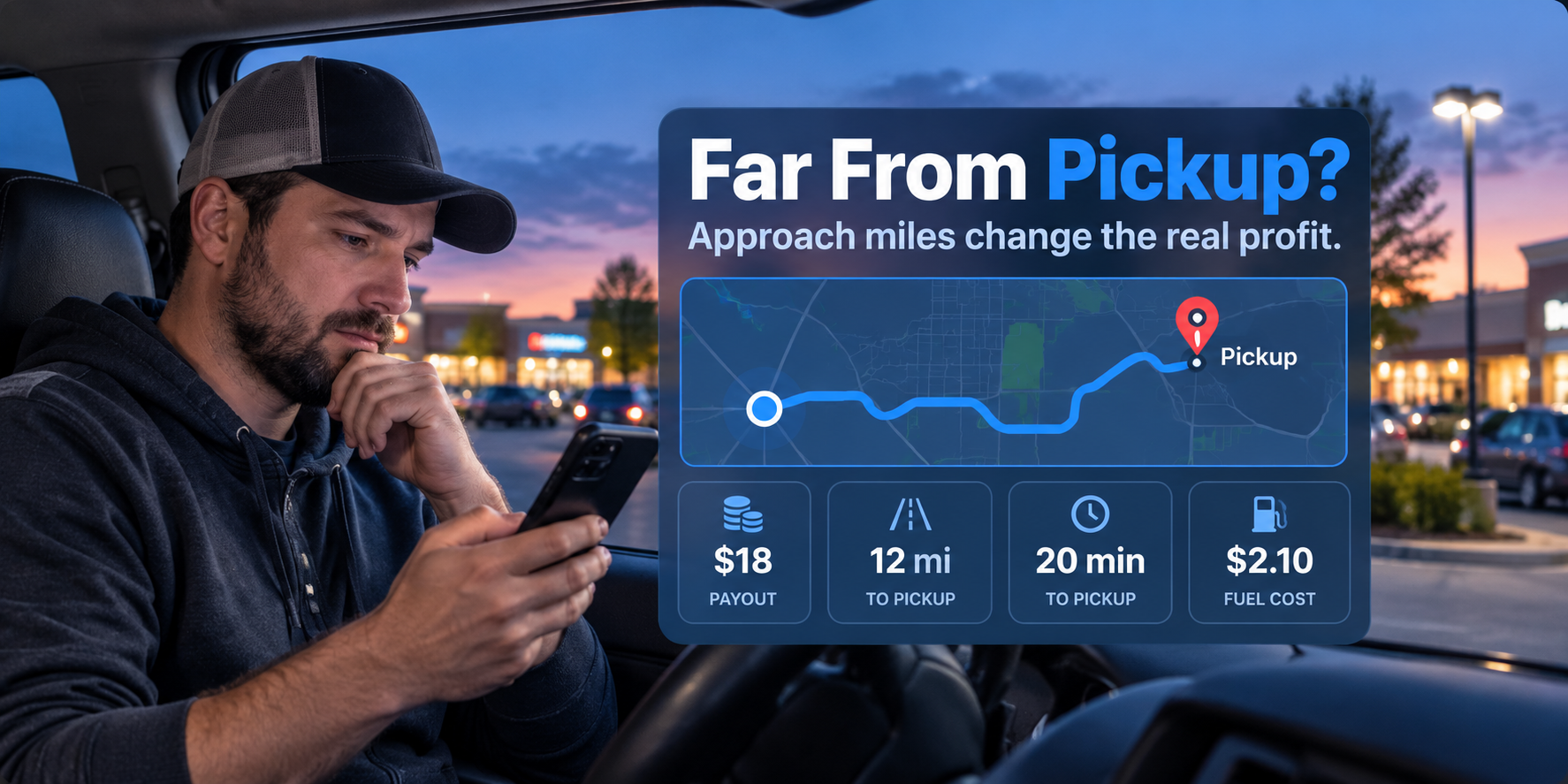
A delivery offer can look strong at first glance.
The payout may seem fair.
The delivery miles may look reasonable.
The estimated time may seem manageable.
But there is another part of the trip that can change the real value of the offer before the delivery even begins.
The distance to the pickup.
Approach Miles Are Part of the Real Trip
If you are several miles away from the pickup location, those miles still count.
You still use fuel.
You still add wear to your vehicle.
You still spend time getting there.
And in many cases, those miles are not included in the mileage shown on the offer screen.
The Offer May Only Show Part of the Driving
An offer may show six delivery miles from pickup to customer.
But if you are already four miles away from the pickup, the real driving connected to that order may be closer to ten miles before any return driving is considered.
That can change the profit quickly.
Pickup Distance Can Change a Good-Looking Offer
Two drivers can see the same delivery offer and get very different results.
One driver may already be parked near the pickup.
Another driver may be several miles away.
The payout is the same.
The delivery miles are the same.
But the second driver may spend more time, fuel, and vehicle cost just getting into position to start the order.
Your Starting Location Matters
Before accepting, consider where you are right now.
Ask yourself:
How far is the pickup?
How long will it take to get there?
Will traffic slow the approach?
Will those extra miles still leave enough profit?
The same offer can be worthwhile from one location and weak from another.
Time to Pickup Matters as Much as Distance
A short approach distance can still take a long time.
Traffic lights, congestion, construction, parking, and difficult entrances can all increase the time required to reach the pickup.
A Few Miles Can Still Cost Too Much Time
Imagine the pickup is only three miles away.
That may sound close.
But if those three miles take 15 minutes because of traffic, the offer may already be using a significant amount of your working time before pickup begins.
That can lower profit per hour even if the mileage still looks reasonable.
Fuel and Vehicle Cost Start Before Pickup
Your vehicle does not wait until you arrive at the store to begin costing money.
Every approach mile adds to the trip.
Extra Miles Add Real Cost
Approach miles can increase:
Fuel use
Tire wear
Maintenance
Depreciation
Total business mileage
If you regularly accept offers from far-away pickup locations, those extra miles can become a meaningful part of your weekly vehicle cost.
Do Not Ignore the Pickup Wait
Being far from the pickup can be even more costly if you arrive and then have to wait.
Now the order has already used approach time and mileage before the wait even begins.
Approach Time Plus Wait Time Can Add Up Fast
For example:
10 minutes driving to pickup
10 minutes waiting
20 minutes completing the delivery
That is already 40 minutes of working time.
If the payout is low, the offer may produce weak profit per hour even if the delivery mileage itself is short.
Compare the Full Mileage Before Accepting
A better way to judge the offer is to think about the complete trip.
Include More Than the Advertised Miles
Consider:
Miles to the pickup
Miles from pickup to customer
Likely return miles
Repositioning miles after delivery
Any other unpaid driving connected to the order
You may not know every mile exactly before accepting.
But even a reasonable estimate can give you a better picture than using the displayed delivery miles alone.
Approach Distance Can Affect Profit Per Mile
An offer can look strong on a dollar-per-mile basis until you include the approach miles.
The Ratio Can Change Quickly
Suppose an offer pays $18 and shows six delivery miles.
That looks like $3 per displayed mile.
But if you are four miles from the pickup, the trip may involve at least ten miles before return driving.
Now the same $18 payout is being spread across more real mileage.
The offer did not change.
Your starting position changed the result.
Approach Distance Can Affect Profit Per Hour
Extra driving before pickup also increases total working time.
That can make a major difference when comparing offers.
A Higher Payout May Still Be Weak
A larger payout can look appealing.
But if you spend too much time reaching the pickup, the hourly result may be weaker than a smaller offer that starts nearby.
This is why it helps to compare both profit per mile and profit per hour.
Traffic Can Make Pickup Distance More Important
The same pickup distance can produce different results depending on the time of day.
Three Miles Is Not Always Three Minutes
During light traffic, a pickup may be easy to reach.
During rush hour, the same pickup may take much longer.
That means your decision may need to change depending on current conditions.
An offer that works well at 2:00 PM may be much weaker at 5:00 PM.
Know Which Pickup Locations Are Worth the Drive
Some pickup locations may consistently justify a longer approach.
Others may not.
Your Past Results Can Help
You may notice that certain pickup locations usually have:
Fast loading
Strong payouts
Efficient routes
Good destination areas
Short waits
Those locations may be worth driving farther to reach.
Other locations may regularly involve long waits or weak routes.
In that case, a long approach distance becomes harder to justify.
Do Not Chase an Offer Too Far
It can be tempting to accept a strong-looking payout even when the pickup is far away.
But chasing offers across town can create a lot of unpaid driving.
More Movement Does Not Always Mean More Profit
If you repeatedly drive several miles to reach pickups, you may end the day with high mileage even if the delivery miles themselves were reasonable.
That can reduce both profit per mile and total weekly profit.
Sometimes a Nearby Lower-Paying Offer Can Be Better
The highest payout is not always the strongest choice.
Compare the Complete Commitment
A nearby offer may require:
Less approach driving
Less fuel
Less vehicle wear
Less time before pickup
A faster return to earning
A slightly smaller payout can sometimes produce a better overall result when the full trip is considered.
Use Your Current Position as Part of the Decision
Your location is part of every offer decision.
The app may show the same order to several drivers, but each driver starts from a different place.
The Best Offer Depends on Where You Are
Before accepting, think about:
Your current distance from pickup
Current traffic
Expected pickup wait
Delivery miles
Likely return driving
Total time
Vehicle cost
Expected profit
That creates a much more realistic view of the order.
Track Approach Miles When They Matter
If long pickup drives are common in your area, pay attention to them over time.
Look for Patterns
Compare:
Average distance to pickup
Average pickup travel time
Total trip mileage
Profit per mile
Profit per hour
TRUE profit
You may discover that certain pickup distances consistently reduce your results.
The Trip Starts Before You Reach the Pickup
A delivery offer does not begin when you arrive at the store.
For profitability purposes, it begins when you start driving toward the pickup.
Those approach miles and minutes are part of the real work.
TRUE Driver Profit is designed to help drivers look at the complete cost of a delivery, including mileage, time, vehicle costs, return driving, and what they actually keep.
When you include the distance to the pickup in your decision, you can avoid offers that only look profitable because part of the trip was left out.