How to Compare Two Delivery Offers With the Same Payout
Two delivery offers can pay the same amount and still produce very different profit. Learn how mileage, return driving, vehicle costs, and time can reveal which offer is actually better.
By TRUE Driver Profit · September 12, 2026
How to Compare Two Delivery Offers With the Same Payout
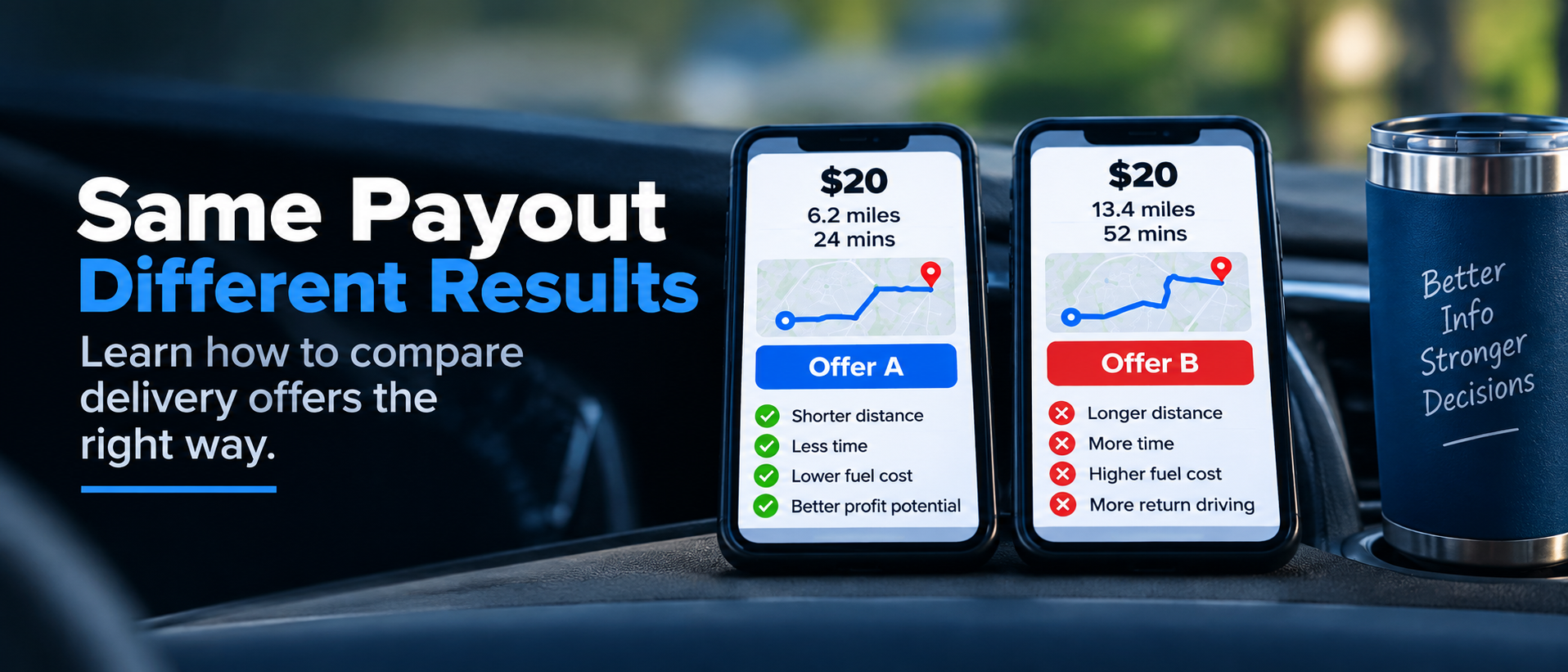
Two delivery offers can show the exact same payout and still produce very different results.
A $20 offer is not automatically equal to another $20 offer.
One may require fewer miles, less time, and very little return driving.
The other may take you farther away, keep you busy longer, and create significantly more vehicle cost.
The payout is the same.
What you actually keep may not be.
That makes sense.
But payout only tells you how much money the delivery is expected to bring in.
It does not automatically tell you:
How many total miles you will drive
How much fuel you will use
How much vehicle wear the trip creates
How long the delivery will take
Whether you will need to drive back afterward
Where the delivery leaves you when it is finished
Those differences can turn two identical payouts into very different offers.
Offer A:
Payout: $20
Offer mileage: 6 miles
Offer B:
Payout: $20
Offer mileage: 13 miles
Before considering anything else, Offer B requires more than twice as much driving.
That means it will generally use more fuel and create more vehicle wear.
The payout did not increase to compensate for those additional miles.
That already gives Offer A an advantage.
But mileage shown on the screen is not always the full story.
You may be able to complete the delivery and continue working without driving very far.
Offer B takes you 13 miles outside your normal working area.
After completing it, you need to drive another 8 miles back.
Now the comparison looks like this:
Offer A:
$20 payout
6 total realistic miles
Offer B:
$20 payout
21 total realistic miles
The offers still pay the same amount.
The actual driving is dramatically different.
Those unpaid return miles matter because they still require fuel, vehicle wear, and time.
Fuel cost changes with distance
More mileage usually means more fuel.
Suppose your vehicle gets 25 miles per gallon and fuel costs $3.25 per gallon.
A 6-mile trip uses far less fuel than a 21-mile trip.
The difference on one delivery may only be a few dollars.
But over an entire week of driving, those differences can add up quickly.
Fuel is not the only cost either.
Vehicle wear matters too
Every delivery puts additional mileage on your vehicle.
That mileage contributes to costs such as:
Oil changes
Tires
Brakes
Maintenance
Repairs
Depreciation
A longer trip creates more of those future costs.
You may not pay the repair bill today.
But the miles contributing to it are being driven today.
That is why comparing two offers by payout alone can be misleading.
Time can change which offer is better
Now imagine both offers pay $20 and require similar mileage.
Offer A takes 25 minutes.
Offer B takes 55 minutes.
The payout is identical.
The amount of your workday each offer consumes is not.
A delivery that takes nearly an hour prevents you from completing other profitable work during that time.
That can reduce your profit per hour even if the trip itself remains profitable.
Waiting can create the same problem.
A short-mileage offer can become less attractive if you spend 30 minutes waiting at pickup.
Distance and time should be considered together.
Consider two $22 offers.
One ends near several places where you commonly receive new offers.
The other ends far outside your normal delivery area.
The second trip may require additional unpaid driving before you are positioned to work again.
That means the destination can affect:
Return mileage
Fuel cost
Vehicle wear
Time
Your ability to receive the next useful offer
Two identical payouts can create very different workday outcomes simply because of where they end.
Offer A:
Payout: $24
Full-trip mileage: 8 miles
Estimated fuel and vehicle cost: $4
Estimated time: 30 minutes
Offer B:
Payout: $24
Full-trip mileage: 18 miles
Estimated fuel and vehicle cost: $9
Estimated time: 55 minutes
Both offers pay $24.
After estimated driving costs:
Offer A has about $20 remaining.
Offer B has about $15 remaining.
Offer A also uses less of your time.
The payout did not tell you any of that.
The full trip did.
Profit per mile helps compare efficiency
Profit per mile can help show how efficiently each offer uses your vehicle.
If two offers pay the same amount but one requires far fewer miles, the shorter trip may produce much stronger profit per mile.
That matters because mileage has a real cost.
A high payout combined with excessive mileage can still produce a weak result.
Profit per hour tells another part of the story
Profit per hour helps you understand how efficiently the offer uses your time.
An offer may look good per mile but take too long because of:
Pickup delays
Traffic
Parking
Apartment access
Long walks
Slow roads
A strong delivery should ideally work for both your mileage and time goals.
That is why comparing only one number can be misleading.
The highest payout is not always the best offer
This same idea applies when payouts are different too.
A $28 offer may not automatically be better than an $18 offer.
If the $28 trip requires significantly more mileage, return driving, and time, the smaller offer may actually produce better profit.
The important number is not simply what the offer pays.
It is what remains after completing the work.
Payout
Offer mileage
Expected return miles
Total realistic mileage
Fuel cost
Vehicle cost
Estimated time
Destination
Profit per mile
Profit per hour
TRUE profit
Looking at those factors gives you a much clearer comparison than payout alone.
Your vehicle can change the answer
The better offer may also differ from one driver to another.
Drivers have different:
Fuel economy
Gas prices
Vehicle costs
Maintenance expenses
Profit goals
Delivery areas
Return-mile patterns
That means the same two offers may produce different results for different drivers.
Your own numbers matter.
TRUE Driver Profit helps compare what the offers actually produce
TRUE Driver Profit is designed to help drivers evaluate the full trip instead of judging an offer by payout alone.
It can account for:
Payout
Mileage
Return miles
Fuel
Vehicle costs
Time
From there, you can see:
TRUE profit
Profit per mile
Profit per hour
Two offers can show the same payout on the screen.
That does not mean they are equally profitable.
The better offer is the one that works better after the miles, costs, and time are taken into account.
Two delivery offers can show the exact same payout and still produce very different results.
A $20 offer is not automatically equal to another $20 offer.
One may require fewer miles, less time, and very little return driving.
The other may take you farther away, keep you busy longer, and create significantly more vehicle cost.
The payout is the same.
What you actually keep may not be.
Why payout alone is not enough
Payout is usually the first number drivers notice.That makes sense.
But payout only tells you how much money the delivery is expected to bring in.
It does not automatically tell you:
How many total miles you will drive
How much fuel you will use
How much vehicle wear the trip creates
How long the delivery will take
Whether you will need to drive back afterward
Where the delivery leaves you when it is finished
Those differences can turn two identical payouts into very different offers.
Start with the mileage
Imagine two offers that both pay $20.Offer A:
Payout: $20
Offer mileage: 6 miles
Offer B:
Payout: $20
Offer mileage: 13 miles
Before considering anything else, Offer B requires more than twice as much driving.
That means it will generally use more fuel and create more vehicle wear.
The payout did not increase to compensate for those additional miles.
That already gives Offer A an advantage.
But mileage shown on the screen is not always the full story.
Return miles can completely change the comparison
Suppose Offer A ends near another active pickup area.You may be able to complete the delivery and continue working without driving very far.
Offer B takes you 13 miles outside your normal working area.
After completing it, you need to drive another 8 miles back.
Now the comparison looks like this:
Offer A:
$20 payout
6 total realistic miles
Offer B:
$20 payout
21 total realistic miles
The offers still pay the same amount.
The actual driving is dramatically different.
Those unpaid return miles matter because they still require fuel, vehicle wear, and time.
Fuel cost changes with distance
More mileage usually means more fuel.
Suppose your vehicle gets 25 miles per gallon and fuel costs $3.25 per gallon.
A 6-mile trip uses far less fuel than a 21-mile trip.
The difference on one delivery may only be a few dollars.
But over an entire week of driving, those differences can add up quickly.
Fuel is not the only cost either.
Vehicle wear matters too
Every delivery puts additional mileage on your vehicle.
That mileage contributes to costs such as:
Oil changes
Tires
Brakes
Maintenance
Repairs
Depreciation
A longer trip creates more of those future costs.
You may not pay the repair bill today.
But the miles contributing to it are being driven today.
That is why comparing two offers by payout alone can be misleading.
Time can change which offer is better
Now imagine both offers pay $20 and require similar mileage.
Offer A takes 25 minutes.
Offer B takes 55 minutes.
The payout is identical.
The amount of your workday each offer consumes is not.
A delivery that takes nearly an hour prevents you from completing other profitable work during that time.
That can reduce your profit per hour even if the trip itself remains profitable.
Waiting can create the same problem.
A short-mileage offer can become less attractive if you spend 30 minutes waiting at pickup.
Distance and time should be considered together.
Destination matters
Where the delivery ends can also affect its value.Consider two $22 offers.
One ends near several places where you commonly receive new offers.
The other ends far outside your normal delivery area.
The second trip may require additional unpaid driving before you are positioned to work again.
That means the destination can affect:
Return mileage
Fuel cost
Vehicle wear
Time
Your ability to receive the next useful offer
Two identical payouts can create very different workday outcomes simply because of where they end.
A simple side-by-side comparison
Consider these two offers.Offer A:
Payout: $24
Full-trip mileage: 8 miles
Estimated fuel and vehicle cost: $4
Estimated time: 30 minutes
Offer B:
Payout: $24
Full-trip mileage: 18 miles
Estimated fuel and vehicle cost: $9
Estimated time: 55 minutes
Both offers pay $24.
After estimated driving costs:
Offer A has about $20 remaining.
Offer B has about $15 remaining.
Offer A also uses less of your time.
The payout did not tell you any of that.
The full trip did.
Profit per mile helps compare efficiency
Profit per mile can help show how efficiently each offer uses your vehicle.
If two offers pay the same amount but one requires far fewer miles, the shorter trip may produce much stronger profit per mile.
That matters because mileage has a real cost.
A high payout combined with excessive mileage can still produce a weak result.
Profit per hour tells another part of the story
Profit per hour helps you understand how efficiently the offer uses your time.
An offer may look good per mile but take too long because of:
Pickup delays
Traffic
Parking
Apartment access
Long walks
Slow roads
A strong delivery should ideally work for both your mileage and time goals.
That is why comparing only one number can be misleading.
The highest payout is not always the best offer
This same idea applies when payouts are different too.
A $28 offer may not automatically be better than an $18 offer.
If the $28 trip requires significantly more mileage, return driving, and time, the smaller offer may actually produce better profit.
The important number is not simply what the offer pays.
It is what remains after completing the work.
Build your comparison around the full trip
When comparing offers, consider:Payout
Offer mileage
Expected return miles
Total realistic mileage
Fuel cost
Vehicle cost
Estimated time
Destination
Profit per mile
Profit per hour
TRUE profit
Looking at those factors gives you a much clearer comparison than payout alone.
Your vehicle can change the answer
The better offer may also differ from one driver to another.
Drivers have different:
Fuel economy
Gas prices
Vehicle costs
Maintenance expenses
Profit goals
Delivery areas
Return-mile patterns
That means the same two offers may produce different results for different drivers.
Your own numbers matter.
TRUE Driver Profit helps compare what the offers actually produce
TRUE Driver Profit is designed to help drivers evaluate the full trip instead of judging an offer by payout alone.
It can account for:
Payout
Mileage
Return miles
Fuel
Vehicle costs
Time
From there, you can see:
TRUE profit
Profit per mile
Profit per hour
Two offers can show the same payout on the screen.
That does not mean they are equally profitable.
The better offer is the one that works better after the miles, costs, and time are taken into account.