When a High-Paying Delivery Offer Is Actually a Trap
A big payout can look hard to pass up, but long miles, wait time, return driving, and vehicle costs can turn a high-paying offer into a weak deal.
By TRUE Driver Profit · September 10, 2026
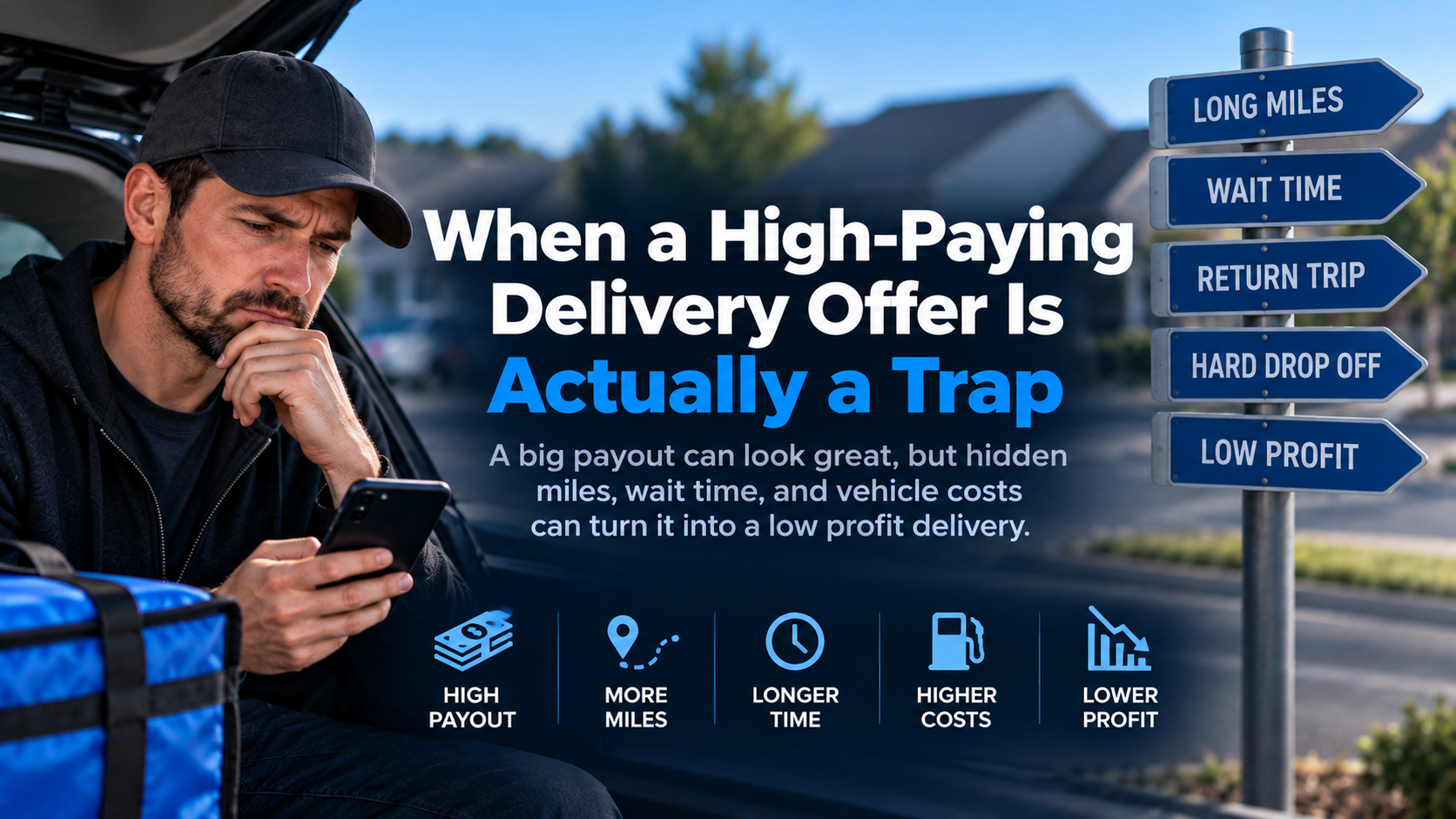
A high-paying delivery offer gets your attention fast.
$20.
$25.
$30.
It can feel like an automatic yes.
But a large payout does not always mean a strong offer.
Sometimes the bigger number is hiding bigger costs.
Long mileage, pickup delays, difficult delivery locations, return miles, and vehicle wear can turn an offer that looks excellent into one that barely works.
That is where drivers can get caught.
Suppose an offer pays $28.
That sounds great.
But now look at the rest of the trip.
Maybe it requires 18 miles.
Maybe the customer is far outside your normal pickup area.
Maybe the pickup is known for long waits.
Maybe the entire order will take more than an hour.
The $28 still matters.
But it is not the only number that matters.
That can mean more:
Fuel
Vehicle wear
Tire use
Maintenance
Time on the road
Depreciation
A $30 order that requires 25 miles can cost much more to complete than a $17 order that requires 6 miles.
The bigger payout may still win.
But you cannot know that from the payout alone.
Imagine a $26 order that takes you 12 miles away from your normal pickup area.
If you have to drive most of those 12 miles back before you are in a useful position for another order, the real trip may be closer to 24 miles.
The payout did not change.
Your total driving did.
That can completely change profit per mile.
Wait time can erase the advantage
A big payout can also lose value while you sit at pickup.
Suppose a $24 offer looks excellent.
Then you wait 25 minutes before the order is ready.
What looked like a 35-minute delivery may now take an hour.
The payout is still $24.
But your profit per hour may be much lower than expected.
This is why time matters just as much as distance.
Difficult deliveries can add hidden time
Not every delivery ends at an easy front door.
Some orders involve:
Large apartment complexes
Gated properties
Parking problems
Long walks
Stairs
Slow elevators
Hard-to-find addresses
Customer delays
Those extra minutes may not show up clearly when you first see the offer.
A higher payout may justify the extra effort.
But it should still be part of the decision.
If the customer is far from your preferred pickup area, the delivery may create more unpaid driving afterward.
That can affect the rest of your shift.
You may spend time repositioning.
You may miss stronger offers while driving back.
You may accept a weaker order just to get moving in the right direction.
One high-paying offer can sometimes create a chain of lower-quality decisions afterward.
A big payout can hide poor profit per mile
Imagine two offers.
Offer A:$30 payout22 total miles
Offer B:$18 payout7 total miles
Offer A pays much more.
But Offer B may produce stronger profit per mile and leave you better positioned for the next order.
That does not automatically make Offer B better.
It means the larger payout should not end the evaluation.
Look at what is left after the driving cost.
A big payout can also hide poor profit per hour
Now compare time.
Offer A takes 75 minutes.
Offer B takes 30 minutes.
The higher-paying order still brings in more money.
But the lower-paying order may create a better hourly result.
Again, the goal is not to chase one number.
It is to see the full picture.
A large payout can absolutely be a great offer.
Sometimes the mileage is reasonable.
Sometimes the route is easy.
Sometimes the customer is near another pickup area.
Sometimes the high payout is exactly what it looks like: a strong opportunity.
The point is not to distrust every big number.
The point is to verify what is behind it.
How many total miles will I likely drive?
Will I need to drive back afterward?
How long will the order realistically take?
Is the pickup likely to be slow?
Where will the delivery leave me?
What will fuel and vehicle costs do to the payout?
What will the profit per mile look like?
What will the profit per hour look like?
You do not need a perfect prediction.
You just need enough information to avoid letting the payout make the whole decision for you.
The best offer is the one that leaves something behind
Gross pay looks good on the screen.
Profit is what remains after the cost of earning it.
A $30 offer that costs too much time and mileage can be weaker than it appears.
A smaller offer with short mileage, fast completion, and good positioning can sometimes do more for your shift.
That is why drivers need more than payout.
TRUE Driver Profit helps you look past the big number
TRUE Driver Profit is designed to help drivers evaluate what an offer may really be worth.
By considering payout, mileage, return miles, time, fuel, and vehicle costs, you can see:
TRUE profit
Profit per mile
Profit per hour
The goal is not to tell you that high-paying offers are bad.
The goal is to help you know when a high payout is truly strong and when it is hiding a weak deal.
Because sometimes the biggest number on the screen is not the biggest profit.
$20.
$25.
$30.
It can feel like an automatic yes.
But a large payout does not always mean a strong offer.
Sometimes the bigger number is hiding bigger costs.
Long mileage, pickup delays, difficult delivery locations, return miles, and vehicle wear can turn an offer that looks excellent into one that barely works.
The payout is only the beginning
A high payout can make it easy to stop evaluating the rest of the offer.That is where drivers can get caught.
Suppose an offer pays $28.
That sounds great.
But now look at the rest of the trip.
Maybe it requires 18 miles.
Maybe the customer is far outside your normal pickup area.
Maybe the pickup is known for long waits.
Maybe the entire order will take more than an hour.
The $28 still matters.
But it is not the only number that matters.
Long mileage can eat through a big payout
Higher-paying offers often come with more distance.That can mean more:
Fuel
Vehicle wear
Tire use
Maintenance
Time on the road
Depreciation
A $30 order that requires 25 miles can cost much more to complete than a $17 order that requires 6 miles.
The bigger payout may still win.
But you cannot know that from the payout alone.
Return miles can make the offer much worse
This is where some high-paying offers really fall apart.Imagine a $26 order that takes you 12 miles away from your normal pickup area.
If you have to drive most of those 12 miles back before you are in a useful position for another order, the real trip may be closer to 24 miles.
The payout did not change.
Your total driving did.
That can completely change profit per mile.
Wait time can erase the advantage
A big payout can also lose value while you sit at pickup.
Suppose a $24 offer looks excellent.
Then you wait 25 minutes before the order is ready.
What looked like a 35-minute delivery may now take an hour.
The payout is still $24.
But your profit per hour may be much lower than expected.
This is why time matters just as much as distance.
Difficult deliveries can add hidden time
Not every delivery ends at an easy front door.
Some orders involve:
Large apartment complexes
Gated properties
Parking problems
Long walks
Stairs
Slow elevators
Hard-to-find addresses
Customer delays
Those extra minutes may not show up clearly when you first see the offer.
A higher payout may justify the extra effort.
But it should still be part of the decision.
Positioning after the delivery matters
A high-paying offer can leave you in a bad place for the next order.If the customer is far from your preferred pickup area, the delivery may create more unpaid driving afterward.
That can affect the rest of your shift.
You may spend time repositioning.
You may miss stronger offers while driving back.
You may accept a weaker order just to get moving in the right direction.
One high-paying offer can sometimes create a chain of lower-quality decisions afterward.
A big payout can hide poor profit per mile
Imagine two offers.
Offer A:$30 payout22 total miles
Offer B:$18 payout7 total miles
Offer A pays much more.
But Offer B may produce stronger profit per mile and leave you better positioned for the next order.
That does not automatically make Offer B better.
It means the larger payout should not end the evaluation.
Look at what is left after the driving cost.
A big payout can also hide poor profit per hour
Now compare time.
Offer A takes 75 minutes.
Offer B takes 30 minutes.
The higher-paying order still brings in more money.
But the lower-paying order may create a better hourly result.
Again, the goal is not to chase one number.
It is to see the full picture.
High-paying offers are not bad
This is important.A large payout can absolutely be a great offer.
Sometimes the mileage is reasonable.
Sometimes the route is easy.
Sometimes the customer is near another pickup area.
Sometimes the high payout is exactly what it looks like: a strong opportunity.
The point is not to distrust every big number.
The point is to verify what is behind it.
Ask a few questions before accepting
When a high-paying offer appears, look at:How many total miles will I likely drive?
Will I need to drive back afterward?
How long will the order realistically take?
Is the pickup likely to be slow?
Where will the delivery leave me?
What will fuel and vehicle costs do to the payout?
What will the profit per mile look like?
What will the profit per hour look like?
You do not need a perfect prediction.
You just need enough information to avoid letting the payout make the whole decision for you.
The best offer is the one that leaves something behind
Gross pay looks good on the screen.
Profit is what remains after the cost of earning it.
A $30 offer that costs too much time and mileage can be weaker than it appears.
A smaller offer with short mileage, fast completion, and good positioning can sometimes do more for your shift.
That is why drivers need more than payout.
TRUE Driver Profit helps you look past the big number
TRUE Driver Profit is designed to help drivers evaluate what an offer may really be worth.
By considering payout, mileage, return miles, time, fuel, and vehicle costs, you can see:
TRUE profit
Profit per mile
Profit per hour
The goal is not to tell you that high-paying offers are bad.
The goal is to help you know when a high payout is truly strong and when it is hiding a weak deal.
Because sometimes the biggest number on the screen is not the biggest profit.