Fixed Costs vs. Variable Costs for Delivery Drivers
Learn the difference between fixed and variable delivery-driving costs, including fuel, vehicle wear, insurance, mileage, and other expenses that affect your real profit.
By TRUE Driver Profit · September 12, 2026
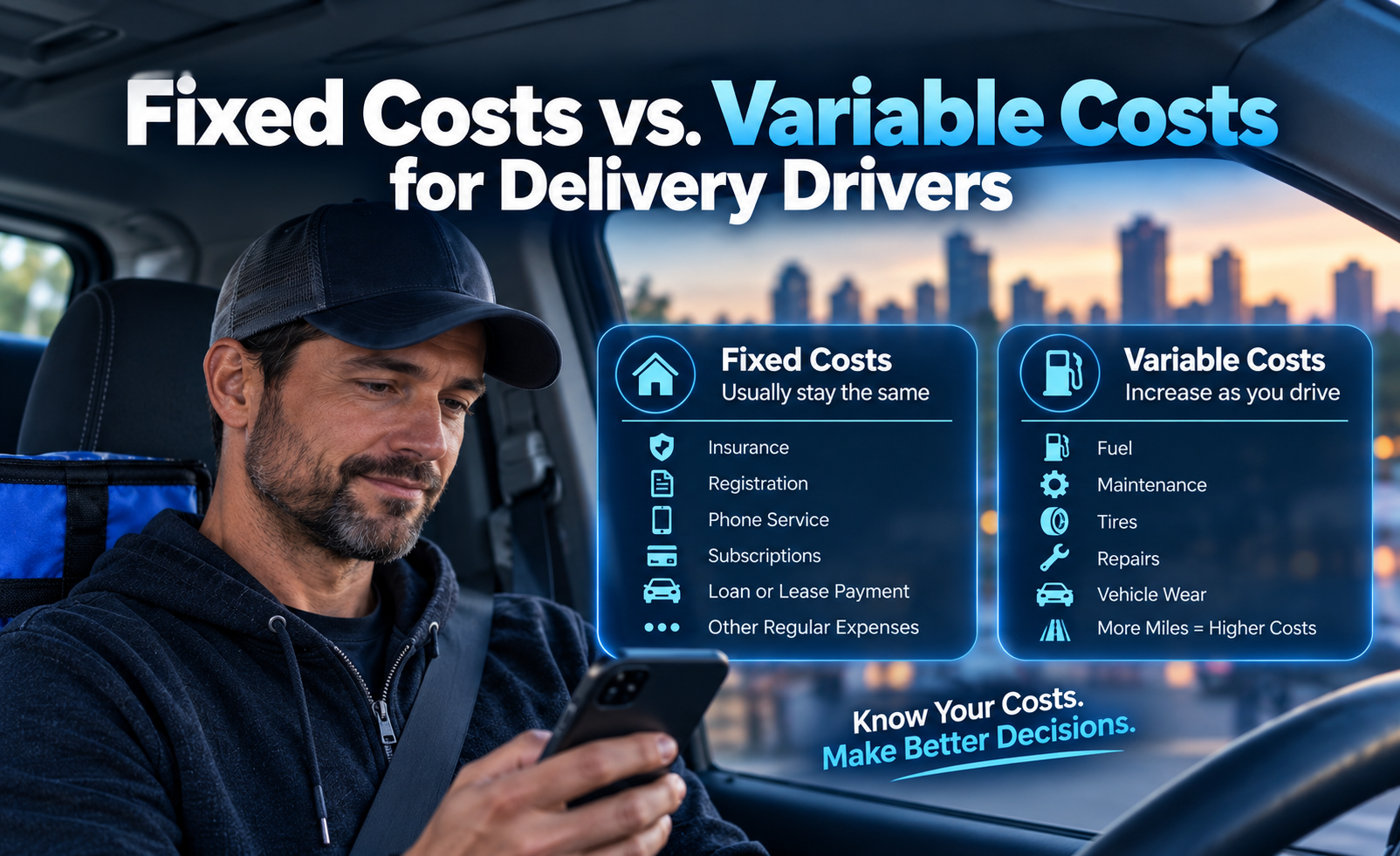
Fixed Costs vs. Variable Costs for Delivery Drivers
Delivery drivers usually think about gas first when they think about expenses.
Gas matters, but it is only one type of cost.
Some expenses change depending on how much you drive. Others stay relatively steady whether you complete five deliveries or fifty.
Understanding the difference between fixed costs and variable costs can help you get a clearer picture of what delivery work actually costs you.
What are fixed costs?
Fixed costs are expenses that generally stay the same over a period of time, even if the number of deliveries you complete changes.
Examples may include:
Vehicle insurance
Vehicle registration
Phone service
Certain subscriptions
Loan or lease payments
Other regular business-related expenses
These costs do not usually increase every time you accept another order.
If your insurance costs the same amount this month whether you drive 500 miles or 2,000 miles, that is a fixed cost.
What are variable costs?
Variable costs change as you drive more.
The more miles you put on your vehicle, the more these costs tend to increase.
Common examples include:
Fuel
Oil changes
Tires
Brakes
Maintenance
Repairs
Vehicle wear
Depreciation related to mileage
A short delivery may create only a small amount of variable cost.
A long-mileage delivery creates more.
That is why two offers with the same payout can produce very different profit.
Fuel is one of the easiest variable costs to see
Fuel is easy to notice because drivers pay for it regularly.
If you drive more miles, you use more fuel.
For example, imagine your vehicle gets 25 miles per gallon and gas costs $3.25 per gallon.
Driving 10 miles uses roughly:
10 ÷ 25 = 0.4 gallons
0.4 × $3.25 = about $1.30 in fuel
If the trip becomes 20 miles, the fuel cost roughly doubles.
That makes fuel a variable cost.
Vehicle wear is also a variable cost
Fuel is not the only expense that increases with mileage.
Every mile contributes to wear on your vehicle.
Over time, delivery driving affects:
Tires
Brakes
Oil
Suspension
Fluids
Repairs
Vehicle value
You may not pay for those costs every day.
But the miles you drive today still contribute to them.
That is why vehicle costs should not be ignored simply because the repair bill comes later.
Fixed costs still matter
Because fixed costs do not change with every trip, they can be easier to forget.
Suppose your delivery work contributes toward expenses such as:
$120 per month for insurance
$80 per month for phone service
$350 per month for a vehicle payment
Those expenses do not disappear on days when you drive less.
They remain part of the overall financial picture.
That does not mean every dollar of a personal vehicle payment or phone bill automatically belongs to delivery work.
The important point is that drivers should understand which recurring costs are connected to their work and account for them appropriately.
Why the difference matters
Fixed and variable costs behave differently.
A variable cost grows with activity.
A fixed cost stays relatively stable.
This matters because a driver can increase gross earnings while also increasing variable expenses.
Imagine two weeks:
Week A:
$900 gross earnings
700 miles driven
Week B:
$1,100 gross earnings
1,150 miles driven
Week B earned $200 more.
But it also required 450 additional miles.
Those extra miles create more fuel use and more vehicle wear.
The higher gross earnings do not automatically mean the week produced better profit.
More driving can spread fixed costs out
There is another side to fixed costs.
Because fixed costs stay relatively stable, completing more profitable deliveries can spread those costs across more earnings.
For example, if a work-related fixed cost is $100 per month, that $100 may feel much larger during a month with low earnings than during a month with strong earnings.
But driving more just to spread out fixed costs is not automatically better.
If the additional driving creates too much fuel use, vehicle wear, and time, the extra activity can still hurt profitability.
Return miles increase variable costs
Return miles are especially important when thinking about variable costs.
A delivery may show 7 miles on the offer.
But after drop-off, you may need to drive another 5 miles back toward your normal pickup area.
That means the trip affected 12 miles of your workday.
Those extra miles increase:
Fuel cost
Vehicle wear
Time
The original payout does not increase just because you had to drive back.
That is why full-trip mileage matters.
Time is different from both
Time is not always treated like a traditional fixed or variable vehicle expense.
But for delivery drivers, it still matters.
A 20-minute delivery and a 60-minute delivery may have similar vehicle costs but produce very different profit per hour.
Waiting at pickup can also reduce how efficiently you use your workday.
That is why a complete profitability picture should consider more than expenses alone.
Drivers should also look at how much time it took to produce the profit.
A simple example
Suppose you accept a $20 delivery.
The full trip requires 14 miles.
Your estimated variable vehicle costs include:
Fuel: $2.10
Vehicle wear: $4.20
Total variable cost: $6.30
That leaves:
$20 - $6.30 = $13.70
Now imagine that you also have regular work-related costs that you track across the month.
Those fixed costs affect your overall business profitability, even though they did not increase specifically because of this one trip.
Looking at both types of costs gives you a clearer view than looking at fuel alone.
Why this matters when comparing offers
Delivery apps show payout.
They usually do not show you what the trip will cost your particular vehicle.
That means two offers paying the same amount may not be equally profitable.
A longer trip can create higher variable costs.
A shorter trip may leave more of the payout behind as profit.
Knowing how your costs behave helps you evaluate offers based on your own situation instead of only the number shown on the screen.
Track the costs you can control
Drivers cannot control every expense.
But understanding your costs can help you notice patterns.
You may discover that:
Long-distance offers create too much vehicle cost
Certain areas create excessive return miles
Waiting reduces your profit per hour
Your fuel economy changes the types of offers that work for you
Some higher-paying offers are not as profitable as they appear
Those insights can help you make more informed decisions over time.
TRUE Driver Profit helps you see more than gross earnings
TRUE Driver Profit is designed to help delivery drivers understand what they actually keep after the cost of doing the work.
It can account for factors such as:
Fuel
Vehicle costs
Mileage
Return miles
Time
From there, drivers can see:
TRUE profit
Profit per mile
Profit per hour
Understanding fixed and variable costs is one part of understanding your real delivery profit.
Because the payout tells you what came in.
Your costs help show you what stayed.