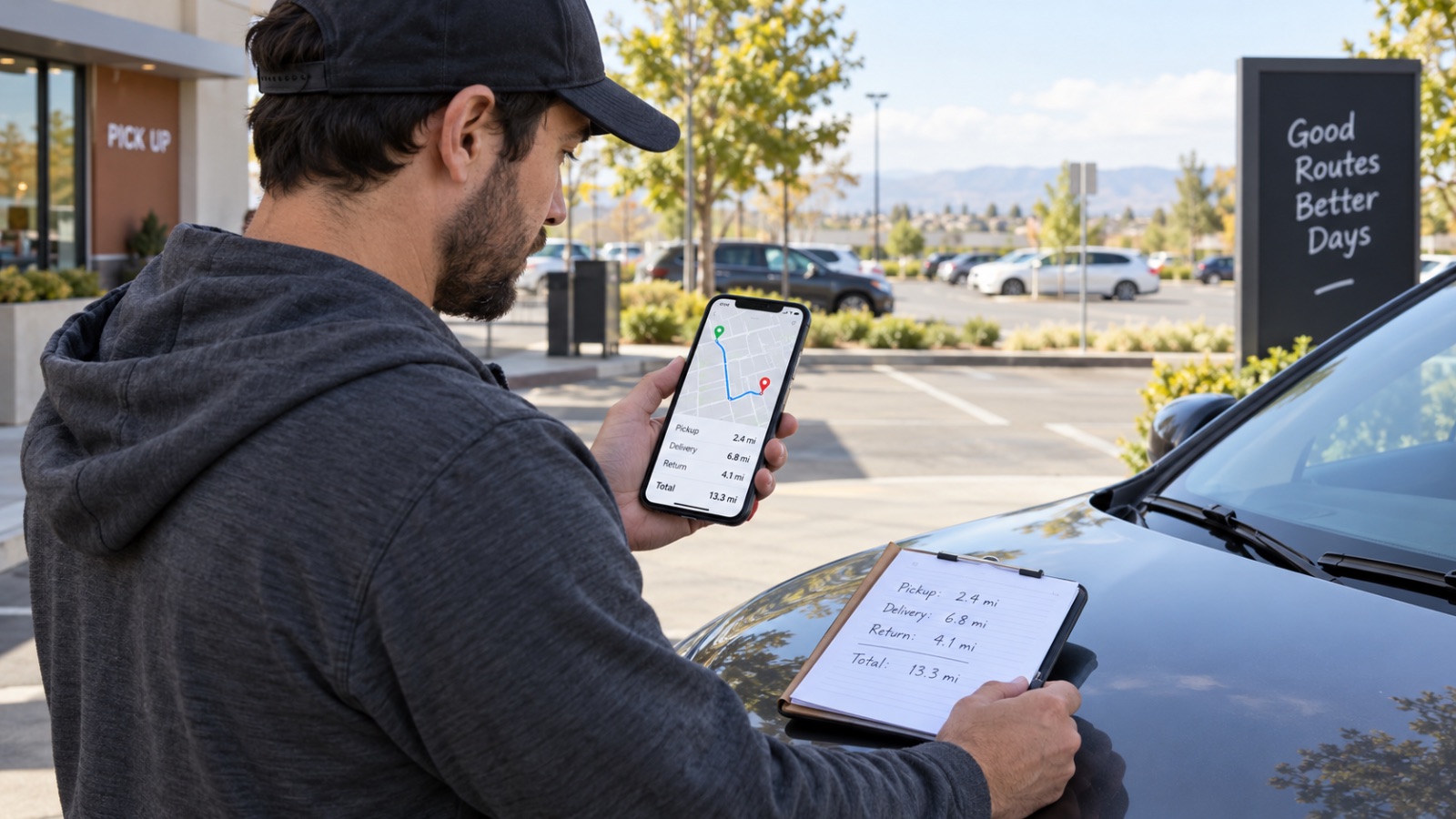
A delivery offer may show a payout and a mileage number.
At first glance, that number can make the decision feel simple.
If the miles seem low enough and the payout seems high enough, the offer may look good.
But the miles shown on the screen do not always tell the full story.
That is why one of the most useful skills a delivery driver can build is learning how to estimate the real miles of a delivery offer before accepting it.
What are the real miles of a delivery offer?
The real miles of a delivery offer are the miles you are likely to drive for the entire trip, not just the number that catches your eye on the offer screen.
That can include more than the obvious route from pickup to drop-off.
Depending on the situation, the real miles may involve:
- Driving from your current location to the pickup
- Driving from the pickup to the customer
- Extra route distance caused by road layout
- Multi-stop routing
- Driving back toward a useful area after drop-off
The displayed miles may not tell the whole story
Sometimes the mileage shown in an app is fairly close to the full working trip.
Other times it can leave out part of what really matters to your business decision.
That is why drivers should think in terms of total trip miles, not just offer-card miles.
Why do real miles matter so much?
Every mile affects your business.
More miles usually mean more:
- Fuel use
- Tire wear
- Maintenance
- Depreciation
- Future repairs
- Time spent driving
If you underestimate the true mileage of an offer, you can easily overestimate how profitable it will be.
A small mileage mistake can change the entire offer
An order that looks like 6 miles may seem fine.
But if the real trip turns into 11 or 12 miles once you include pickup distance and return positioning, the offer may no longer work the same way.
That difference matters.
Start with your distance to the pickup
One of the first things to check is how far you are from the pickup location.
Drivers sometimes focus only on the delivery portion of the route.
But the offer begins where you are, not where the store is.
Pickup miles are real working miles
Suppose an offer pays $11 and shows 5 miles.
That may seem reasonable.
But if you are 4 miles from the pickup, then the trip is already much bigger than it first appeared.
Before even reaching the customer, you may already be driving more than the simple offer number suggests.
Check the pickup-to-customer route
The core route still matters.
This is the part most drivers naturally notice first.
But even here, a quick estimate should go beyond the raw number.
Think about the actual road path
Not all miles are equal.
A route may look short on the map but still involve:
- Slow traffic
- Indirect roads
- Stoplights
- One-way streets
- Construction
- Rural roads
- Difficult turns
The road path matters, not just the straight-line impression.
Think about return miles after drop-off
Return miles are one of the most overlooked parts of delivery work.
A delivery may be complete in the app, but your business day may not be in a good position yet.
The trip may not truly end at the customer
If the drop-off leaves you far away from active stores or areas where you usually receive useful offers, you may need to drive back.
That return driving may not be paid.
It still costs you money.
It still uses time.
And it still uses your vehicle.
Ask where the order leaves you
A delivery ending near restaurants, grocery stores, or busy pickup zones may be much more valuable than a delivery ending in a dead area.
The payout may be the same.
The impact on your next offer may not be.
Location affects the next part of your shift
Imagine two offers that both pay $18.
One leaves you in an active area.
The other leaves you 9 miles outside your useful zone.
Those are not equal trips even if the shown offer miles look similar.
Look at the whole trip, not just the loaded part
Drivers sometimes think only in terms of the miles while carrying the order.
But your vehicle does not know whether it is carrying food, groceries, or nothing at all.
It is still accumulating mileage.
Unpaid miles still cost you
The route to the pickup costs you.
The drive back costs you.
The repositioning miles cost you.
If you ignore those miles, you can make weak offers look better than they really are.
Multi-stop offers need extra attention
Multi-stop routes can hide mileage more easily than single-order deliveries.
The total payout may look strong.
But several stops can increase the route quickly.
More stops can create more miles than expected
A multi-stop trip can add:
- Extra turns
- Longer route loops
- Additional drop-off distance
- More backtracking
- More neighborhood driving
Do not assume the total payout means the route is automatically efficient.
Shop-and-deliver orders can hide movement too
Shopping orders may also create extra movement that drivers do not think about right away.
You may spend time and motion inside the store before the driving even begins.
That is not vehicle mileage, but it does affect how much value you are getting from the route.
The driving may not be the only effort
A short driving distance does not always mean the offer is easy.
If the order includes shopping, substitutions, and checkout time, the mileage estimate still needs to be considered together with total time and effort.
Rural offers often create larger real miles
Rural or spread-out areas can make an offer look different from what it might look like in town.
The same payout that works in a dense area may not work in a spread-out area.
Distance between useful zones matters
A rural delivery may involve:
- Longer roads between stops
- Fewer nearby pickups after drop-off
- More return driving
- Less chance of getting stacked back-to-back orders
That can increase the real trip effect even when the offer itself does not look extreme.
City offers can hide mileage in another way
Urban offers may not have huge mileage, but the route can still be inefficient.
A city trip may involve short distance with difficult driving.
Short miles can still be expensive
City routes may mean:
- Heavy traffic
- Parking trouble
- One-way detours
- Complex apartment access
- Time-consuming drop-offs
Real miles matter, but so does how those miles behave in your market.
Use your own working area as a reference
Drivers usually know where their most productive zones are.
That knowledge can help estimate real route impact very quickly.
Ask whether the order stays inside your useful map
If the trip stays inside your normal working area, the displayed miles may be more manageable.
If it pulls you away from that area, you should think about what it takes to get back.
That simple mental check can improve offer decisions fast.
Watch for hidden repositioning miles
Sometimes a trip does not require a full drive back, but it still creates repositioning miles.
Maybe the drop-off leaves you just far enough from active pickups that you need to move again.
Repositioning is part of your delivery business
If you routinely need to drive 2, 3, or 5 miles after a delivery before your next useful offer appears, that pattern matters.
Those miles should not be ignored just because they do not belong to one specific order card.
Compare real miles with payout
Once you estimate the likely full route, you can compare it with the payout more honestly.
This is where some offers start to change.
A good-looking payout may shrink fast
Suppose an offer pays $14.
If you first think it is a 5-mile trip, that may seem attractive.
If the real working route is closer to 10 or 11 miles, the picture changes.
The payout did not move.
Your estimate got more accurate.
Compare real miles with time too
Miles alone are not enough.
You also need to think about how much time those miles are likely to use.
Time and mileage work together
A route may have moderate miles but take a long time.
Another may have more miles but move quickly.
That is why estimating real miles helps most when paired with estimated time.
Build a quick mental mileage check
You do not need a complicated system every time an offer appears.
A fast mental process can work well.
A simple mileage check can be:
Current location to pickup.
Pickup to customer.
Likely return or repositioning miles.
Then ask:
What is the probable total?
That simple habit can stop you from relying only on the number shown on the screen.
Learn from completed deliveries
One of the best ways to improve your estimates is to compare your expectations with what actually happened after the trip.
Your own results teach you the most
You may discover patterns such as:
- Certain stores usually require more approach miles than expected
- Certain drop-offs create return trips
- Certain neighborhoods leave you disconnected from the next order
- Certain routes look short but take longer loops than expected
The more you notice these patterns, the faster your offer judgment gets.
Keep notes on problem areas
Some locations repeatedly create the same mileage problem.
Tracking those patterns can make future decisions easier.
Small notes can improve future estimates
You might notice:
- This store often pulls me too far from the zone
- This part of town usually creates a dead return
- This route always leads to more miles than the screen suggests
That kind of practical memory is valuable.
Real miles help protect profit per mile
Drivers often use dollars per mile as a quick check.
That can be useful, but only if the miles are realistic.
Bad mileage assumptions create false confidence
If you think an order is paying well per mile because you are only using the displayed route, but your actual driving is much higher, then your dollars-per-mile judgment may be inflated.
Real miles make the calculation more honest.
Real miles also affect profit per hour
A longer total route usually means more time.
That can reduce your hourly result.
Extra miles often create extra time too
Even when traffic is light, more miles generally mean more minutes.
If the offer also includes a weak ending location or return drive, your true hourly result may fall more than expected.
Some offers are still worth taking with extra miles
The goal is not to reject every offer with added route impact.
It is to understand what the offer actually requires.
Accurate estimates lead to better decisions
A long route might still be worth it if:
- The payout is strong enough
- The destination stays productive
- The timing is good
- The route fits your current strategy
The point is not to fear mileage.
The point is to estimate it honestly.
A useful final question before accepting
Once you estimate the route, ask yourself:
What will I probably drive from where I am now until I am ready for my next worthwhile order?
That question is better than asking only what the app shows
The offer card gives part of the story.
Your job is to think through the rest.
That is how you move from surface-level offer checking to a more complete profit decision.
The bottom line
The real miles of a delivery offer usually involve more than the number shown on the screen.
To estimate the trip more accurately, think about:
- Your distance to the pickup
- The route from pickup to drop-off
- Multi-stop routing
- The ending location
- Return or repositioning miles
The better you estimate the true miles of the trip, the better you can judge whether the payout is worth your time, your fuel, and your vehicle.
That does not mean every route has to be perfect.
It means you should understand what the route is likely to cost before you accept it.
That is one of the clearest ways to protect your TRUE profit.
Related reading