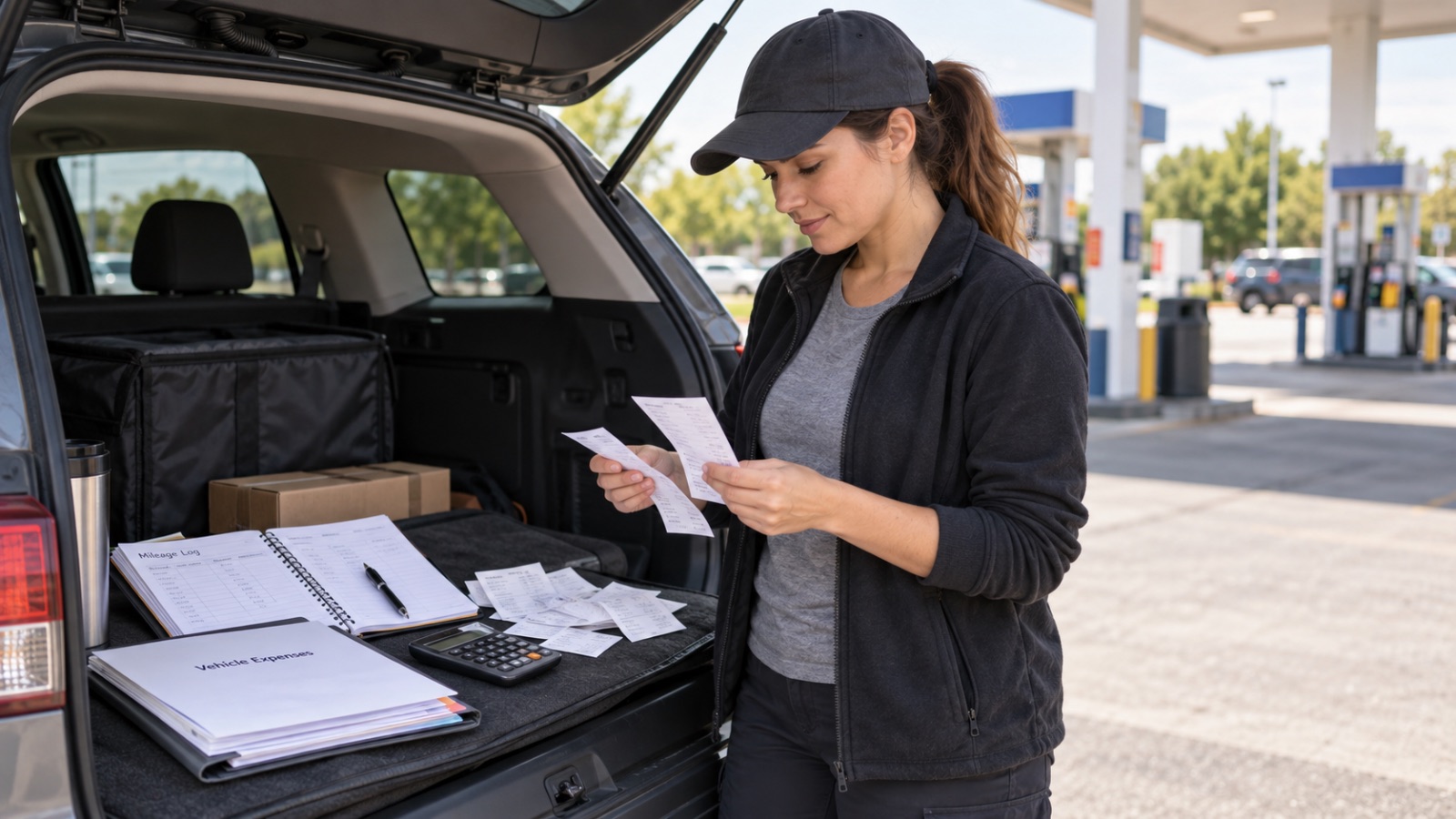
Gas is one of the most obvious costs of delivery driving.
Every trip to a pickup, every customer drop-off, and every unpaid mile back toward a busy area uses fuel.
So it makes sense that drivers often ask whether gas can be deducted on their taxes.
The answer depends on which vehicle-expense method you use.
Can delivery drivers deduct gas?
Possibly.
If you use the actual-expense method for your vehicle, the business-use portion of your gas expenses may generally be included as a deductible vehicle cost.
If you use the standard mileage method, gas is already built into the mileage rate.
That means you generally cannot use the standard mileage deduction and then deduct your gas receipts separately on top of it.
The deduction method matters
This is where many drivers get confused.
You generally choose between:
- Standard mileage
- Actual vehicle expenses
Both methods are designed to account for the cost of using your vehicle for business.
They simply calculate that cost differently.
What is the standard mileage method?
With the standard mileage method, you multiply your qualifying business miles by the IRS mileage rate for that year.
The rate is designed to account for many vehicle costs.
Those costs include fuel.
Gas is already included in the mileage rate
If you use the standard mileage method, you generally cannot also deduct:
- Gas
- Oil
- Insurance
- Repairs
- Maintenance
- Tires
- Depreciation
Those costs are already represented in the mileage rate.
Adding them again would generally mean deducting the same vehicle costs twice.
What is the actual-expense method?
The actual-expense method works differently.
Instead of using one mileage rate, you keep track of what you actually spend to own and operate the vehicle.
Eligible costs may include:
- Gas
- Oil
- Insurance
- Repairs
- Maintenance
- Tires
- Registration
- Licenses
- Depreciation
- Lease payments when applicable
You then determine what portion of those expenses relates to business use.
How much of your gas can be a business expense?
If your vehicle is used for both business and personal driving, you generally need to separate those uses.
You cannot automatically treat every gallon of fuel as a delivery expense.
Business-use percentage matters
Suppose you drive:
- 24,000 total miles during the year
- 16,000 qualified business miles
- 8,000 personal miles
Your business-use percentage would be about 66.7%.
Under the actual-expense method, that percentage may generally be applied to eligible vehicle costs such as fuel.
Accurate mileage records help support that calculation.
What counts as business driving for fuel purposes?
Fuel itself is not classified trip by trip on your tax return.
Instead, business use is generally determined by how much the vehicle is used for qualified business activity.
That makes your mileage records extremely important.
Business driving can include more than the paid delivery miles
Depending on the facts and applicable tax rules, business driving may include travel connected to performing your delivery work.
That may involve driving between business locations or traveling from one delivery-related location to another.
Not every mile you drive during the day is automatically a business mile.
Personal and commuting rules can still matter.
Can you deduct gas driving to your first pickup?
This can depend on the circumstances.
Not every trip from home to the first work location automatically qualifies as business mileage.
Some driving may be considered commuting.
The details can depend on your work pattern, business location, and individual situation.
Do not assume every mile is deductible
Delivery drivers often think that turning on an app automatically makes every mile business mileage.
Tax rules can be more complicated than that.
Keep accurate records and use current IRS guidance when deciding which miles qualify.
Can you deduct gas after the last delivery?
The same issue applies at the end of the day.
Driving home after your final delivery may be treated differently depending on your circumstances.
That is separate from the question of whether those miles still cost you money.
Tax mileage and TRUE cost are different questions
Even when a mile is not deductible for tax purposes, you still burned fuel.
You still added mileage to the vehicle.
You still spent time driving.
That mile can affect your TRUE profit even if its tax treatment is different.
Do delivery drivers need to save every gas receipt?
If you use the actual-expense method, keeping fuel receipts or other reliable payment records can be important.
You need documentation showing what you actually spent.
Digital records can help
Useful records may include:
- Fuel receipts
- Credit-card statements
- Bank records
- Fuel-app purchase history
- Mileage logs
- Odometer records
A folder full of faded paper receipts is not your only option.
The important thing is having reliable records.
What if you pay cash for gas?
Cash fuel purchases can still be business expenses when they qualify.
But cash can be harder to document.
Keep the receipt
If you pay cash, keep the receipt and record the purchase.
That helps show:
- Date
- Amount
- Fuel purchase
- Business connection
Without documentation, reconstructing those expenses later can be difficult.
What if you use different vehicles for delivery work?
Track each vehicle separately.
Gas costs, mileage, repairs, and business-use percentages can vary significantly between vehicles.
Do not combine everything into one total
If you switch between a car and an SUV, or between two cars, keep separate records.
For each vehicle, track:
- Business miles
- Total miles
- Fuel
- Insurance
- Repairs
- Maintenance
- Other expenses
That gives you a much cleaner picture of what each vehicle costs.
What if someone else pays for the gas?
Generally, you need to actually pay or incur the expense in order to deduct it.
If someone else pays for your fuel and you do not reimburse them, you may not be the person who incurred that expense.
Keep your business expenses connected to your records
If another person occasionally pays for fuel and you reimburse them, keep documentation.
Business records should clearly show who paid and how the expense relates to your delivery work.
Can you deduct premium gas?
If the vehicle requires premium fuel and you use the actual-expense method, qualifying fuel costs may generally be included like other gas expenses.
If you choose premium when the vehicle does not require it, that does not automatically make the extra cost more deductible.
Deductible does not mean smart
A more expensive business expense is still more money out of your pocket.
The fact that something may be deductible does not mean you should spend more than necessary.
That matters especially in delivery work, where small vehicle costs add up quickly.
Does gas still matter if you use the mileage method?
Absolutely.
This is one of the most important distinctions for delivery drivers.
For taxes, you may choose the standard mileage method.
For your own profitability, you still need to know what fuel actually costs you.
Fuel affects TRUE profit every day
Suppose two drivers earn the same $150 in a shift.
One spends $12 on fuel.
The other spends $28.
Their gross earnings are the same.
Their real profit is not.
Gas prices, fuel economy, mileage, traffic, and vehicle type all affect what you actually keep.
Fuel economy can change which offers are worth taking
A driver getting 40 miles per gallon has a very different fuel cost from a driver getting 18 miles per gallon.
That can change the economics of the exact same delivery offer.
The same payout can produce different profit
Imagine a $20 delivery requiring 30 miles of driving.
For one driver, fuel may be a relatively small cost.
For another driver in a less efficient vehicle, fuel may take a much larger piece of the payout.
That is why there is no universal answer to whether an offer is good based only on dollars per mile.
Your own vehicle matters.
Why return miles matter for fuel cost
The app may show the miles needed to complete the delivery.
But that does not always tell you how many miles you will actually drive before you are ready for another useful order.
Unpaid miles still burn gas
If a delivery takes you 10 miles away from where you want to work and you need to drive 8 miles back, those return miles still use fuel.
They still add vehicle wear.
And they still reduce your TRUE profit.
Ignoring them can make an order look better than it really was.
Should drivers choose the actual method because gas is expensive?
Not automatically.
High gas prices can make actual vehicle expenses larger, but that does not mean the actual-expense method will always produce a better tax result.
You have to compare the complete picture.
Compare the whole vehicle
The actual method may involve:
- Gas
- Insurance
- Repairs
- Maintenance
- Tires
- Registration
- Depreciation
- Other eligible vehicle costs
The standard mileage method uses one rate based on qualifying business miles.
Which method is better depends on your numbers and your situation.
Keep gas records even if you use mileage for taxes
This can still be valuable for business management.
Your fuel cost tells you something the mileage deduction does not:
What your vehicle is actually costing you right now.
Tax records and profit records serve different purposes
Tax records help determine allowable deductions.
Profit records help you decide whether delivery work is worth doing.
A driver should understand both.
You may use mileage for taxes while still tracking actual fuel spending for TRUE profit.
The bottom line
Delivery drivers may generally include the business-use portion of gas when using the actual-expense method.
If you use the standard mileage method, fuel is already included in the mileage rate and generally cannot be deducted separately.
Either way, gas still matters.
It affects your cash flow.
It affects which offers are worth taking.
It affects what vehicle makes sense for delivery work.
And it affects how much money you actually keep.
Tax deductions are important.
But knowing your real fuel cost is part of knowing your TRUE profit.
Related reading
Can Delivery Drivers Deduct Car Insurance?
Can Delivery Drivers Deduct Their Car Payment?
How to Track Mileage for Delivery Drivers
How Gas Prices Change Which Delivery Offers Are Worth Taking
Delivery Driver Profit Guide
This article is for general educational information and is not tax advice. Vehicle deduction rules and qualifying business mileage can depend on your circumstances and the method you use. Review current IRS guidance or speak with a qualified tax professional about your situation.