How to Track Mileage for Delivery Drivers
A practical guide to tracking delivery mileage, including pickup miles, delivery miles, return driving, repositioning, and personal trips.
By TRUE Driver Profit · September 12, 2026
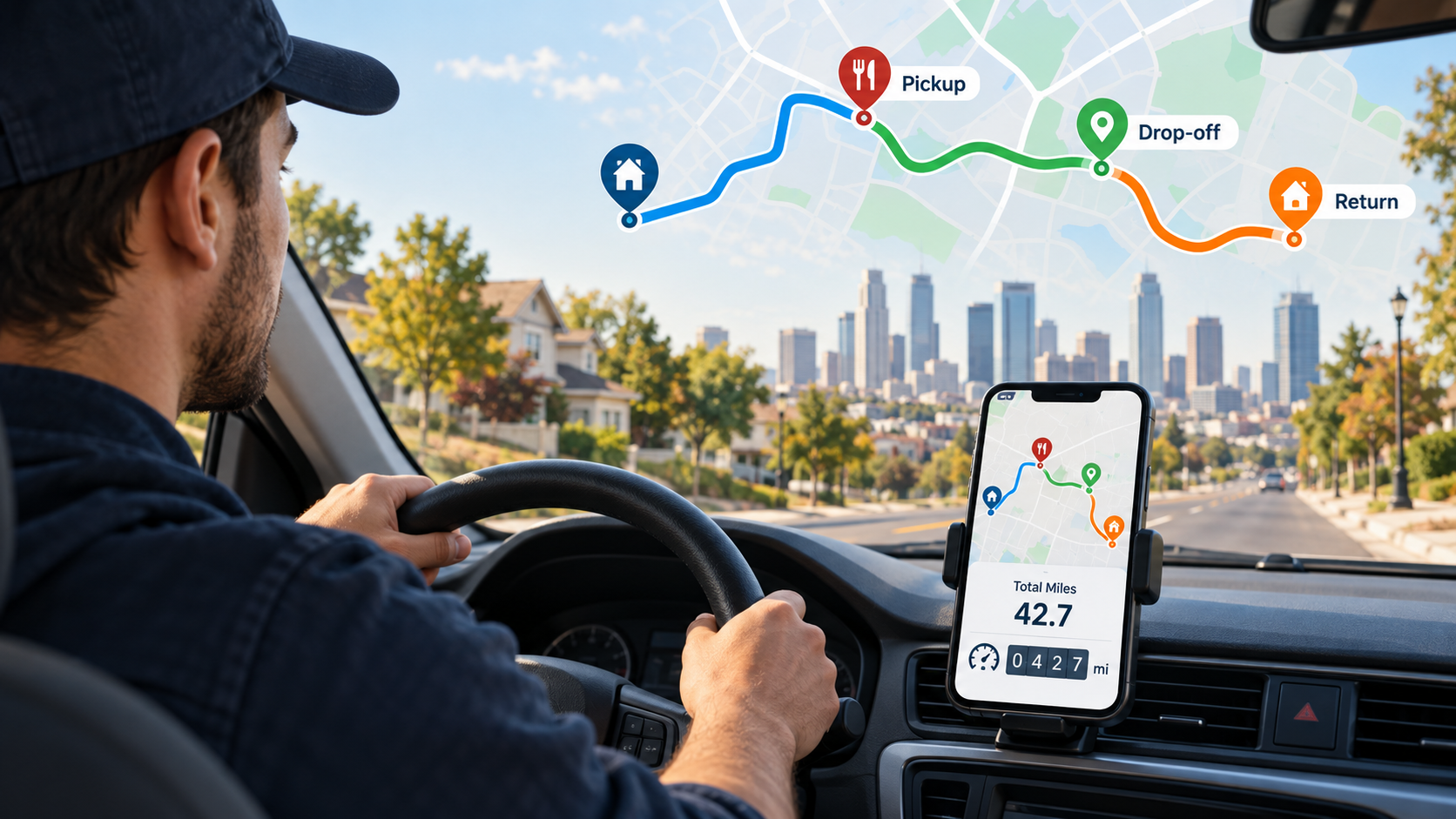
Delivery driving can put far more miles on your vehicle than the number shown on an offer screen. The trip may include driving to the pickup, completing the delivery, returning to your usual area, moving between stores, and searching for your next order. If you only record the mileage shown when you accept an offer, a large part of your actual driving can disappear from your records. Tracking every work mile gives you a clearer picture of what delivery work is really costing you. It can also make weekly reviews and tax preparation much easier.
Why Delivery Mileage Is Easy to Undercount
Most delivery offers show only part of the trip. The mileage displayed may begin at your current location and end at the customer, but it does not always represent everything you will drive because of that order.
The Offer May Not Include Your Return Trip
Imagine accepting an offer that shows six miles. After completing it, you discover that the drop-off is five miles outside your normal delivery area. The offer may have looked like a six-mile delivery, but returning to a useful location turns it into an eleven-mile decision. Those return miles still use fuel, consume your time, and add wear to your vehicle.
Small Movements Add Up
Moving across a parking lot, driving to another pickup location, circling an apartment complex, and repositioning after a delivery may not feel important individually. Over an entire week, those short drives can add a surprising number of miles. That is why mileage should be tracked across the whole work period instead of relying only on the distance attached to individual offers.
What Mileage Should a Delivery Driver Record?
For understanding your actual profit, record every mile driven because you were working. That can include: - Driving toward a pickup location - Driving from the pickup to the customer - Traveling between multiple stops - Returning from a distant drop-off - Repositioning to another delivery area - Driving between pickup locations - Looking for a safe place to park during a delivery Personal driving should be kept separate. If you stop working and use the vehicle for a personal errand, that portion should not be included in your work mileage. Tax rules can treat certain trips differently depending on the driver’s individual circumstances. Keep complete records and speak with a qualified tax professional when deciding what can be claimed on a tax return.
2026 IRS Mileage Rates for Delivery Drivers
The IRS business standard mileage rate changed in the middle of 2026. For eligible business miles driven from January 1 through June 30, 2026, the rate is 72.5 cents per mile. For eligible business miles driven on or after July 1, 2026, the rate is 76 cents per mile. The IRS announced the midyear increase in Announcement 2026-11.
For example, 1,000 eligible business miles at 72.5 cents per mile produce a $725 standard-mileage calculation. At 76 cents per mile, 1,000 eligible miles produce $760. This is a tax calculation under the standard mileage method; it is not pay from a delivery app, a reimbursement promise, or a measure of your vehicle’s actual cost per mile.
Keep tax mileage separate from TRUE Profit miles
For TRUE Profit, track all miles the vehicle uses to complete delivery work, including driving to a pickup, between stops, and return or repositioning miles. That gives you a more complete operating picture. Tax rules decide which miles qualify for a deduction, and the answer can depend on your work situation. Do not assume every mile driven during a shift is deductible; check the IRS rules for your circumstances or ask a qualified tax professional.
A mileage record should identify the date, destination or delivery area, business purpose, business miles, and beginning and ending odometer readings. Keep a record of total annual miles as well, so business and personal use can be distinguished. The IRS explains vehicle records and the standard-mileage and actual-expense methods in Publication 463 and Tax Topic 510.
If you use the standard mileage method for a vehicle, you generally cannot also deduct the same vehicle’s ordinary operating costs—such as gas, repairs, or insurance—as actual expenses for those same business miles. Eligibility and exceptions apply, so confirm the current IRS instructions before filing.
Three Practical Ways to Track Delivery Mileage
There is no single system that works perfectly for every driver. The best method is the one you can use consistently without forgetting entire shifts.
GPS Tracking
GPS tracking can record your route while you work. This reduces the need to remember every turn or write down the odometer after each delivery. It is convenient, but it still needs to be reviewed. Weak signals, battery settings, lost permissions, and accidentally paused tracking can create missing miles. Check your recorded mileage before ending the workday so problems can be corrected while the route is still fresh in your mind.
Odometer Readings
A simple method is to record your odometer when work begins and again when work ends. If you drive 42,118 miles at the beginning of a shift and finish at 42,186, the vehicle traveled 68 miles during that period. Personal miles taken during the shift would need to be removed from the work total. Odometer readings provide a useful backup when GPS tracking fails.
Manual Mileage Entries
Manual tracking can work when a driver records mileage immediately and consistently. The problem begins when several days pass and the driver tries to rebuild each route from memory. If you enter mileage manually, include enough detail to recognize the work later: - Date - Starting and ending mileage - Total work miles - General business purpose - Notes about personal stops or unusual routes A basic record made today is usually more reliable than a detailed guess made months later.
When Should Mileage Tracking Begin and End?
For profit tracking, begin when you start driving for delivery work and stop when the work-related driving is finished. That does not always mean your first accepted order through your final customer. You might drive toward a pickup area before receiving an offer, return from a distant delivery, or move to another location while waiting for work. Those miles affect your real operating cost even when no active order is attached to them. Suppose your shift looks like this: - 4 miles to the pickup area - 28 miles completing deliveries - 7 miles repositioning between orders - 9 miles returning after the final drop-off The delivery offers may account for only 28 miles, but the workday placed 48 miles on the vehicle. Leaving the other 20 miles out would make the day appear more profitable than it really was.
Common Mileage-Tracking Mistakes
Mileage records become less useful when they capture only the easiest miles to remember.
Depending Entirely on Delivery-App Estimates
An estimated distance helps evaluate an offer, but it is not a complete record of what your vehicle actually traveled. Detours, parking, missed turns, road closures, and return driving can all change the final mileage.
Forgetting Unpaid Driving
Miles without an active order can still be part of the cost of working. Returning to your preferred area and moving between pickup locations do not produce a payout, but they still cost money.
Mixing Personal and Work Mileage
Combining every mile driven during the day can overstate work mileage. Clearly mark personal errands so they can be separated from delivery activity.
Waiting Until Tax Season
Trying to remember months of delivery routes is difficult. App histories may help, but they may not include all the driving that occurred before, between, and after orders. Reviewing mileage at the end of every shift is much easier than rebuilding an entire year.
Mileage Records Are Useful Beyond Taxes
Many drivers think about mileage only when preparing taxes. However, mileage is also one of the most important numbers for understanding delivery profit. Your mileage can help you estimate: - Fuel used during a shift - Vehicle cost per delivery - Profit per mile - The effect of return driving - Which delivery areas create excessive unpaid mileage - Whether higher-paying offers are actually producing better results Two shifts with the same earnings can produce very different profit if one requires substantially more driving. Accurate mileage records allow you to compare those shifts honestly.
Build a Routine You Can Maintain
A complicated system that you stop using will not help. Choose a routine that takes only a few moments at the beginning and end of each workday.
Before Driving
1. Start GPS tracking or record your odometer. 2. Confirm that location permissions are working. 3. Note where the work period begins.
After Driving
1. Confirm that tracking stopped correctly. 2. Record the ending odometer if needed. 3. Remove any personal mileage. 4. Review the total before the route is forgotten. Consistency matters more than having a perfect system. A dependable routine creates better records and gives you a more accurate view of what your delivery work is producing.
The Bottom Line
Delivery mileage is more than the distance between a pickup and a customer.
The whole workday can include approach miles, delivery miles, return driving, repositioning, and trips between pickup locations. Every one of those miles affects fuel use, vehicle wear, time, and profit.
Track the complete workday, separate personal driving, and review the total while the route is still fresh. Better mileage records lead to better profit decisions and fewer surprises later.