What Should Delivery Drivers Track After Every Order?
Tracking payout, miles, time, fuel, vehicle costs, and delivery notes can help you understand what each order really produced and spot patterns over time.
By TRUE Driver Profit · September 10, 2026
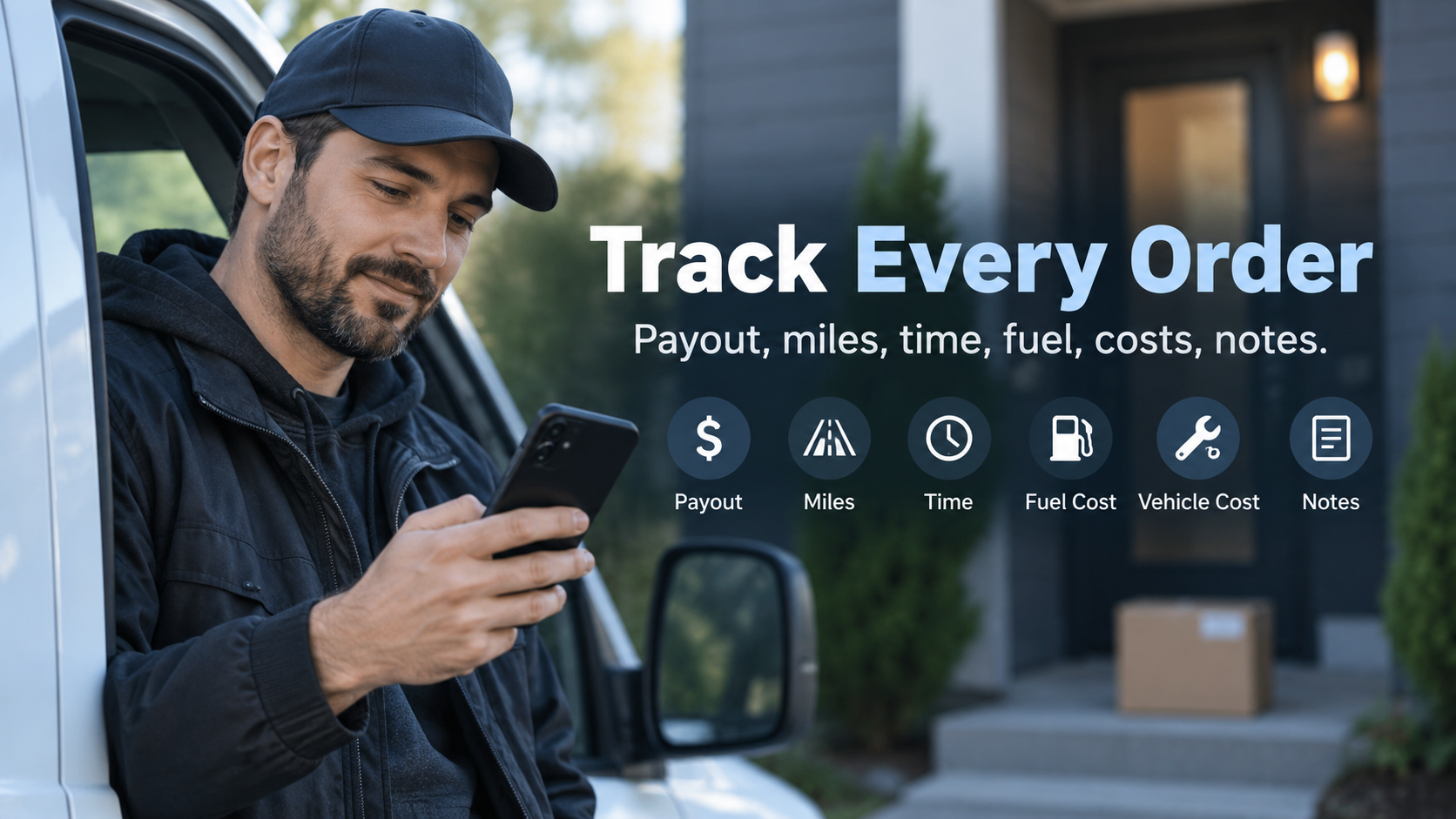
What Should Delivery Drivers Track After Every Order?
Finishing a delivery is not the end of the useful information.
A completed order leaves behind numbers that can help you understand whether the delivery was actually worth your time and your vehicle.
You do not need to record every tiny detail.
But tracking a few important things consistently can help you see patterns that are easy to miss when you only look at gross earnings.
That usually includes:
Base pay
Tip
Any incentive connected to that delivery
This gives you the starting point for understanding the order.
The payout tells you what came in.
The rest of the numbers help explain what it cost to earn it.
That can include:
Driving to pickup
Driving to the customer
Return miles
Repositioning after the order
If you only record the delivery miles and ignore the extra driving around the order, your cost picture can look better than it really was.
Your vehicle keeps counting miles whether an order is active or not.
Record or review how long the delivery actually took.
That can include:
Driving to pickup
Waiting at pickup
Loading or receiving the order
Driving to the customer
Completing the drop-off
Returning or repositioning afterward
An order that looked like 25 minutes may have taken 45.
That difference matters.
Pickup wait time deserves attention
Waiting is easy to forget once the order is over.
But repeated wait time can have a major effect on profit per hour.
If one pickup regularly takes 15 or 20 minutes longer than expected, that is useful information.
One delay may be random.
A pattern can help you make better decisions later.
Fuel cost matters
Every mile uses fuel.
Your actual fuel cost depends on:
Your vehicle's MPG
The price you are paying for gas
The total miles connected to your work
You do not need to manually calculate fuel after every delivery if your app is already doing it.
The important part is making sure your fuel settings are current.
Outdated gas prices or MPG can make your estimates less useful.
Vehicle cost matters too
Fuel is not the only cost of driving.
Every delivery also contributes to:
Tires
Brakes
Oil changes
Maintenance
Repairs
Depreciation
These costs often happen later.
The wear happens while you are driving.
Tracking vehicle cost helps you avoid treating all of the payout as profit.
Track notes that could matter next time
Some delivery details are worth remembering.
A private note can help you remember things such as:
Difficult parking
Long walk
Apartment access problem
Loose dog
Bumpy road or driveway
Narrow access
GPS problem
Long wait
These notes can be useful when you see the same location again.
The goal is not to judge the customer.
The goal is to remember what the delivery actually required.
You complete the order and drive back toward your normal pickup area.
By the time the next offer arrives, those miles may no longer feel connected to the previous delivery.
But they still used fuel, time, and vehicle life.
If the delivery caused that return trip, those miles are part of the bigger picture.
Profit per mile helps compare orders
Once payout and costs are considered, profit per mile can help you compare different deliveries.
An order with a high payout may still produce weak profit per mile if it requires a lot of driving.
Another order with a smaller payout may use far fewer miles and leave more profit behind per mile.
This does not mean profit per mile should make every decision.
It is one useful part of the picture.
Profit per hour shows what your time produced
Profit per hour helps you understand whether the order used your time well.
Two orders may create the same profit.
One takes 25 minutes.
The other takes 55.
The longer order ties up more of your day.
That difference matters when you are trying to understand which kinds of deliveries work best for you.
A missed note or imperfect time estimate does not ruin anything.
Consistency matters more.
Over time, you may start to notice:
Certain pickups are consistently faster
Certain areas create more return miles
Certain hours produce stronger profit
Some order types take longer than expected
Some delivery locations regularly create extra work
Those patterns can help you make better decisions later.
A single order tells a small story
One order can tell you whether that delivery was profitable.
A week of orders tells you much more.
It can show:
Which hours worked best
Which areas created too many dead miles
Which pickups caused the longest waits
Which days produced the strongest profit
How much your vehicle was actually used
That is where tracking becomes especially useful.
Gross earnings are not enough
A payout total can tell you how much money came in.
It cannot tell you:
How far you drove
How long you worked
How much fuel you used
How much vehicle wear was created
How much of the payout was actually left
That is why tracking a few extra numbers can make such a big difference.
The goal is not to spend several minutes documenting every order.
The best system is one you can use quickly and consistently.
A few useful numbers recorded after each delivery are better than a complicated system you eventually stop using.
What should you track?
At a minimum, consider keeping track of:
Payout and tip
Total miles
Return miles when applicable
Total time
Pickup wait time
Fuel cost
Vehicle cost
TRUE profit
Profit per mile
Profit per hour
Useful private delivery notes
Together, those numbers give you a much clearer picture of what the order really produced.
TRUE Driver Profit helps keep the record together
TRUE Driver Profit is designed to help drivers keep important delivery information in one place.
Instead of remembering everything later, you can build a record of your:
Orders
Mileage
Time
Fuel cost
Vehicle cost
TRUE profit
Profit per mile
Profit per hour
Delivery notes
That makes it easier to review what happened after the day is over.
The goal is not to collect data just for the sake of collecting it.
The goal is to learn from your own driving.
Because the more clearly you understand what each order required, the easier it becomes to recognize the ones that actually work for you.
Finishing a delivery is not the end of the useful information.
A completed order leaves behind numbers that can help you understand whether the delivery was actually worth your time and your vehicle.
You do not need to record every tiny detail.
But tracking a few important things consistently can help you see patterns that are easy to miss when you only look at gross earnings.
Start with payout and tip
The first thing to record is what the order actually paid.That usually includes:
Base pay
Tip
Any incentive connected to that delivery
This gives you the starting point for understanding the order.
The payout tells you what came in.
The rest of the numbers help explain what it cost to earn it.
Track the miles
Mileage is one of the most important pieces of the picture.That can include:
Driving to pickup
Driving to the customer
Return miles
Repositioning after the order
If you only record the delivery miles and ignore the extra driving around the order, your cost picture can look better than it really was.
Your vehicle keeps counting miles whether an order is active or not.
Track the time
Time can change the value of an order just as quickly as mileage.Record or review how long the delivery actually took.
That can include:
Driving to pickup
Waiting at pickup
Loading or receiving the order
Driving to the customer
Completing the drop-off
Returning or repositioning afterward
An order that looked like 25 minutes may have taken 45.
That difference matters.
Pickup wait time deserves attention
Waiting is easy to forget once the order is over.
But repeated wait time can have a major effect on profit per hour.
If one pickup regularly takes 15 or 20 minutes longer than expected, that is useful information.
One delay may be random.
A pattern can help you make better decisions later.
Fuel cost matters
Every mile uses fuel.
Your actual fuel cost depends on:
Your vehicle's MPG
The price you are paying for gas
The total miles connected to your work
You do not need to manually calculate fuel after every delivery if your app is already doing it.
The important part is making sure your fuel settings are current.
Outdated gas prices or MPG can make your estimates less useful.
Vehicle cost matters too
Fuel is not the only cost of driving.
Every delivery also contributes to:
Tires
Brakes
Oil changes
Maintenance
Repairs
Depreciation
These costs often happen later.
The wear happens while you are driving.
Tracking vehicle cost helps you avoid treating all of the payout as profit.
Track notes that could matter next time
Some delivery details are worth remembering.
A private note can help you remember things such as:
Difficult parking
Long walk
Apartment access problem
Loose dog
Bumpy road or driveway
Narrow access
GPS problem
Long wait
These notes can be useful when you see the same location again.
The goal is not to judge the customer.
The goal is to remember what the delivery actually required.
Return miles deserve their own attention
Return miles can be one of the easiest things to forget.You complete the order and drive back toward your normal pickup area.
By the time the next offer arrives, those miles may no longer feel connected to the previous delivery.
But they still used fuel, time, and vehicle life.
If the delivery caused that return trip, those miles are part of the bigger picture.
Profit per mile helps compare orders
Once payout and costs are considered, profit per mile can help you compare different deliveries.
An order with a high payout may still produce weak profit per mile if it requires a lot of driving.
Another order with a smaller payout may use far fewer miles and leave more profit behind per mile.
This does not mean profit per mile should make every decision.
It is one useful part of the picture.
Profit per hour shows what your time produced
Profit per hour helps you understand whether the order used your time well.
Two orders may create the same profit.
One takes 25 minutes.
The other takes 55.
The longer order ties up more of your day.
That difference matters when you are trying to understand which kinds of deliveries work best for you.
Look for patterns, not perfection
You do not need perfect data after every order.A missed note or imperfect time estimate does not ruin anything.
Consistency matters more.
Over time, you may start to notice:
Certain pickups are consistently faster
Certain areas create more return miles
Certain hours produce stronger profit
Some order types take longer than expected
Some delivery locations regularly create extra work
Those patterns can help you make better decisions later.
A single order tells a small story
One order can tell you whether that delivery was profitable.
A week of orders tells you much more.
It can show:
Which hours worked best
Which areas created too many dead miles
Which pickups caused the longest waits
Which days produced the strongest profit
How much your vehicle was actually used
That is where tracking becomes especially useful.
Gross earnings are not enough
A payout total can tell you how much money came in.
It cannot tell you:
How far you drove
How long you worked
How much fuel you used
How much vehicle wear was created
How much of the payout was actually left
That is why tracking a few extra numbers can make such a big difference.
Keep the process simple
Tracking should not become another job.The goal is not to spend several minutes documenting every order.
The best system is one you can use quickly and consistently.
A few useful numbers recorded after each delivery are better than a complicated system you eventually stop using.
What should you track?
At a minimum, consider keeping track of:
Payout and tip
Total miles
Return miles when applicable
Total time
Pickup wait time
Fuel cost
Vehicle cost
TRUE profit
Profit per mile
Profit per hour
Useful private delivery notes
Together, those numbers give you a much clearer picture of what the order really produced.
TRUE Driver Profit helps keep the record together
TRUE Driver Profit is designed to help drivers keep important delivery information in one place.
Instead of remembering everything later, you can build a record of your:
Orders
Mileage
Time
Fuel cost
Vehicle cost
TRUE profit
Profit per mile
Profit per hour
Delivery notes
That makes it easier to review what happened after the day is over.
The goal is not to collect data just for the sake of collecting it.
The goal is to learn from your own driving.
Because the more clearly you understand what each order required, the easier it becomes to recognize the ones that actually work for you.