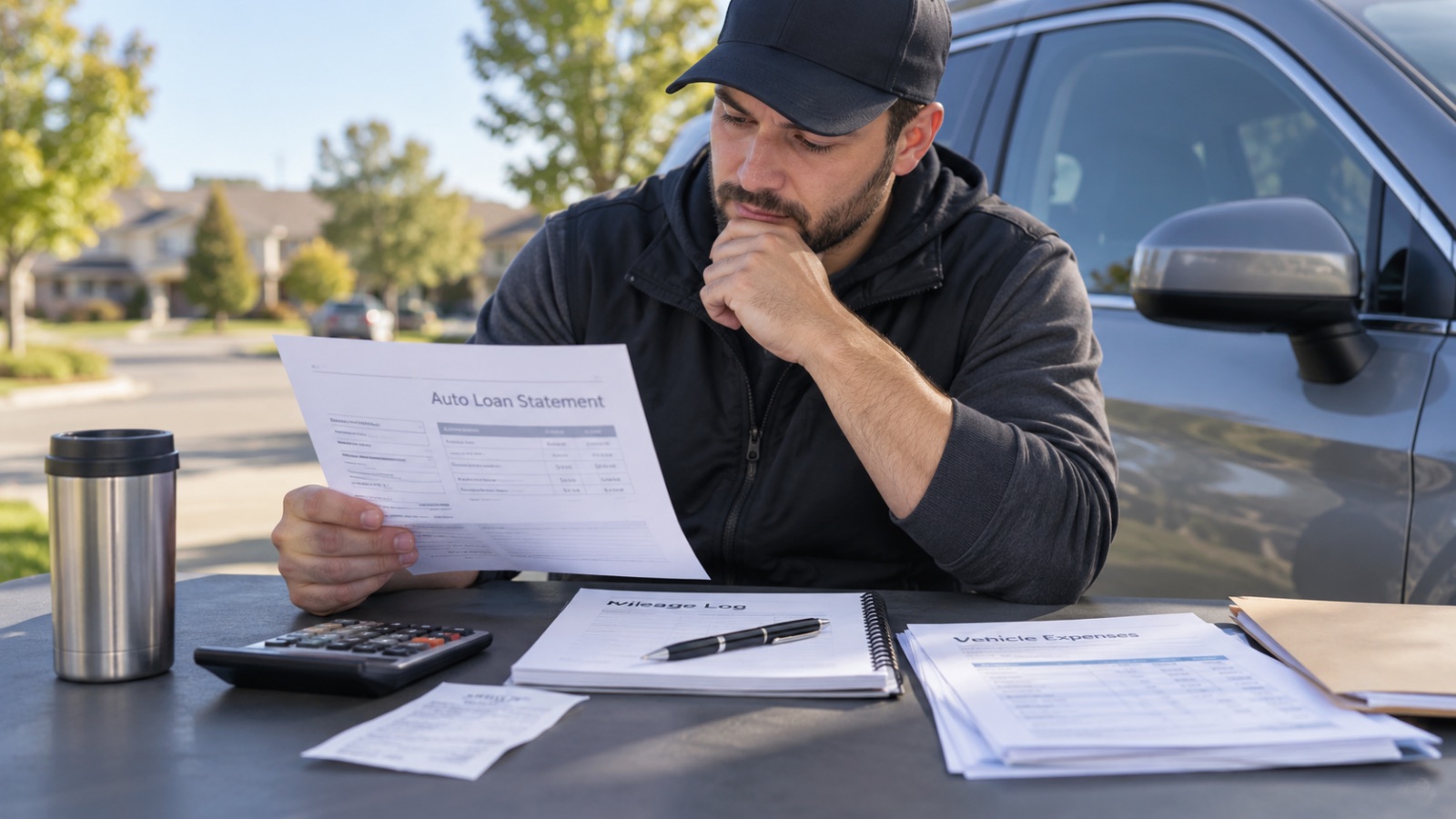
Delivery drivers put a lot of miles on their vehicles, so it is natural to wonder whether the monthly car payment can be treated as a business expense.
The answer is not as simple as deducting the entire payment.
If you finance a vehicle, your monthly payment can include both principal and interest. Tax rules generally treat those parts differently.
Understanding the difference can help you avoid overstating your expenses while still keeping track of the vehicle costs that really matter.
Can delivery drivers deduct their entire car payment?
Generally, no.
A delivery driver usually cannot take the entire monthly payment on a financed vehicle and deduct it as a business expense.
A car payment is normally made up of different parts.
Part of the payment reduces the amount you borrowed.
Another part may be interest charged by the lender.
Those two pieces are treated differently for tax purposes.
The principal part of the payment is not usually a direct expense
When you make a payment toward the amount you borrowed to purchase the vehicle, you are building ownership in the vehicle.
That principal payment is not generally treated the same way as paying for fuel, repairs, or another ordinary operating expense.
Instead, the cost of a vehicle used for business may be recovered through depreciation when using the actual-expense method, subject to applicable tax rules and limits.
Can delivery drivers deduct car loan interest?
Self-employed drivers may be able to deduct the business-use portion of interest paid on a car loan.
For example, if a vehicle is used partly for delivery work and partly for personal driving, only the business portion of the interest would generally be considered for the business deduction.
Business use matters
Suppose your vehicle is used 70% for business and 30% for personal driving.
The business portion of eligible vehicle expenses may generally be limited to that 70% business use.
That is one reason accurate mileage records matter.
You need a reasonable way to distinguish business driving from personal driving.
What about depreciation?
If you use the actual-expense method, depreciation may allow you to recover part of the cost of the vehicle over time.
Depreciation is different from deducting the car payment itself.
You are not simply adding up your monthly payments and calling that the deduction.
Instead, tax rules determine how much of the vehicle's business-use cost may be depreciated.
Vehicle depreciation has special rules
Vehicles can be subject to depreciation limits and other restrictions.
The amount you can deduct may depend on factors such as:
- When the vehicle was placed in service
- The cost of the vehicle
- Business-use percentage
- Vehicle type
- Depreciation method
- Other tax elections
That is one reason vehicle deductions can become more complicated than they first appear.
What is the standard mileage method?
Instead of tracking and deducting many individual vehicle expenses, eligible self-employed drivers may choose to use the IRS standard mileage rate.
Under this method, you multiply your qualifying business miles by the applicable mileage rate for the year.
The mileage rate is designed to account for the cost of operating the vehicle, including depreciation.
You cannot deduct everything twice
If you use the standard mileage method, you generally cannot also deduct the same vehicle costs separately.
For example, you do not normally use the standard mileage deduction and then add depreciation on top of it.
The mileage rate already includes an allowance for depreciation and other vehicle costs.
Self-employed drivers may still have separate rules for certain expenses such as qualifying business parking, tolls, and the business portion of eligible car-loan interest. ([IRS](https://www.irs.gov/publications/p463?utm_source=chatgpt.com))
What is the actual-expense method?
With the actual-expense method, you track the costs of owning and operating the vehicle and deduct the business-use portion of eligible expenses.
Possible actual vehicle expenses can include:
- Gas
- Oil
- Repairs
- Tires
- Insurance
- Registration fees
- Licenses
- Depreciation
- Certain garage expenses
- Lease payments when applicable
You then separate the business portion from personal use.
Actual expenses require stronger recordkeeping
If the vehicle is used for both personal and delivery driving, you need records showing how much of the vehicle use was business-related.
Mileage is often used to calculate that percentage.
For example, if you drove 20,000 total miles during the year and 12,000 were qualified business miles, the business-use percentage would be 60%.
That percentage may then apply to eligible vehicle expenses under the actual-expense method.
Standard mileage or actual expenses: which is better?
There is no single answer that works for every delivery driver.
The better method depends on your vehicle, mileage, expenses, and tax situation.
A driver who puts a very large number of business miles on an inexpensive, fuel-efficient vehicle may find the standard mileage method attractive.
A driver with unusually high actual vehicle costs may want to compare the actual-expense method.
Run the numbers instead of guessing
Do not assume one method is automatically better.
Track enough information to understand both possibilities.
That includes:
- Business miles
- Total vehicle miles
- Fuel
- Maintenance
- Repairs
- Insurance
- Registration
- Tires
- Loan interest
- Vehicle purchase information
Better records give you more information when it is time to make a tax decision.
What if the vehicle is leased?
Leased vehicles are handled differently from financed vehicles.
If you use the actual-expense method, the business-use portion of lease payments may generally be included as an expense, subject to applicable rules.
If you use the standard mileage method for a leased vehicle, you generally cannot also deduct lease payments separately.
The IRS also requires drivers choosing the standard mileage method for a leased vehicle to generally continue using that method for the entire lease period, including renewals. ([IRS](https://www.irs.gov/faqs/small-business-self-employed-other-business/income-expenses?utm_source=chatgpt.com))
A lease payment and a financed payment are not the same
This difference is important.
A lease payment is generally paying for the use of the vehicle.
A financed payment is partly paying down ownership of the vehicle.
That is one reason the tax treatment is different.
What if you use the vehicle personally too?
Most delivery drivers use the same car for both business and personal driving.
That is completely normal.
But it means you need to separate those uses when calculating certain deductions.
Personal driving is not a business expense
Driving to the grocery store, visiting family, taking a vacation, or other personal trips generally do not become business miles just because you also use the vehicle for delivery work.
Keep your business mileage records separate.
That helps support your business-use percentage and gives you a better picture of what your delivery work is actually costing you.
Why accurate mileage records matter so much
Mileage affects much more than just the standard mileage deduction.
It can also help establish how much of your vehicle use is business-related when you use actual expenses.
Without good mileage records, it can be much harder to separate business costs from personal costs.
Track mileage throughout the year
Trying to recreate an entire year of business driving at tax time is difficult.
A better approach is to track mileage as you work.
Keep records of:
- Business miles
- Personal miles when needed for allocation
- Dates
- Business purpose
- Beginning and ending mileage when appropriate
Consistent records are much easier to work with than estimates made months later.
Does paying more for a vehicle mean a bigger deduction?
Not necessarily.
Buying a more expensive vehicle just to create a larger tax deduction usually does not make the vehicle free.
You are still spending real money.
A tax deduction generally reduces taxable income. It does not normally reimburse you dollar for dollar for the cost of the vehicle.
A deduction does not erase the expense
Suppose you spend an extra $5,000 on a vehicle because you believe you can deduct it.
You still had to spend that $5,000.
The business decision should make sense before considering the tax deduction.
For delivery work, keeping vehicle costs under control can be just as important as finding deductions.
Car payment versus TRUE vehicle cost
Your monthly car payment is only one part of what the vehicle costs you.
A delivery vehicle can also create costs from:
- Fuel
- Maintenance
- Tires
- Repairs
- Insurance
- Registration
- Depreciation
- Financing interest
- Cleaning
- Increased wear from high mileage
That means a low monthly payment does not automatically mean the vehicle is cheap to use for delivery work.
Look beyond the payment
A vehicle with a $350 monthly payment might still be expensive if it uses a lot of fuel, needs frequent repairs, or loses value quickly because of high mileage.
Another vehicle with a larger payment may have lower operating costs.
The monthly payment by itself does not tell you which vehicle is better for delivery work.
Can you deduct a car payment if the car is only used for delivery work?
Even when a vehicle is used entirely for business, the full financed payment is generally not treated as a simple monthly operating deduction.
The same distinction between principal, interest, and depreciation still matters.
Business use affects how much of eligible expenses can be considered business-related.
It does not turn the entire loan payment into an ordinary expense.
Keep purchase and loan records
If you finance a vehicle used for delivery work, keep records such as:
- Purchase agreement
- Loan documents
- Interest statements
- Vehicle cost
- Date placed in service
- Mileage records
- Business-use percentage
Those records can become important when calculating depreciation and other vehicle deductions.
Do not confuse tax deductions with real profit
Tax deductions can lower taxable income.
They do not change what you actually paid to operate the vehicle.
That distinction matters for delivery drivers.
You can have a legitimate tax deduction and still have a vehicle that is too expensive for the amount you earn.
Profitability and taxes answer different questions
Taxes ask what expenses and deductions are allowed under tax rules.
Profitability asks whether the work is actually worth doing after your real costs.
Both matter.
But they are not the same calculation.
That is why delivery drivers should track both their tax records and their real operating costs.
The bottom line
Delivery drivers generally cannot simply deduct their entire financed car payment.
The principal portion is tied to the cost of acquiring the vehicle, while the business-use portion of eligible loan interest may be deductible.
If you use the actual-expense method, depreciation and other eligible vehicle expenses may apply.
If you use the standard mileage method, many vehicle costs are already reflected in the mileage rate.
The best approach is to keep accurate mileage and vehicle records throughout the year and compare the options that actually apply to your situation.
Your vehicle is one of the biggest costs in delivery work.
Understanding what it really costs you matters for both taxes and TRUE profit.
Related reading
How to Track Mileage for Delivery Drivers
Fixed Costs vs. Variable Costs for Delivery Drivers
How Vehicle Wear Quietly Cuts Into Delivery Profit
How Much Do Delivery Drivers Actually Make After Expenses?
Delivery Driver Profit Guide
This article is for general educational information and is not tax advice. Vehicle deduction rules can depend on business use, ownership, lease terms, depreciation, tax elections, and individual circumstances. Review current IRS guidance or speak with a qualified tax professional about your specific situation.