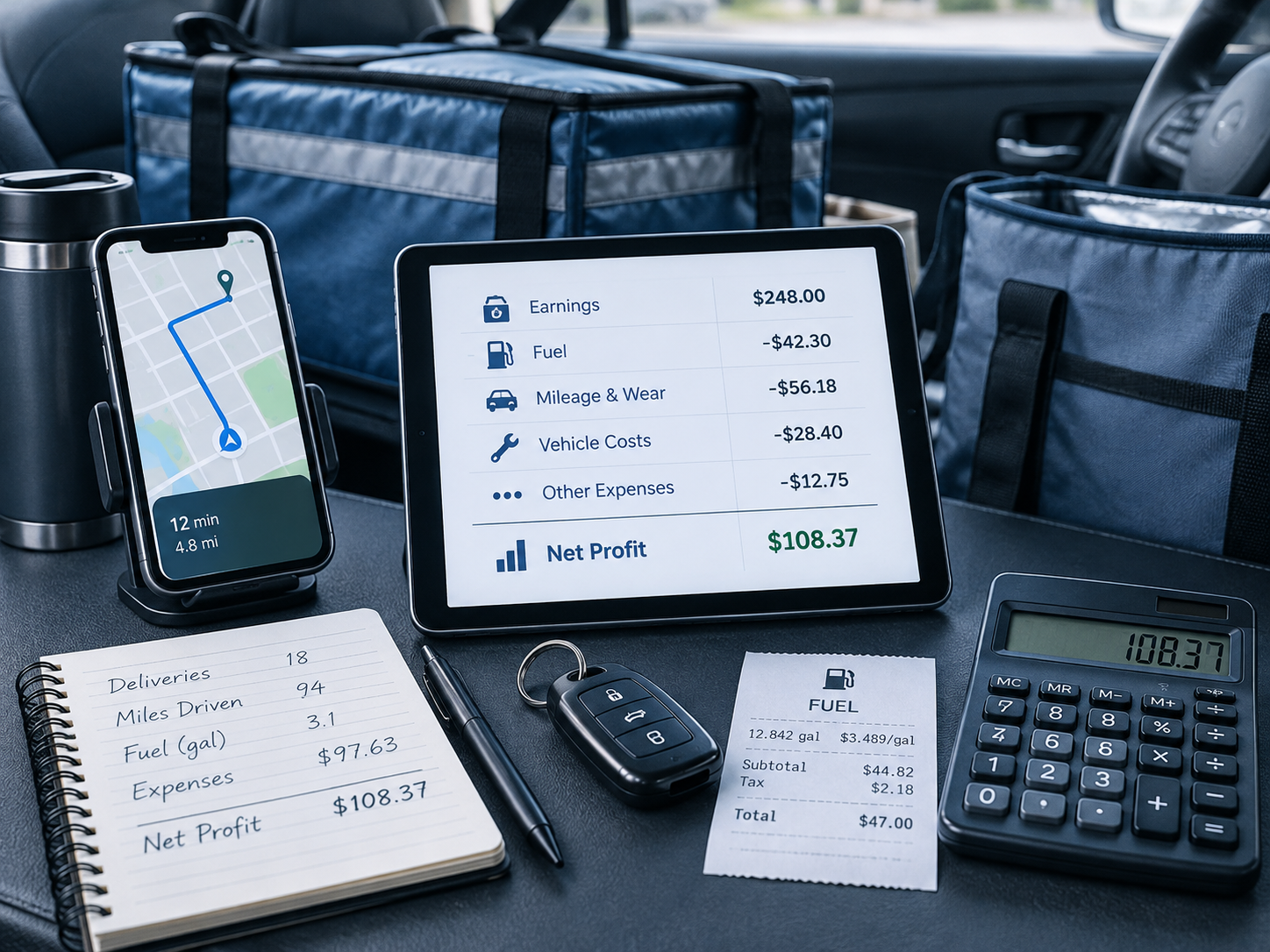
A delivery app may tell you that you earned $150, $200, or even more during a shift.
But that number is not the same thing as profit.
Delivery drivers use their own vehicles, fuel, time, tires, maintenance, and other resources to produce those earnings.
That means the better question is not simply:
How much did I make?
It is:
How much did I actually keep after the cost of doing the work?
Gross earnings are only the starting point
Gross earnings are the total amount you received before subtracting business costs.
That can include:
- Base pay
- Tips
- Incentives
- Bonuses
- Other delivery income
Gross earnings are useful.
But they only tell you how much money came in.
They do not tell you what it cost to earn it.
A $200 day does not automatically mean $200 of profit
Imagine a driver finishes a long shift with $200 in gross earnings.
During that shift, the driver used fuel, added mileage to the vehicle, spent hours waiting and driving, and put wear on tires, brakes, oil, and other components.
The $200 is real income.
But it is not all money the driver gets to keep.
Fuel is only one part of the cost
Fuel is the expense drivers notice most often because it is easy to see.
You fill the tank.
You see the price.
You know the money left your account.
But fuel is not the only vehicle expense connected to delivery work.
Every mile creates more than a fuel cost
Driving also contributes to:
- Tire wear
- Oil changes
- Brake wear
- Maintenance
- Repairs
- Depreciation
- Other vehicle-related costs
A delivery can be cheap on fuel and still be expensive overall if it adds a lot of miles.
Vehicle wear matters because delivery driving is high-mileage work
Delivery drivers can add miles much faster than many normal commuters.
A regular commute may involve driving to work and back once each day.
Delivery work can involve repeated trips all day long.
Pickup.
Drop-off.
Return.
Reposition.
Another pickup.
Another drop-off.
Those miles accumulate quickly.
Small per-mile costs become large over time
A few cents of additional vehicle cost per mile may not sound like much.
But multiply that by thousands of business miles.
The total becomes significant.
This is one reason a driver can have strong gross earnings and still feel like the vehicle is consuming a large portion of the money.
Unpaid miles reduce what you keep
Not every business mile has a payout attached to it.
Drivers may travel:
- To a pickup location
- Back from a distant delivery
- Between busy areas
- Toward a hotspot
- Home after finishing a shift
Those miles still cost money.
Return miles can change the value of an order
Suppose an offer looks good because the payout is high compared with the displayed mileage.
But the delivery ends far from your next useful pickup area.
You may have to drive several miles back without another order.
That extra mileage changes the real cost of the decision.
The original payout did not increase.
Your cost did.
Waiting time affects real earnings too
A driver can spend a surprising amount of a shift waiting.
Waiting for an offer.
Waiting at pickup.
Waiting for an order to be prepared.
Waiting after a distant drop-off.
Waiting for business to pick up.
That time may not create an immediate expense like fuel.
But it affects how much you earn per hour.
Your time should be part of the calculation
Imagine you make $90 during three hours of active deliveries.
That sounds like $30 per hour.
But suppose your entire shift lasted five hours because two additional hours were spent waiting and repositioning.
Now the workday tells a different story.
The full shift averaged $18 in gross earnings per hour before vehicle costs.
That is a much more useful number.
Profit per hour tells you something gross pay cannot
Two drivers can both earn $150.
One may do it in five hours.
The other may take nine hours.
Those are very different workdays.
Time efficiency matters
Suppose Driver A earns $150 in five hours.
Driver B earns $170 in eight hours.
Driver B earned more total money.
But Driver A may have produced a much stronger hourly result.
Once vehicle costs are included, the difference may become even larger.
This is why total earnings should not be the only measurement.
Profit per mile matters too
Mileage tells you how much of your vehicle was used to produce the earnings.
Suppose two drivers each earn $120.
Driver A drives 60 miles.
Driver B drives 120 miles.
The gross earnings are identical.
The vehicle use is not.
More mileage usually means more cost
Driver B likely used more:
Fuel.
Tires.
Maintenance life.
Vehicle value.
That can make Driver A's shift more profitable even though both drivers earned the same amount.
Fixed costs also belong in the bigger picture
Some delivery expenses do not happen every mile.
They may happen every month or every year.
Examples can include:
- Insurance
- Phone service
- Vehicle registration
- Equipment
- Supplies
- Business-related subscriptions
These are often called fixed costs because they do not change directly with every delivery.
Small monthly costs still affect profit
Suppose your business-related fixed costs total $150 each month.
That cost still has to be covered by your delivery work.
If you drive frequently, the cost may be spread across many shifts.
If you only drive occasionally, each shift effectively carries a larger share of it.
Maintenance is easy to underestimate
Many maintenance costs do not happen every day.
That makes them easy to ignore.
You may drive for weeks without buying tires or replacing brakes.
Then a large repair bill arrives all at once.
The cost existed before the repair happened
Your tires were wearing down every mile.
Your oil was getting closer to the next change.
Your brakes were being used.
The fact that you did not pay the bill today does not mean today's driving had no cost.
A realistic profit calculation should recognize that vehicle wear happens gradually.
A simple profit example
Imagine a driver earns $180 during a shift.
The shift lasts seven hours.
The driver travels 110 total business miles.
Now suppose estimated business costs for the shift are:
Fuel: $18
Vehicle wear and operating cost: $24
Allocated fixed costs: $6
Total estimated costs: $48
The driver's TRUE profit would be:
$180 gross earnings minus $48 in costs.
That leaves $132.
The gross number and profit number tell different stories
Gross earnings: $180
TRUE profit: $132
Difference: $48
That $48 represents part of what it cost to produce the earnings.
Ignoring it would make the workday look more profitable than it actually was.
Now look at profit per hour
The shift lasted seven hours.
$132 in TRUE profit divided by seven hours equals about $18.86 in profit per hour.
That tells you much more than simply saying:
I made $180 today.
Both numbers are true.
But they answer different questions.
Now look at profit per mile
The driver traveled 110 business miles.
$132 divided by 110 miles is about $1.20 in TRUE profit per mile.
That gives you another way to understand how efficiently the vehicle produced profit.
One number should not replace the others
Gross earnings.
TRUE profit.
Profit per hour.
Profit per mile.
Each number answers a different question.
Together, they provide a much clearer picture.
Tips can make two similar shifts look very different
Tips can have a major impact on delivery profitability.
Two drivers may complete similar mileage and work similar hours.
One may receive significantly higher tips.
That can change the final profit without changing the underlying vehicle costs much.
Do not confuse a great tip with a great cost structure
A large tip can make a poor-mileage order profitable.
That does not mean the mileage was efficient.
It means the additional income was enough to overcome the cost.
Understanding both sides helps drivers recognize whether good results came from strong efficiency, strong tips, or both.
Your vehicle changes the answer
There is no single expense number that applies to every delivery driver.
A fuel-efficient car may cost less to operate than a larger vehicle.
An older vehicle may have lower depreciation but higher repair risk.
A newer vehicle may require less maintenance but lose value faster.
Fuel prices also vary.
Your numbers matter more than somebody else's
Another driver may tell you a certain offer is profitable.
That does not automatically mean it is profitable for you.
Your:
- Vehicle
- Fuel economy
- Gas price
- Maintenance cost
- Driving area
- Return mileage
- Waiting time
can all change the result.
Where you drive matters
One driver's five-mile delivery may be quick.
Another driver's five-mile delivery may involve:
Heavy traffic.
Slow roads.
Long lights.
Apartment complexes.
Difficult parking.
A long walk to the customer.
Mileage alone cannot capture every difference.
That is why time also matters.
A higher-paying delivery app does not always produce higher profit
One platform may show larger average payouts.
Another may produce shorter trips.
Another may create less waiting.
Another may keep you closer to useful pickup areas.
Gross earnings alone cannot tell you which one is better.
Compare the full workday
Look at:
Total earnings.
Total miles.
Total time.
Waiting.
Return miles.
Vehicle costs.
TRUE profit.
That is a much fairer comparison than simply looking at the biggest earnings total.
Taxes are separate from operating profit
It is also important to separate business operating profit from taxes.
TRUE profit helps show what remains after the costs connected to doing delivery work.
Taxes are a separate obligation and depend on individual circumstances.
Tax rules can also change.
Keep accurate records
Drivers should maintain good records of:
Mileage.
Income.
Expenses.
Vehicle-related costs.
Other business expenses.
Those records can help when reviewing the year or working with a qualified tax professional.
What should delivery drivers track?
You do not need to make this complicated.
A useful starting point is tracking:
- Gross earnings
- Total business miles
- Work time
- Fuel cost
- Vehicle cost
- Other business expenses
- TRUE profit
- Profit per mile
- Profit per hour
These numbers help turn a vague feeling about whether a shift was good into something measurable.
Compare shifts instead of guessing
One of the best ways to learn what works is to compare your own workdays.
You may discover that:
A shorter shift produces better hourly profit.
A certain area creates too many return miles.
A specific time of day has less waiting.
Long-distance offers reduce profit per mile.
A smaller gross earnings day can produce higher TRUE profit.
Those patterns can help improve future decisions.
The goal is not to avoid every cost
Delivery work will always have expenses.
You need fuel.
Your vehicle will wear.
Some waiting is unavoidable.
The goal is not to eliminate every cost.
The goal is to understand them.
A profitable business still spends money
Spending money does not automatically make a shift bad.
What matters is whether the income is high enough to justify the cost.
A $25 delivery with $5 in total operating cost may still be excellent.
A $12 delivery with $8 in cost may not be.
Profit is the relationship between what came in and what it took to earn it.
What do delivery drivers actually make after expenses?
There is no single number that applies to every driver.
The answer depends on:
Where you drive.
What vehicle you use.
How far you travel.
How long you work.
How much you wait.
Which offers you accept.
How much you receive in tips.
What your vehicle costs to operate.
That is why broad claims about what delivery drivers make can be misleading.
The most useful answer comes from your own numbers.
Know what you actually kept
Gross earnings tell you what the apps paid you.
TRUE profit tells you what remained after the cost of doing the work.
Both numbers matter.
But only one answers the question most drivers ultimately care about:
Was the work actually worth it?
TRUE Driver Profit helps drivers compare payout, mileage, time, fuel, vehicle costs, return miles, and the full workday so they can see what they actually kept.
Because earning more is useful.
Keeping more is what matters.
Related reading