How Difficult Drop-Offs Eat Into Delivery Profit
Apartments, gates, parking problems, stairs, and long walks can turn a simple delivery into a time-consuming one. See how difficult drop-offs can reduce real profit.
By TRUE Driver Profit · September 10, 2026
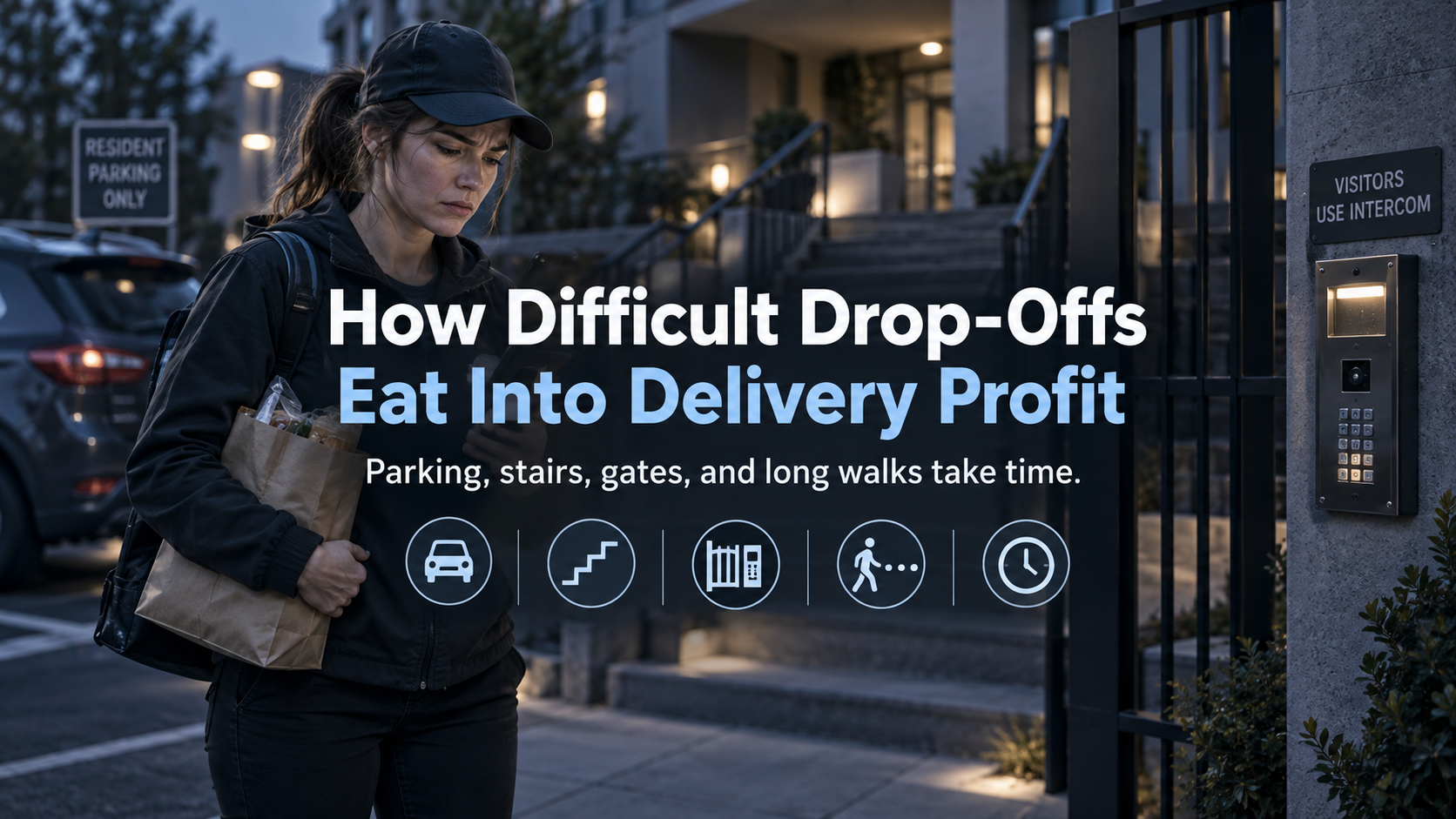
How Difficult Drop-Offs Eat Into Delivery Profit
Not every delivery ends with a quick walk to a front door.
Some drop-offs are easy.
You pull up, walk a few steps, complete the order, and move on.
Others can take much longer.
Apartment complexes, gated communities, parking problems, stairs, elevators, long hallways, confusing building numbers, and hard-to-find entrances can all add time to a delivery.
That extra time matters.
The payout does not increase just because the drop-off became harder.
Maybe the customer is only three miles away.
That sounds great.
But what happens when you arrive?
You may have to:
Find legal parking
Walk across a large complex
Wait for a gate code
Search for the right building
Climb several flights of stairs
Wait on an elevator
Contact the customer for directions
Walk back to your vehicle
The mileage may still be low.
The time may not be.
That can change profit per hour quickly.
In some areas, it is simple.
In others, finding a place to stop can take several minutes.
You may have to circle a building.
You may have to park farther away.
You may have to walk from a garage or another street.
Those minutes are part of the delivery.
If difficult parking happens repeatedly, it can have a noticeable effect on a shift.
Some are straightforward.
Others can involve multiple buildings, confusing numbering, locked entrances, long hallways, elevators, stairs, or customers who forget to provide access instructions.
A five-minute drop-off can turn into 15 or 20 minutes.
That may not sound dramatic on one order.
But over several deliveries, those extra minutes can reduce the number of orders you complete during the day.
Long walks matter too
A delivery does not always end where the vehicle stops.
Sometimes the customer is hundreds of feet away.
Large complexes, campuses, hotels, hospitals, office buildings, and downtown locations can all create long walks.
You are still working during that time.
The vehicle may not be moving, but the clock is.
That matters when you look at profit per hour.
Stairs and heavy orders can slow things down
Some deliveries require more physical effort.
Multiple bags, cases of drinks, stairs, or long distances from the vehicle can make a drop-off take much longer than expected.
Again, the payout usually does not change because the delivery became harder.
That does not mean these orders should always be avoided.
It means the extra effort and time should be part of how you judge the offer.
You may arrive and discover:
No gate code was provided
The code does not work
The customer does not answer
The entrance is on another side of the property
The building requires a call box
You must wait for someone to let you in
Every extra minute reduces the value of the order if the payout stays the same.
A good-looking offer can become average
Suppose an offer pays $16 and requires only four miles.
At first glance, that may look very strong.
But the drop-off takes 20 extra minutes because of parking, a locked entrance, and a long walk.
Now the order takes much longer than expected.
Your profit per mile may still look good.
Your profit per hour may not.
That is why one number rarely tells the whole story.
Difficult drop-offs can affect the next order too
The impact does not always stop when the delivery is complete.
If you spend an extra 15 minutes at the customer location, you may miss another offer.
You may leave the area later than expected.
Traffic may increase.
A busy period may end.
One difficult drop-off can change the timing of the rest of your shift.
Sometimes an address looks simple and turns out to be complicated.
But repeated patterns can help.
You may notice that a certain apartment complex usually takes longer.
You may know that one downtown area has difficult parking.
You may recognize that a certain type of delivery regularly requires more walking.
Those observations can help you make better decisions the next time you see a similar offer.
Private notes can help you remember
Drivers see a lot of addresses.
It is easy to forget which locations were difficult.
A private note can help you remember things such as:
Long walk
Difficult parking
Narrow access
Bumpy driveway
GPS problem
Loose dog
Apartment access issue
That information can help you evaluate a future delivery to the same place more accurately.
The goal is not to avoid every difficult location.
The goal is to remember what the location really required.
Time is part of the real cost
Drivers often think about fuel and mileage when discussing delivery costs.
Time deserves the same attention.
You only have so many working hours in a day.
If a delivery consumes more of that time than expected, it affects what you can earn during the rest of the shift.
That is why profit per hour can be just as useful as profit per mile.
A difficult drop-off is not automatically a bad order
Some difficult deliveries still pay well enough to be worth taking.
A large payout may justify the extra time.
A short trip may still produce a strong result even with a longer drop-off.
The important thing is knowing what you are dealing with.
The same address may be a great order at one payout and a weak order at another.
Payout
Miles
Also think about:
Expected time
Pickup wait
Customer location
Parking
Walking distance
Access difficulty
Return miles
Vehicle costs
The more complete the picture, the better the decision can be.
TRUE Driver Profit helps you see more than the mileage
TRUE Driver Profit is designed to help delivery drivers evaluate the full cost of an offer.
Mileage matters.
Fuel matters.
Vehicle wear matters.
But time matters too.
A short-mile delivery can still become a weak order if the drop-off takes much longer than expected.
Understanding those patterns can help you make better decisions before the next offer arrives.
Because sometimes the most expensive part of a delivery is not the drive.
It is everything that happens after you park.
Not every delivery ends with a quick walk to a front door.
Some drop-offs are easy.
You pull up, walk a few steps, complete the order, and move on.
Others can take much longer.
Apartment complexes, gated communities, parking problems, stairs, elevators, long hallways, confusing building numbers, and hard-to-find entrances can all add time to a delivery.
That extra time matters.
The payout does not increase just because the drop-off became harder.
A short trip can still take a long time
Mileage can make an offer look easy.Maybe the customer is only three miles away.
That sounds great.
But what happens when you arrive?
You may have to:
Find legal parking
Walk across a large complex
Wait for a gate code
Search for the right building
Climb several flights of stairs
Wait on an elevator
Contact the customer for directions
Walk back to your vehicle
The mileage may still be low.
The time may not be.
That can change profit per hour quickly.
Parking can become part of the delivery
Parking is easy to overlook when evaluating an offer.In some areas, it is simple.
In others, finding a place to stop can take several minutes.
You may have to circle a building.
You may have to park farther away.
You may have to walk from a garage or another street.
Those minutes are part of the delivery.
If difficult parking happens repeatedly, it can have a noticeable effect on a shift.
Apartments can add hidden time
Apartment deliveries can vary widely.Some are straightforward.
Others can involve multiple buildings, confusing numbering, locked entrances, long hallways, elevators, stairs, or customers who forget to provide access instructions.
A five-minute drop-off can turn into 15 or 20 minutes.
That may not sound dramatic on one order.
But over several deliveries, those extra minutes can reduce the number of orders you complete during the day.
Long walks matter too
A delivery does not always end where the vehicle stops.
Sometimes the customer is hundreds of feet away.
Large complexes, campuses, hotels, hospitals, office buildings, and downtown locations can all create long walks.
You are still working during that time.
The vehicle may not be moving, but the clock is.
That matters when you look at profit per hour.
Stairs and heavy orders can slow things down
Some deliveries require more physical effort.
Multiple bags, cases of drinks, stairs, or long distances from the vehicle can make a drop-off take much longer than expected.
Again, the payout usually does not change because the delivery became harder.
That does not mean these orders should always be avoided.
It means the extra effort and time should be part of how you judge the offer.
Gates and access problems can create delays
Gated communities and secured buildings can add another layer of uncertainty.You may arrive and discover:
No gate code was provided
The code does not work
The customer does not answer
The entrance is on another side of the property
The building requires a call box
You must wait for someone to let you in
Every extra minute reduces the value of the order if the payout stays the same.
A good-looking offer can become average
Suppose an offer pays $16 and requires only four miles.
At first glance, that may look very strong.
But the drop-off takes 20 extra minutes because of parking, a locked entrance, and a long walk.
Now the order takes much longer than expected.
Your profit per mile may still look good.
Your profit per hour may not.
That is why one number rarely tells the whole story.
Difficult drop-offs can affect the next order too
The impact does not always stop when the delivery is complete.
If you spend an extra 15 minutes at the customer location, you may miss another offer.
You may leave the area later than expected.
Traffic may increase.
A busy period may end.
One difficult drop-off can change the timing of the rest of your shift.
Patterns are more useful than one bad delivery
You cannot predict every difficult customer location.Sometimes an address looks simple and turns out to be complicated.
But repeated patterns can help.
You may notice that a certain apartment complex usually takes longer.
You may know that one downtown area has difficult parking.
You may recognize that a certain type of delivery regularly requires more walking.
Those observations can help you make better decisions the next time you see a similar offer.
Private notes can help you remember
Drivers see a lot of addresses.
It is easy to forget which locations were difficult.
A private note can help you remember things such as:
Long walk
Difficult parking
Narrow access
Bumpy driveway
GPS problem
Loose dog
Apartment access issue
That information can help you evaluate a future delivery to the same place more accurately.
The goal is not to avoid every difficult location.
The goal is to remember what the location really required.
Time is part of the real cost
Drivers often think about fuel and mileage when discussing delivery costs.
Time deserves the same attention.
You only have so many working hours in a day.
If a delivery consumes more of that time than expected, it affects what you can earn during the rest of the shift.
That is why profit per hour can be just as useful as profit per mile.
A difficult drop-off is not automatically a bad order
Some difficult deliveries still pay well enough to be worth taking.
A large payout may justify the extra time.
A short trip may still produce a strong result even with a longer drop-off.
The important thing is knowing what you are dealing with.
The same address may be a great order at one payout and a weak order at another.
Look at the whole delivery
Before deciding whether an offer is worth taking, consider more than:Payout
Miles
Also think about:
Expected time
Pickup wait
Customer location
Parking
Walking distance
Access difficulty
Return miles
Vehicle costs
The more complete the picture, the better the decision can be.
TRUE Driver Profit helps you see more than the mileage
TRUE Driver Profit is designed to help delivery drivers evaluate the full cost of an offer.
Mileage matters.
Fuel matters.
Vehicle wear matters.
But time matters too.
A short-mile delivery can still become a weak order if the drop-off takes much longer than expected.
Understanding those patterns can help you make better decisions before the next offer arrives.
Because sometimes the most expensive part of a delivery is not the drive.
It is everything that happens after you park.