How One Bad Order Can Hurt an Entire Shift
One weak delivery can cost more than a few dollars. Long waits, extra miles, poor positioning, and lost time can affect the rest of your entire shift.
By TRUE Driver Profit · September 10, 2026
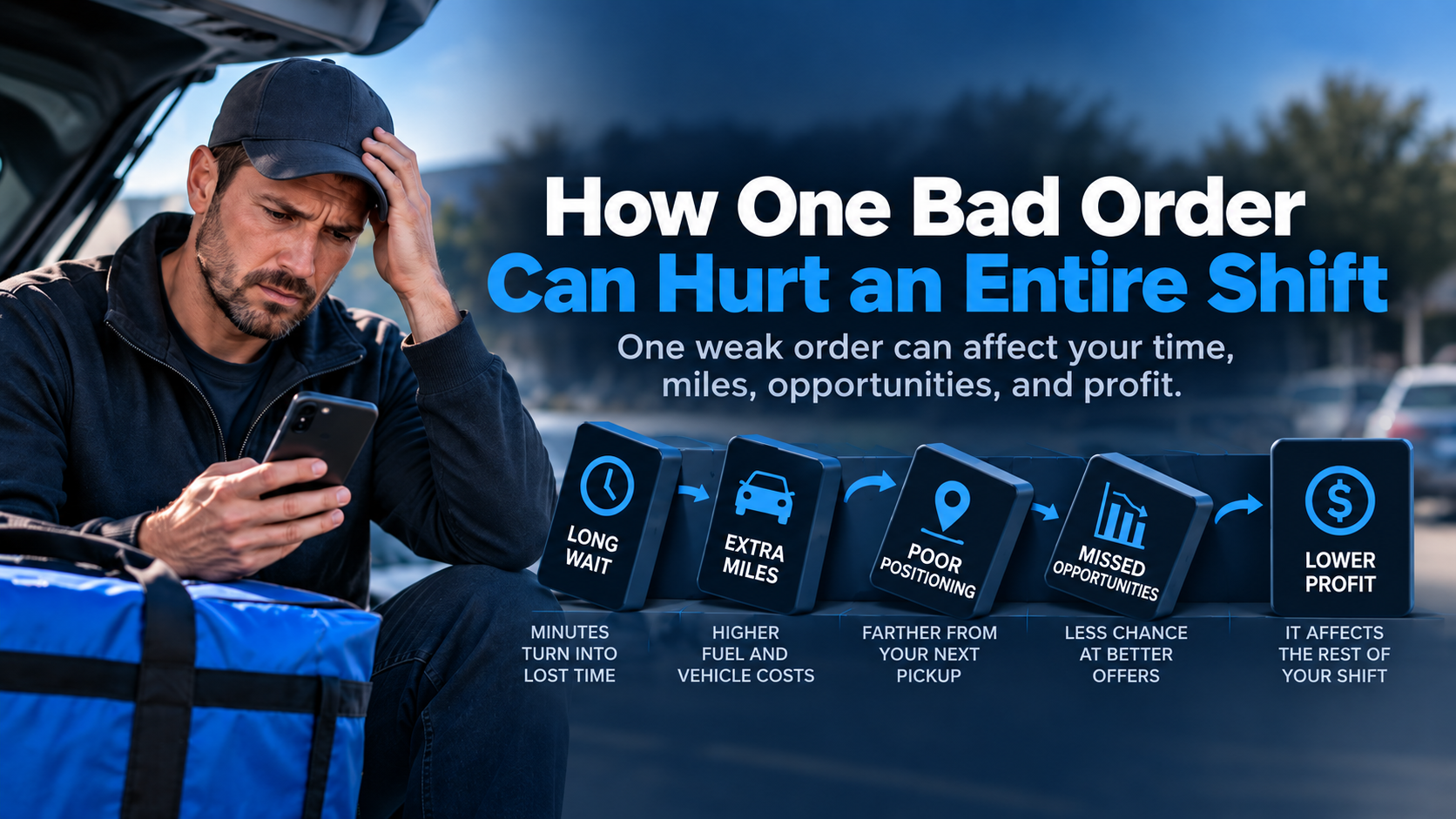
How One Bad Order Can Hurt an Entire Shift
One bad delivery does not always end when the order is complete.
Sometimes the real damage shows up afterward.
A long wait can push you out of a busy period.
A distant drop-off can leave you far from your next pickup.
Extra return miles can increase your costs.
A slow order can take time away from better opportunities.
That means one weak order can affect more than the profit from that single delivery.
It can change the rest of your shift.
The mileage looks acceptable.
The delivery seems simple.
You accept it.
Then you wait 20 minutes at pickup.
The customer is farther from your normal pickup area than expected.
Traffic slows the trip down.
By the time you finish, the order has taken nearly an hour.
You still earned the $14.
But the cost was not just the time and mileage used on that one delivery.
You may also have lost the chance to complete another order during that same hour.
That is where the ripple effect begins.
Suppose you normally get your best offers between 5:00 and 7:00 PM.
If one slow order takes 50 minutes instead of 25, you may miss a large part of that stronger period.
The problem is not only that the order itself produced a weak hourly result.
It also consumed time when better opportunities may have been available.
That lost opportunity does not show up on the original offer screen.
An order that takes you far outside your normal pickup area may require a long drive back.
During that return trip, you may not receive useful offers.
Even if you do, they may send you farther away instead of back toward where you want to work.
That means one delivery can change the starting point for the next one.
Good positioning can help keep a shift moving.
Poor positioning can make the next decision harder.
Return miles add another layer of cost
Return miles do not come with another payout.
But they still use:
Fuel
Vehicle life
Time
Tires
Maintenance
That means a delivery can look acceptable when judged only by the miles shown on the offer but become much weaker once the return trip is included.
If one order adds six or eight unpaid miles before you are ready for the next offer, that can lower the value of the entire hour.
After spending too much time on one weak order, drivers can feel pressure to make the time back.
That can lead to accepting the next offer too quickly.
You may take a mediocre order because you want to stay moving.
Then another weak order follows.
One bad decision can turn into two or three.
That is why slowing down for a few seconds before accepting the next offer can matter.
The goal is not to chase lost time.
The goal is to make the next decision based on the next offer.
Not every bad order is avoidable
No driver can predict everything.
A pickup that is normally fast can suddenly be delayed.
Traffic can change.
A customer location can be more difficult than expected.
An order can look good and still turn out badly.
The goal is not to eliminate every weak delivery.
That is impossible.
The better goal is to understand what happened so you can recognize patterns.
If a certain delivery area consistently requires long return trips, that matters.
If particular times of day produce slower orders, that matters.
One bad order may be random.
Several similar bad orders can reveal a pattern.
Patterns are where better decisions begin.
Look beyond the individual payout
A $20 order may sound better than a $14 order.
But if the $20 order takes twice as long, adds more mileage, and leaves you far from your next pickup, it may hurt the rest of the shift more than the smaller offer.
That does not mean lower-paying orders are always better.
It means the payout should be judged together with time, mileage, return miles, and positioning.
The whole trip matters.
The whole shift matters too.
They come from dozens of decisions.
Some will be great.
Some will be average.
A few will be bad.
The important part is keeping one bad order from turning into a string of bad decisions.
Understanding your numbers can help.
TRUE Driver Profit helps you see the effect
TRUE Driver Profit is designed to help drivers look beyond the payout on a single offer.
By considering mileage, return driving, time, fuel, and vehicle costs, you can get a clearer picture of what an order may really contribute to your shift.
That can help you spot when an offer is likely to cost more time or mileage than it first appears.
One bad order does not have to ruin your day.
But knowing what made it bad can help protect the next decision.
One bad delivery does not always end when the order is complete.
Sometimes the real damage shows up afterward.
A long wait can push you out of a busy period.
A distant drop-off can leave you far from your next pickup.
Extra return miles can increase your costs.
A slow order can take time away from better opportunities.
That means one weak order can affect more than the profit from that single delivery.
It can change the rest of your shift.
The order itself may only look a little weak
Imagine an order that pays $14.The mileage looks acceptable.
The delivery seems simple.
You accept it.
Then you wait 20 minutes at pickup.
The customer is farther from your normal pickup area than expected.
Traffic slows the trip down.
By the time you finish, the order has taken nearly an hour.
You still earned the $14.
But the cost was not just the time and mileage used on that one delivery.
You may also have lost the chance to complete another order during that same hour.
That is where the ripple effect begins.
Waiting can push you out of a strong time period
Pickup delays can be especially costly during busy hours.Suppose you normally get your best offers between 5:00 and 7:00 PM.
If one slow order takes 50 minutes instead of 25, you may miss a large part of that stronger period.
The problem is not only that the order itself produced a weak hourly result.
It also consumed time when better opportunities may have been available.
That lost opportunity does not show up on the original offer screen.
Poor positioning can affect what comes next
Where a delivery leaves you matters.An order that takes you far outside your normal pickup area may require a long drive back.
During that return trip, you may not receive useful offers.
Even if you do, they may send you farther away instead of back toward where you want to work.
That means one delivery can change the starting point for the next one.
Good positioning can help keep a shift moving.
Poor positioning can make the next decision harder.
Return miles add another layer of cost
Return miles do not come with another payout.
But they still use:
Fuel
Vehicle life
Time
Tires
Maintenance
That means a delivery can look acceptable when judged only by the miles shown on the offer but become much weaker once the return trip is included.
If one order adds six or eight unpaid miles before you are ready for the next offer, that can lower the value of the entire hour.
A bad order can change your decision-making
There is another effect that is harder to measure.After spending too much time on one weak order, drivers can feel pressure to make the time back.
That can lead to accepting the next offer too quickly.
You may take a mediocre order because you want to stay moving.
Then another weak order follows.
One bad decision can turn into two or three.
That is why slowing down for a few seconds before accepting the next offer can matter.
The goal is not to chase lost time.
The goal is to make the next decision based on the next offer.
Not every bad order is avoidable
No driver can predict everything.
A pickup that is normally fast can suddenly be delayed.
Traffic can change.
A customer location can be more difficult than expected.
An order can look good and still turn out badly.
The goal is not to eliminate every weak delivery.
That is impossible.
The better goal is to understand what happened so you can recognize patterns.
Patterns can help protect future shifts
If the same pickup location repeatedly creates long waits, that matters.If a certain delivery area consistently requires long return trips, that matters.
If particular times of day produce slower orders, that matters.
One bad order may be random.
Several similar bad orders can reveal a pattern.
Patterns are where better decisions begin.
Look beyond the individual payout
A $20 order may sound better than a $14 order.
But if the $20 order takes twice as long, adds more mileage, and leaves you far from your next pickup, it may hurt the rest of the shift more than the smaller offer.
That does not mean lower-paying orders are always better.
It means the payout should be judged together with time, mileage, return miles, and positioning.
The whole trip matters.
The whole shift matters too.
A good shift is built one decision at a time
Drivers do not earn their weekly results from one perfect order.They come from dozens of decisions.
Some will be great.
Some will be average.
A few will be bad.
The important part is keeping one bad order from turning into a string of bad decisions.
Understanding your numbers can help.
TRUE Driver Profit helps you see the effect
TRUE Driver Profit is designed to help drivers look beyond the payout on a single offer.
By considering mileage, return driving, time, fuel, and vehicle costs, you can get a clearer picture of what an order may really contribute to your shift.
That can help you spot when an offer is likely to cost more time or mileage than it first appears.
One bad order does not have to ruin your day.
But knowing what made it bad can help protect the next decision.