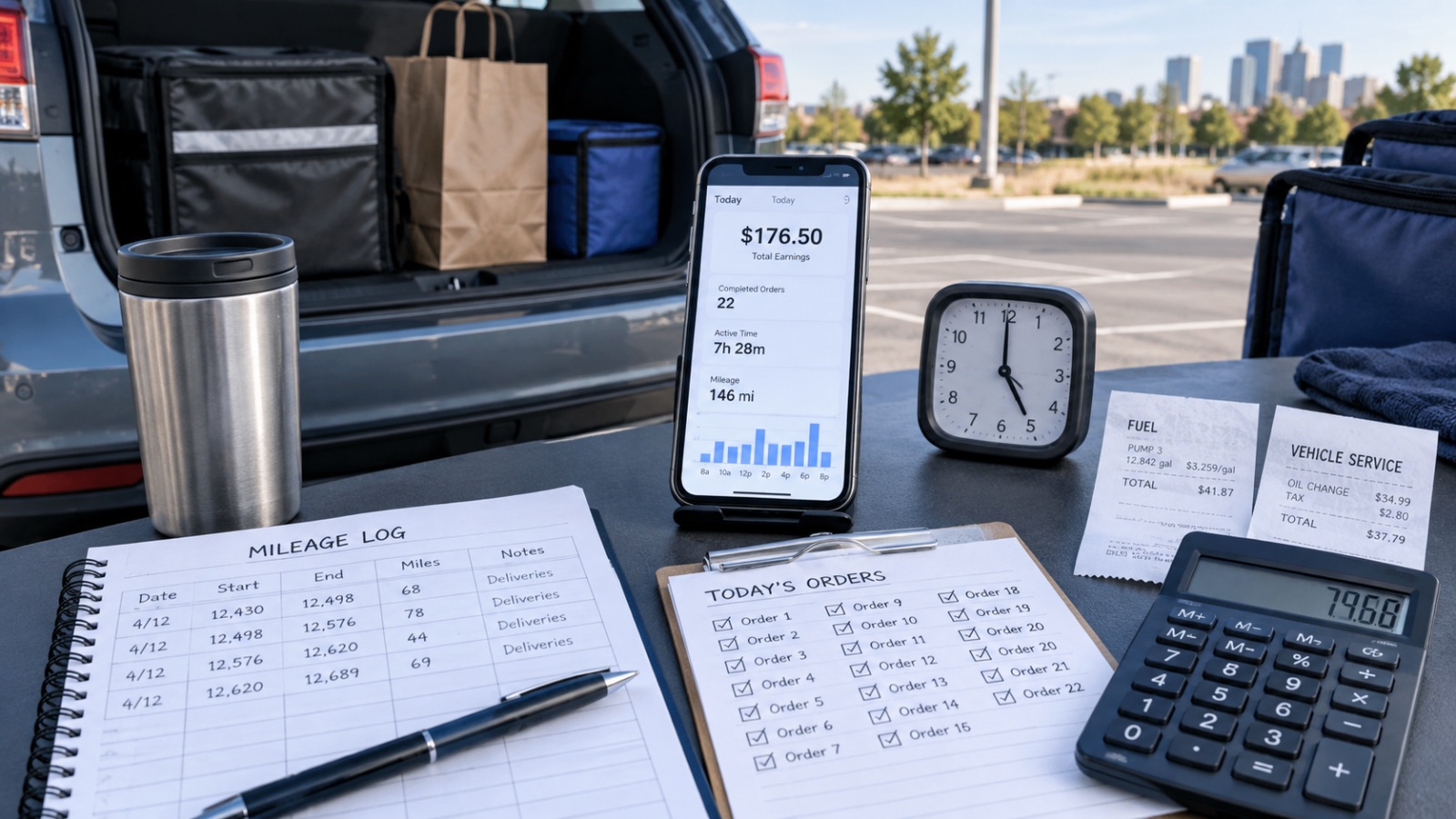
One of the first questions people ask about delivery driving is:
How much can you make in a day?
You might see drivers posting $100 days, $200 days, or even higher earnings online.
Those numbers can happen.
But a screenshot showing daily earnings does not tell you the entire story.
How long did the driver work?
How many miles did they drive?
How much fuel did they use?
How much vehicle wear did they create?
How much unpaid time was involved?
The better question is not only how much a delivery driver can make in a day.
It is how much of that money the driver actually keeps.
How much can delivery drivers make in a day?
There is no single daily earnings number that applies to every delivery driver.
Daily earnings can change based on:
- Hours worked
- Number of available orders
- Payouts
- Tips
- Mileage
- Traffic
- Pickup wait time
- Type of deliveries
- Time of day
- Day of the week
- Weather
- Driver strategy
Two drivers working the same number of hours can finish the day with very different results.
Daily earnings can change from one day to the next
A strong Friday night does not guarantee a strong Monday afternoon.
Delivery work can change quickly.
One day may have steady orders.
Another may have long periods with little worth accepting.
That is why one day's earnings should not be treated as a guaranteed daily income.
Can delivery drivers make $100 a day?
Yes, many drivers may be able to gross $100 during a delivery day under the right conditions.
But how long it takes matters.
Earning $100 in four hours is very different from earning $100 in eight hours.
Mileage matters too
Suppose two drivers both finish the day with $100.
Driver A drove 45 miles.
Driver B drove 110 miles.
Their gross earnings are identical.
Their vehicle costs are not.
Driver B likely spent more to produce the same $100.
Can delivery drivers make $200 a day?
A $200 gross day is possible in some areas and under some conditions.
But the amount of time and driving required can vary significantly.
A driver may reach $200 after:
- A strong dinner rush
- A long workday
- Several profitable shopping orders
- Multiple delivery platforms
- Weekend demand
- Promotional incentives
A $200 day is not automatically a $200 profit day
If you gross $200, you still have business costs.
Those may include:
- Fuel
- Maintenance
- Tires
- Repairs
- Depreciation
- Insurance
- Phone costs
- Supplies
- Parking
- Tolls
What remains after those costs is much more useful than the gross number alone.
How many hours does it take to make $200?
There is no reliable universal answer.
Some days may be busy enough for a driver to reach a goal quickly.
Other days may require many more hours.
Gross hourly earnings change throughout the day
Imagine a driver earns:
$70 during three busy lunch hours
$25 during three slow afternoon hours
$105 during four dinner hours
The driver grossed $200.
But it took 10 hours.
That works out to:
$200 ÷ 10 = $20 gross per hour
And that is before business expenses.
A busy day is not always a profitable day
Drivers often judge a day by how many orders they completed.
But completing more deliveries does not automatically mean earning more profit.
Too many low-value orders can create expensive miles
Imagine completing 15 deliveries in one day.
That sounds productive.
But if those deliveries required excessive mileage and produced low payouts, the day may not have been especially profitable.
Another driver may complete only eight deliveries but keep more money.
The number of orders is not the goal.
Profit is.
Daily mileage can change everything
The more miles you drive to produce your earnings, the more important vehicle costs become.
Suppose you gross $180 during a day.
If you drove 60 miles, that is one situation.
If you drove 160 miles, that is a very different day.
Your car is part of the business
Every business mile contributes to vehicle use.
That can eventually show up through:
- Fuel
- Oil changes
- Tires
- Brakes
- Repairs
- Depreciation
Those costs may not arrive on the same day you earn the money.
But they are still created by the work.
Return miles can lower daily profit
Some of the most expensive miles can happen after the customer receives the order.
A delivery may leave you far from your normal pickup area.
Then you have to decide what to do next.
Driving back without an order still costs money
Suppose you complete a delivery 12 miles outside your working area.
The offer looked good when you accepted it.
But now you drive 12 miles back without another delivery.
Those miles use fuel and vehicle life.
They also consume time.
That can lower both your daily profit and your profit per hour.
Pickup wait time affects daily earnings
A driver can lose a surprising amount of the day waiting.
Five minutes here.
Ten minutes there.
Twenty minutes somewhere else.
By the end of the day, those delays can add up to an hour or more.
Waiting can limit how many profitable orders you complete
If you spend 45 minutes waiting for one pickup, that is time you cannot use on another delivery.
The offer may still be profitable.
But the wait changes what the order contributed to the entire day.
Slow periods matter
Delivery demand is rarely constant throughout the entire day.
There may be strong periods and weak periods.
Staying online longer does not guarantee better results
Suppose you have a strong morning and lunch period.
Then orders slow dramatically.
You remain online for another three hours and accept several weak offers because there is little else available.
Your total gross earnings rise.
But your average profit per hour may fall.
Sometimes ending a shift can be better than forcing more deliveries into a slow period.
The time of day matters
Different delivery types may become busier at different times.
Breakfast, lunch, dinner, grocery shopping, and package delivery can all follow different patterns.
Your own records can reveal your strongest hours
Instead of assuming dinner is always best, look at your actual results.
You may discover that your strongest periods are:
- Weekend mornings
- Weekday lunch
- Friday evenings
- Sunday grocery hours
Another driver may see completely different patterns.
Day of the week can affect earnings
A Tuesday may not perform like a Friday.
A holiday weekend may not behave like a normal weekend.
Even similar days can vary.
Do not build expectations around one great day
A driver who earns unusually high gross earnings one Saturday may begin expecting that number every day.
That can lead to frustration and poor decisions.
A better approach is to look at averages over several weeks.
Weather can increase demand and difficulty
Rain, cold weather, storms, or snow can sometimes change order volume.
But difficult weather can also slow deliveries and increase risk.
Higher demand does not automatically mean higher profit
Bad weather may create more offers.
But it can also create:
- Slower traffic
- Longer travel times
- Difficult parking
- Longer walks
- Higher accident risk
The payout still needs to justify the work.
Shopping orders can change daily earnings
Shop-and-deliver orders may have higher payouts than simple pickup orders.
But they can also require more time.
You may need to:
- Find items
- Handle substitutions
- Communicate with customers
- Wait at checkout
- Load groceries
- Unload larger orders
Bigger payouts need to be compared with bigger time commitments
A $30 shopping order can be excellent.
It can also be poor if it consumes two hours.
Always consider time and mileage with payout.
Multi-stop orders can increase gross earnings
Some multi-stop routes offer larger payouts.
But they can involve considerably more work.
Each additional stop may create:
- More driving
- More parking
- More walking
- More unloading
- More navigation
- More opportunities for delays
Large payouts can hide long routes
Do not judge the route only by the total payout.
Look at how long the entire route may take and where it ends.
Can multi-apping increase daily earnings?
Using more than one delivery app can sometimes give drivers access to more opportunities.
But more offers do not automatically create more profit.
More choices can help if they are managed carefully
The biggest benefit may simply be having more opportunities to choose from.
But drivers still need to evaluate each offer.
Taking poor orders from several apps is not better than taking poor orders from one.
Your vehicle changes what you keep
Two drivers can gross exactly the same amount while earning different TRUE profit.
A fuel-efficient vehicle may cost less to operate than a larger vehicle.
Maintenance history matters too.
Daily profit depends on your own costs
Consider:
- Fuel economy
- Fuel price
- Maintenance
- Tires
- Repairs
- Vehicle value
- Insurance
- Other business expenses
The same $150 gross day can produce a different result for each driver.
What does a $150 day really look like?
Suppose you gross $150.
Now imagine your estimated business costs for that day total $32.
Your TRUE profit would be:
$150 - $32 = $118
That $118 tells you more about the value of the day than the $150 payout alone.
Then consider your time
If you worked six hours:
$118 ÷ 6 = about $19.67 TRUE profit per hour
If you worked nine hours:
$118 ÷ 9 = about $13.11 TRUE profit per hour
Same earnings.
Same expenses.
Very different value for your time.
Do not compare only daily screenshots
Social media makes it easy to compare your day with another driver's best day.
Someone may post a $300 earnings screen.
What you may not see is:
- Total hours worked
- Total miles
- Fuel cost
- Return miles
- Vehicle costs
- Promotions
- Unusual demand
A screenshot is not a profit report
Gross earnings can be useful.
But they are only one part of the story.
The goal should be understanding your own results.
Should delivery drivers have a daily earnings goal?
A daily goal can be useful.
But a gross earnings goal by itself may encourage bad decisions.
Suppose your goal is $200.
You reach $180 and orders become weak.
Chasing the last $20 can cost more than expected
You may accept a long-distance offer simply because you want to reach the number.
The order may add mileage, time, and return driving that lowers the quality of the whole day.
Sometimes stopping below a gross goal can be the more profitable decision.
A profit goal can be more useful
Instead of asking:
"Did I make $200?"
Try asking:
"What did I actually keep?"
That changes how you judge the day.
TRUE profit gives the earnings number context
Track:
- Gross earnings
- Working hours
- Total miles
- Fuel
- Vehicle costs
- Other business expenses
- TRUE profit
- Profit per hour
- Profit per mile
Together, those numbers provide a much clearer picture.
Look at weekly results too
One day can be unusually good or unusually bad.
Weekly results help smooth out those extremes.
A strong delivery strategy should work over time
Look for patterns such as:
- Best days
- Weakest days
- Best hours
- Most profitable order types
- Highest-mileage days
- Stores with long waits
- Areas that create return miles
Those patterns can help you make better decisions the following week.
How can drivers improve daily profit?
Improving your day does not always require earning more gross income.
You may improve profit by reducing waste.
That can mean:
- Driving fewer unpaid miles
- Avoiding consistently slow pickups
- Rejecting weak long-distance offers
- Working your strongest hours
- Reducing unnecessary idling
- Avoiding poor ending locations
Efficiency can matter as much as earnings
Suppose you normally gross $175 while driving 120 miles.
Later, you learn to gross the same $175 while driving 80 miles.
Your gross earnings did not increase.
But your business became more efficient.
That can improve TRUE profit.
How much should you try to make in a day?
There is no single correct number.
Your target should reflect:
- Your income goals
- Available hours
- Vehicle costs
- Typical demand
- Mileage
- Personal schedule
One driver may be satisfied with a profitable four-hour shift.
Another may work a full day.
Neither strategy is automatically better.
The goal should fit your life and your numbers
Delivery work offers flexibility.
Use that flexibility to build a strategy that works for you rather than trying to copy another driver's daily earnings.
The bottom line
Delivery drivers can have $100 days, $150 days, $200 days, and sometimes much higher gross earnings.
But gross earnings alone do not tell you how successful the day was.
Ask:
How many hours did I work?
How many miles did I drive?
What did the vehicle cost me?
How much unpaid driving did I do?
How much did I actually keep?
A $150 day with strong profit can be better than a $200 day filled with unnecessary mileage and long waits.
The goal is not to chase the biggest number on the earnings screen.
The goal is to understand what you truly earned after the cost of doing the work.
That is the difference between daily earnings and TRUE profit.
Related reading