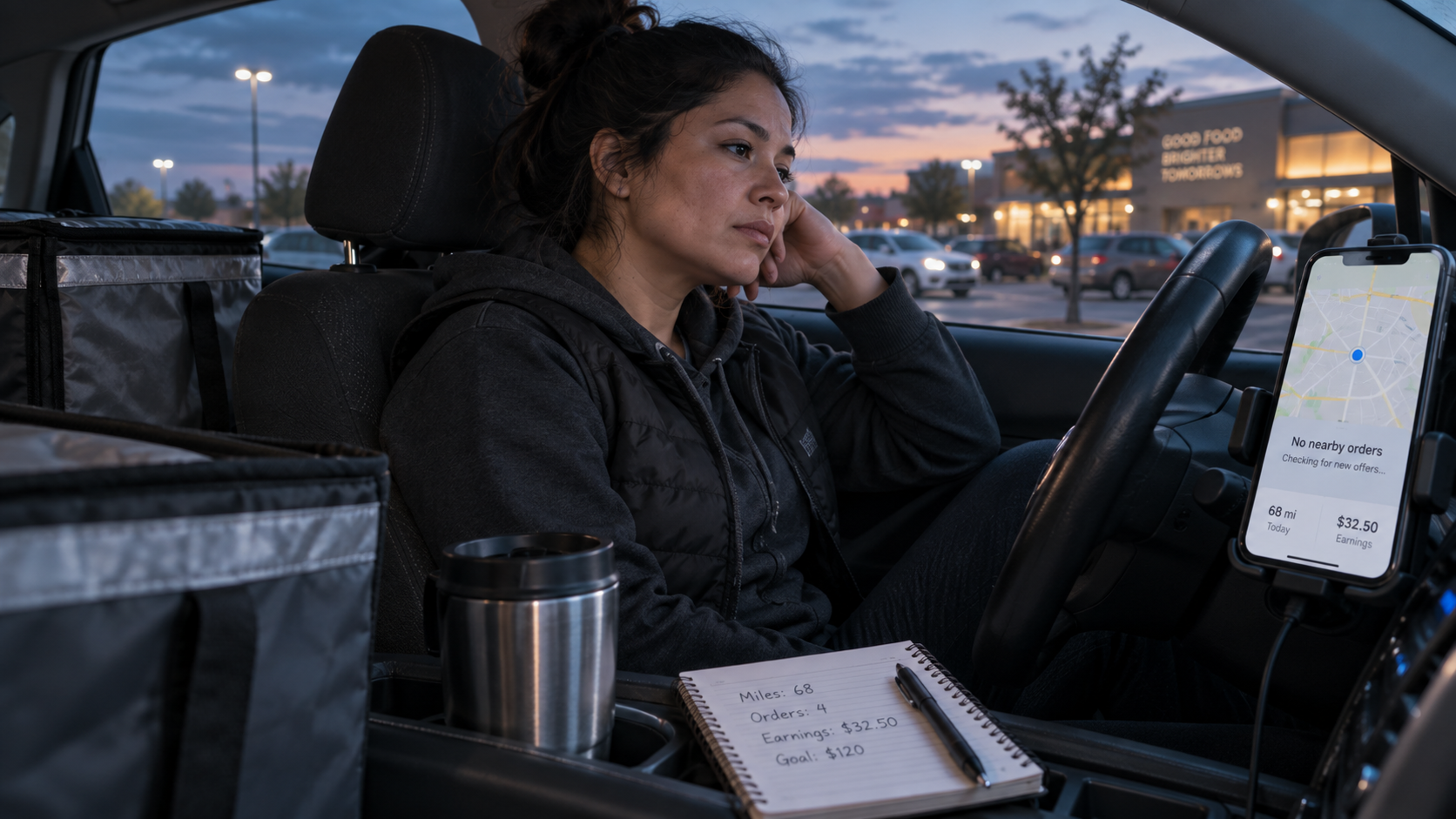
Idle time is one of the easiest parts of delivery work to overlook.
You are not actively spending money at a gas pump.
You are not necessarily putting miles on the vehicle.
You may simply be sitting in a parking lot waiting for the next offer.
But that time still affects your results.
Every unpaid minute between profitable deliveries changes how much you are actually earning per hour.
And if idle time includes repositioning, driving back toward pickup areas, or chasing better zones, the cost can grow even faster.
Idle time is still part of your workday
Delivery apps usually focus attention on active orders.
You see the payout.
You see the miles.
You see the delivery time.
What is easier to miss is everything between those orders.
That can include:
- Waiting for an offer
- Waiting for a better offer
- Sitting at a pickup location
- Driving back after a distant delivery
- Repositioning to another area
- Waiting for a store or restaurant to get busy again
Those minutes may not have a payout attached to them.
But they still use your time.
Your hourly profit can fall while you are sitting still
Suppose you make $60 in TRUE profit during the first three hours of your shift.
That is $20 per hour.
Then you sit for one full hour without completing another profitable order.
Your total profit is still $60.
But now you worked four hours.
Your average has dropped to $15 per hour.
Nothing changed except the clock
You did not lose money directly during that hour.
You did not necessarily buy more fuel.
But the value of your time changed.
That is why idle time matters even when the car is parked.
A shift should be measured by the whole time you committed to the work, not only the minutes when an order was active.
Waiting for a better offer has a cost too
Declining weak offers can absolutely be the right decision.
But waiting for something better is not free.
If you reject several bad offers and then wait 30 minutes for a good one, that waiting period becomes part of the real cost of getting that better order.
That does not mean you should accept weak offers just to stay busy.
It means the decision should include time as well as payout.
A good offer can still arrive too late
Imagine you turn down several poor orders and finally get a strong $20 offer after 40 minutes.
The order itself takes 30 minutes.
If you only look at the order, it may seem excellent.
But the full block of time was more than an hour.
That changes the real hourly result.
Repositioning can turn idle time into mileage cost
Sometimes drivers do not sit still when business slows down.
They move.
You may drive toward another store.
You may head to a different group of restaurants.
You may leave one zone and try another.
Now the idle period includes both time and mileage.
Driving without a payout still costs money
Suppose you spend 20 minutes driving 10 miles toward a busier area.
You eventually receive a good offer there.
Those 10 miles did not disappear just because they happened before the order appeared.
They still used fuel.
They still added wear.
They still took time.
The next delivery needs to be strong enough to justify not only itself, but also the effort it took to get into position for it.
Return miles are a form of unpaid time
A delivery can end far from your normal pickup area.
At that point, you may technically be finished with the order.
But your work may not really be finished.
You may have to drive back before you have a realistic chance of getting another useful offer.
That return drive is unpaid time unless another order happens to cover it.
The trip is bigger than the offer screen
An offer might show 8 miles.
But if the delivery leaves you 7 miles from where you need to be next, the real driving connected to that decision may be much greater.
The same is true for time.
The order may take 25 minutes.
The return may add another 15.
That is why whole-trip thinking matters.
Pickup delays create another kind of idle time
Not all waiting happens between orders.
Sometimes the delay begins after you accept.
You arrive at the pickup location and the order is not ready.
Five minutes becomes ten.
Ten becomes twenty.
You are committed to the delivery, but the clock keeps moving.
The payout does not increase while you wait
If a $12 delivery takes 25 minutes, the result may look reasonable.
If that same delivery takes 50 minutes because of a long pickup delay, the payout did not change.
The time did.
That can cut the value of the order dramatically.
Busy does not always mean productive
There is a big difference between being busy and being profitable.
You can spend an entire shift:
Driving.
Waiting.
Checking offers.
Moving between pickup areas.
Watching for something better.
That can feel like a full day of work.
And it is.
But the number of hours you were busy does not automatically tell you how productive those hours were.
Activity can hide weak results
A driver can stay in motion all day and still produce poor profit per hour.
Another driver may complete fewer orders, drive fewer miles, and finish earlier with a better overall result.
That is why total activity should not be confused with profitability.
Idle time becomes more important on slow days
When demand is strong, short waiting periods may not matter much.
One order ends and another good one appears quickly.
But on slower days, idle periods can become a large part of the shift.
That is when they deserve more attention.
A slow day can change your normal standards
An offer that would normally look acceptable may not be enough after a long wait.
For example, if you have already spent 35 minutes waiting, the next order has to help recover the value of that time.
Again, this does not mean taking a bad offer.
It means understanding that the full decision began before the offer appeared.
Idle time can also affect your judgment
Long waits can make drivers impatient.
After sitting for 30 or 40 minutes, even a weak offer can start to look better.
You may accept something you normally would not take simply because you want to get moving.
That is understandable.
But it can also lead to expensive decisions.
Frustration can lower your standards
A long idle period can create pressure to make up for lost time.
That can lead to:
- Taking longer-mileage orders
- Accepting lower payouts
- Ignoring return miles
- Chasing distant pickup areas
- Staying out longer than planned
The desire to recover a slow period can sometimes make the rest of the shift worse.
Track patterns in your waiting time
Idle time becomes much more useful when you look for patterns.
Ask yourself:
When do I wait the longest?
Which pickup areas leave me sitting?
Which times of day produce the most downtime?
How often do I reposition before getting another order?
Do my slow periods usually recover, or do they stay slow?
Your own history can help you decide whether waiting is worth it.
Some waiting is predictable
You may notice that a certain hour is almost always slow.
You may discover that one area gets quiet after lunch.
You may find that your late-evening wait times are longer than the orders justify.
Those patterns can help you plan future shifts more efficiently.
Set a personal limit for unproductive time
There is no universal rule for how long a driver should wait.
Five minutes may be normal in one area.
Twenty minutes may be reasonable in another.
The better approach is to create a personal standard based on your own results.
That might include questions such as:
How long am I willing to wait before moving?
How far am I willing to reposition?
What profit per hour am I trying to maintain?
At what point does the shift stop being worth continuing?
A personal standard helps keep frustration from making the decision for you.
Look at the full shift instead of one order
One strong order can make a slow hour look better.
One bad wait can make a good shift feel worse.
The best way to understand idle time is to look at the entire workday.
Compare:
- Total profit
- Total work time
- Total mileage
- Waiting time
- Repositioning miles
- Return miles
- Profit per hour
That gives you a much clearer picture of how much downtime affected the day.
Idle time is not always wasted time
Not every waiting period is bad.
Sometimes waiting is the smartest move.
You may know that a stronger delivery period is about to begin.
You may be in a proven pickup area.
You may avoid taking weak orders because your standards protect your profit.
The goal is not to eliminate every minute of waiting.
The goal is to understand what that waiting is costing you.
The important question is whether the wait pays off
If a 15-minute wait consistently leads to good orders, it may be worth it.
If a 40-minute wait regularly leads to weak offers and more repositioning, it may not be.
That answer can change by time of day, area, platform, and season.
Your own results matter more than a universal rule.
Time is one of your real operating costs
Fuel is easy to measure.
Mileage is easy to see.
Time is easier to ignore.
But it is one of the most valuable things you spend during a delivery shift.
Every hour you commit to delivery work should be part of the calculation.
TRUE Driver Profit helps drivers look at the entire workday, including the time and mileage that happen between individual orders.
Because the cost of a delivery shift is not only what you spend at the pump.
It is also the time you gave up to earn the money.
Related reading