When More Stops Can Actually Make a Delivery Route Better
More stops do not always mean a worse delivery. Learn how route density, short distances between stops, total time, and positioning can make some multi-stop routes more efficient.
By TRUE Driver Profit · September 12, 2026
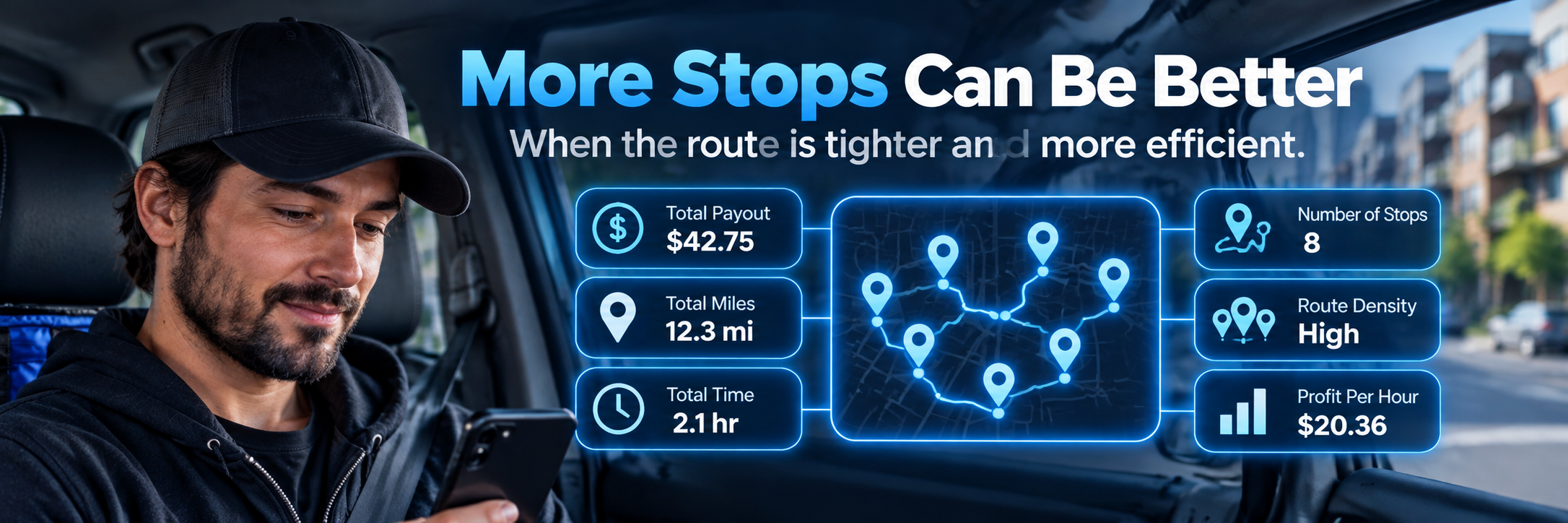
More stops can make a delivery offer look complicated.
At first glance, a route with several drop-offs may seem like more work, more time, and more chances for something to go wrong.
Sometimes that is true.
But not every multi-stop route is inefficient.
If the stops are close together, the route is well organized, and the total time stays reasonable, a route with more stops can sometimes work better than a route with fewer stops spread much farther apart.
The number of stops matters, but the spacing between those stops can matter even more.
That is why the stop count by itself does not tell you whether a route is good or bad.
Total payout
Total miles
Estimated time
Distance between stops
Likely return driving
Drop-off difficulty
Where the route ends
A route with six stops packed into one neighborhood may be more efficient than a route with three stops spread across several miles.
When several deliveries are concentrated in the same area, you may spend less time driving between customers.
The stops are all within a few blocks of each other.
Now compare that with another route that has only three stops, but each customer is several miles apart.
The second route has fewer stops, but it may require more driving, more fuel, and more time.
That is why the total route matters more than the stop count alone.
You also need to think about how much time each stop is likely to take.
But the same number of stops can become much less attractive if the route includes:
Apartment complexes
Gated communities
Long walks
Difficult parking
Stairs
Hard-to-find addresses
Customer delays
A tightly grouped route can still lose value if every stop takes too long.
That can reduce the amount of unpaid time spent waiting for another offer or driving back to another pickup location.
Pick up once
Complete several nearby deliveries
Finish in a useful area
Avoid additional unpaid repositioning
That can sometimes improve how much profit is produced from the total time spent working.
The important question is not how many stops there are.
The important question is how efficiently the entire route works.
Where does the route finish?
Are there useful pickup areas nearby?
Will I need to drive back?
How many unpaid miles could come after the last delivery?
A dense route that ends near another good pickup area may be much stronger than one that finishes far outside your normal delivery area.
You may have more addresses to confirm, more packages or bags to manage, and more chances for delays.
That extra work should be reflected in the payout.
Total route miles
Estimated completion time
Number of stops
Difficulty of those stops
Vehicle costs
Likely return miles
A larger payout does not automatically mean a better route.
The full workload matters.
Others send drivers back and forth unnecessarily.
Backtracking
Stops in opposite directions
Long gaps between customers
A final stop far outside the main route
Extra miles that do not add much payout
Those patterns can reduce profit quickly.
A route with more stops can still be good, but the route itself needs to make sense.
Pickup time
Waiting
Driving
Each drop-off
Traffic
Parking
Return driving
If a route pays well but takes much longer than expected, your profit per hour can fall quickly.
A route with several efficient stops may sometimes produce a stronger hourly result than a simpler route that requires more total driving.
That can help reduce:
Fuel use
Vehicle wear
Maintenance cost
Unpaid repositioning
A route with more stops but fewer total miles can sometimes be more efficient than one with fewer stops and a much larger driving distance.
Your vehicle, delivery area, traffic, parking conditions, and local geography can all affect profitability.
Total payout
Total miles
Total time
Wait time
Number of stops
TRUE profit
Profit per hour
Profit per mile
Where the route ended
Over time, you may notice which kinds of routes consistently work well and which ones usually create too much extra time or mileage.
The real question is whether those stops are arranged efficiently.
A route with more stops can sometimes work well when:
The stops are close together
The route avoids unnecessary backtracking
Drop-offs are reasonably simple
The payout supports the workload
The total time stays under control
The final destination leaves you in a useful position
TRUE Driver Profit is designed to help drivers look at the entire route instead of judging an offer by one number.
When you compare payout, mileage, time, vehicle costs, route density, and where the route ends, you can get a much clearer picture of whether a multi-stop delivery is actually worth taking.
At first glance, a route with several drop-offs may seem like more work, more time, and more chances for something to go wrong.
Sometimes that is true.
But not every multi-stop route is inefficient.
If the stops are close together, the route is well organized, and the total time stays reasonable, a route with more stops can sometimes work better than a route with fewer stops spread much farther apart.
The number of stops matters, but the spacing between those stops can matter even more.
More Stops Do Not Automatically Mean More Miles
A route with several nearby stops may require less total driving than a route with only two stops that are far apart.That is why the stop count by itself does not tell you whether a route is good or bad.
Compare the Full Route
Before judging a multi-stop offer, look at:Total payout
Total miles
Estimated time
Distance between stops
Likely return driving
Drop-off difficulty
Where the route ends
A route with six stops packed into one neighborhood may be more efficient than a route with three stops spread across several miles.
Route Density Can Make a Big Difference
Route density is simply how closely the stops are grouped together.When several deliveries are concentrated in the same area, you may spend less time driving between customers.
Tighter Routes Can Reduce Wasted Driving
Imagine one route with five stops.The stops are all within a few blocks of each other.
Now compare that with another route that has only three stops, but each customer is several miles apart.
The second route has fewer stops, but it may require more driving, more fuel, and more time.
That is why the total route matters more than the stop count alone.
Time Between Stops Matters
Miles are only part of the picture.You also need to think about how much time each stop is likely to take.
Fast Drop-Offs Can Improve Route Efficiency
If the stops are simple house deliveries with easy parking and quick drop-offs, several stops may move very quickly.But the same number of stops can become much less attractive if the route includes:
Apartment complexes
Gated communities
Long walks
Difficult parking
Stairs
Hard-to-find addresses
Customer delays
A tightly grouped route can still lose value if every stop takes too long.
More Stops Can Improve Earnings Efficiency
Some multi-stop routes allow one pickup to produce several completed deliveries.That can reduce the amount of unpaid time spent waiting for another offer or driving back to another pickup location.
One Pickup Can Lead to Several Earnings Opportunities
If the route is efficient, the driver may:Pick up once
Complete several nearby deliveries
Finish in a useful area
Avoid additional unpaid repositioning
That can sometimes improve how much profit is produced from the total time spent working.
The important question is not how many stops there are.
The important question is how efficiently the entire route works.
The Route Ending Still Matters
A well-designed route can become less attractive if the final stop leaves you far from where you want to be.Look at the Last Drop-Off
Ask yourself:Where does the route finish?
Are there useful pickup areas nearby?
Will I need to drive back?
How many unpaid miles could come after the last delivery?
A dense route that ends near another good pickup area may be much stronger than one that finishes far outside your normal delivery area.
Payout Needs to Support the Extra Work
More stops still mean more actions.You may have more addresses to confirm, more packages or bags to manage, and more chances for delays.
That extra work should be reflected in the payout.
Do Not Judge by Payout Alone
A high payout can look appealing, but compare it with:Total route miles
Estimated completion time
Number of stops
Difficulty of those stops
Vehicle costs
Likely return miles
A larger payout does not automatically mean a better route.
The full workload matters.
Route Organization Can Change the Experience
Some multi-stop routes are arranged efficiently.Others send drivers back and forth unnecessarily.
Watch for Poor Routing
A weak route may include:Backtracking
Stops in opposite directions
Long gaps between customers
A final stop far outside the main route
Extra miles that do not add much payout
Those patterns can reduce profit quickly.
A route with more stops can still be good, but the route itself needs to make sense.
Compare Profit Per Hour
One of the best ways to judge a multi-stop route is to estimate what it may produce per hour.Include the Whole Time Commitment
Think about:Pickup time
Waiting
Driving
Each drop-off
Traffic
Parking
Return driving
If a route pays well but takes much longer than expected, your profit per hour can fall quickly.
A route with several efficient stops may sometimes produce a stronger hourly result than a simpler route that requires more total driving.
Compare Profit Per Mile
Profit per mile can also help you understand whether the route uses your vehicle efficiently.Dense Routes Can Sometimes Perform Better
When multiple stops are close together, the total mileage may remain relatively low.That can help reduce:
Fuel use
Vehicle wear
Maintenance cost
Unpaid repositioning
A route with more stops but fewer total miles can sometimes be more efficient than one with fewer stops and a much larger driving distance.
Learn Which Multi-Stop Routes Work for You
Not every driver will get the same result from the same type of route.Your vehicle, delivery area, traffic, parking conditions, and local geography can all affect profitability.
Track Your Results
After completing multi-stop routes, compare:Total payout
Total miles
Total time
Wait time
Number of stops
TRUE profit
Profit per hour
Profit per mile
Where the route ended
Over time, you may notice which kinds of routes consistently work well and which ones usually create too much extra time or mileage.
Stop Count Is Only One Part of the Decision
A delivery route should not automatically be rejected just because it has several stops.The real question is whether those stops are arranged efficiently.
A route with more stops can sometimes work well when:
The stops are close together
The route avoids unnecessary backtracking
Drop-offs are reasonably simple
The payout supports the workload
The total time stays under control
The final destination leaves you in a useful position
TRUE Driver Profit is designed to help drivers look at the entire route instead of judging an offer by one number.
When you compare payout, mileage, time, vehicle costs, route density, and where the route ends, you can get a much clearer picture of whether a multi-stop delivery is actually worth taking.