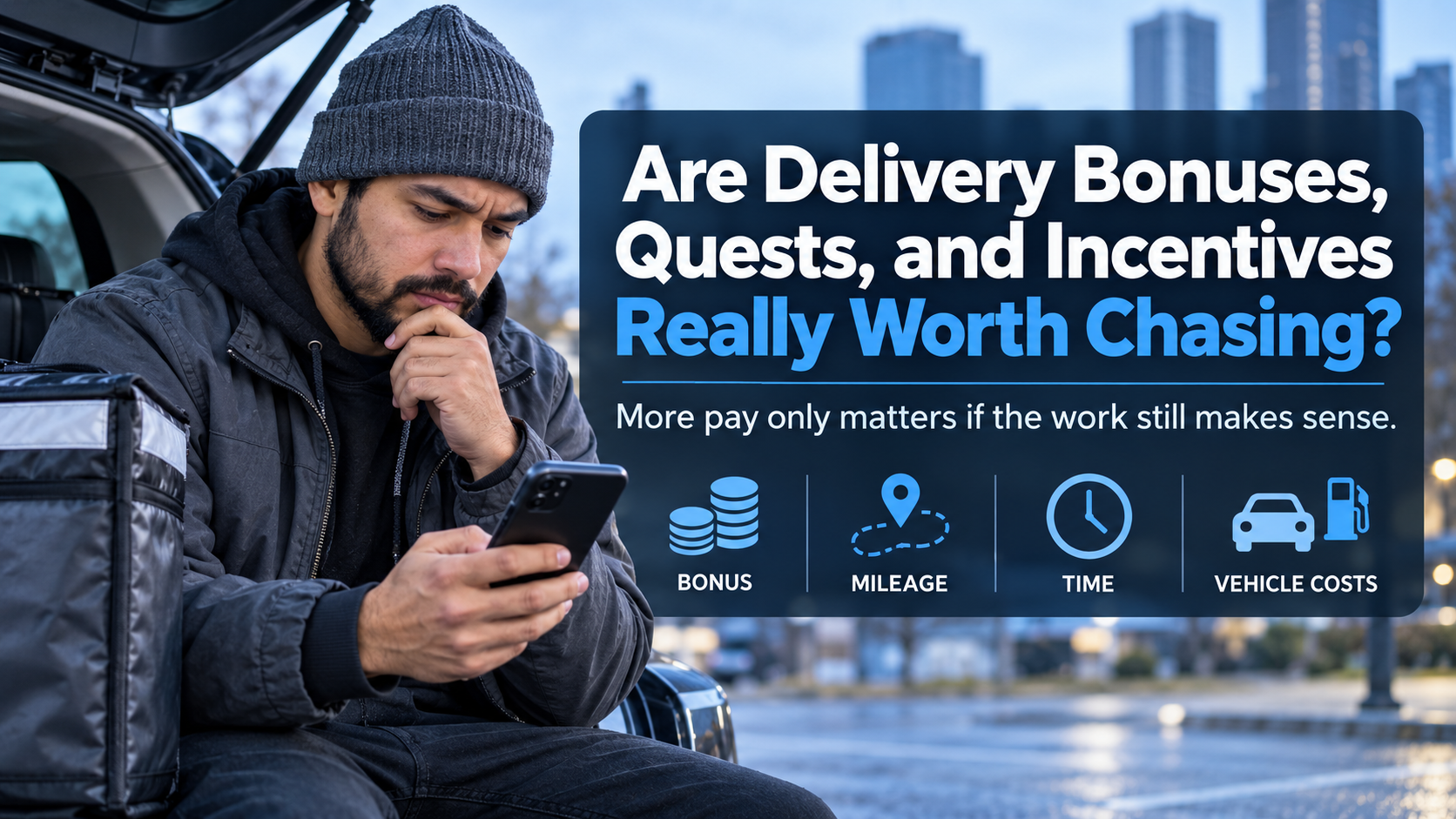
Delivery bonuses can be hard to ignore.
Complete a certain number of orders.
Drive during a certain time.
Finish a streak.
Hit a goal.
Earn extra money.
At first glance, the decision can seem simple.
If a platform is offering a bonus, why not go get it?
Because the bonus is only valuable if the work required to earn it still makes sense.
A bonus can increase profit.
It can also tempt a driver into accepting weak offers, driving extra miles, or staying out longer than planned.
The number at the end of the promotion is not the only number that matters.
A Bonus Is Additional Income, Not Free Money
An incentive may add money to your earnings.
But you still have to do work to earn it.
That work may require:
- Additional deliveries
- Additional miles
- Additional time
- More fuel
- More vehicle wear
- More waiting
- More return driving
That means the true value of a bonus depends on what it costs you to reach it.
The Bonus Does Not Erase the Cost of the Orders
Suppose a platform offers you an extra $40 for completing eight deliveries.
That sounds like another $5 per delivery.
But what if the last few orders needed to finish the promotion are poor offers?
You may end up driving farther, waiting longer, or accepting trips you normally would decline.
The bonus increases your income.
The additional work also increases your costs.
You need to compare both.
Start With the Bonus Per Required Delivery
One useful starting point is dividing the bonus by the number of deliveries required.
Suppose the promotion is:
Complete 10 deliveries and earn an extra $50.
That means the bonus adds an average of $5 to each required delivery.
That can make the promotion attractive.
But it does not automatically make every order worth taking.
Look at the Offer With the Bonus Included
Suppose one of the required deliveries pays $6.
If the promotion effectively adds another $5 to that delivery, you might think of it as an $11 opportunity.
Now compare that adjusted amount with:
- Mileage
- Expected time
- Pickup wait
- Vehicle cost
- Destination
- Return driving
The bonus may turn a weak offer into a worthwhile one.
Or it may not.
The Last Few Orders Can Be the Most Expensive
Bonuses often become more tempting as you get closer to completing them.
If you only need two more deliveries to unlock $50, it can feel almost impossible to stop.
That is where drivers can make poor decisions.
Sunk Time Can Affect Your Judgment
You may think:
I already completed eight orders.
I cannot stop now.
But the eight completed orders are already done.
The real question is whether completing the final two is still profitable.
If those final trips require excessive mileage, long waits, or several extra hours, the cost of finishing may be higher than it appears.
Do Not Let the Bonus Choose the Offer for You
One of the biggest risks with incentives is that they can change how you evaluate individual orders.
Instead of asking:
Is this delivery worth taking?
You start asking:
Will this get me closer to the bonus?
Those are different questions.
Keep Evaluating the Individual Offer
Even during a promotion, consider:
- Payout
- Mileage
- Time
- Pickup distance
- Expected wait
- Drop-off location
- Return miles
- Vehicle cost
Then include the expected bonus value.
A promotion should improve a good decision.
It should not replace good decision-making.
Bonuses Can Increase Acceptance of Weak Orders
Promotions are often designed to encourage more completed deliveries.
That means drivers may begin accepting orders they normally would skip.
This can increase total activity.
It does not guarantee stronger profit.
More Deliveries Can Mean More Expenses
Every additional trip can create:
- More fuel use
- More tire wear
- More maintenance
- More depreciation
- More unpaid repositioning
- More time on the road
If the incentive is not large enough to cover those additional costs and improve your profit, completing more deliveries may not help as much as expected.
A Large Bonus Can Still Be a Bad Deal
The size of the bonus alone does not determine whether it is worthwhile.
Imagine two promotions.
Promotion A offers $25 for completing four deliveries.
Promotion B offers $100 for completing 20 deliveries.
The $100 bonus looks much better.
But Promotion B may require many more hours, much more mileage, and a larger number of weak orders.
Compare the Full Requirement
Before chasing a promotion, ask:
How many additional deliveries do I need?
How long will that probably take?
How many miles might I drive?
Would I normally be working during those hours anyway?
Will I need to accept offers I normally would decline?
Those questions help reveal the true cost of the bonus.
Timing Matters
Some promotions apply only during certain hours.
That can make them more or less valuable depending on when they occur.
A bonus during a strong dinner period may simply add extra income to work you were already planning to do.
A bonus during a slow period may require much more waiting.
The Best Bonus May Be One That Matches Your Normal Schedule
If you already planned to drive from 5 p.m. to 8 p.m., an incentive during that period may be useful.
You are not adding extra hours just to chase it.
But if you normally stop at 8 p.m. and the bonus requires staying out until midnight, the additional hours need to be evaluated carefully.
The bonus has to justify the extra time.
Ask Whether You Would Do the Work Without the Bonus
This is one of the simplest questions you can ask.
Would I still complete these deliveries if the bonus did not exist?
If the answer is yes, the incentive may truly be extra income.
If the answer is no, then the bonus is influencing you to do additional work.
That does not automatically make it bad.
It simply means you need to evaluate the cost of that extra work.
Extra Work Needs Extra Profit
Suppose you normally work four hours.
A promotion convinces you to stay another two hours.
Those additional two hours should be evaluated like any other work period.
How much extra TRUE profit did they create?
If the bonus only makes those additional hours barely worthwhile, the promotion may not be as valuable as it first appeared.
Mileage Can Consume Part of the Bonus
A promotion may cause you to accept longer trips because you are focused on completing the required number of orders.
That can create a lot of extra mileage.
Count the Miles the Promotion Created
Compare your normal mileage with the mileage from a bonus-chasing shift.
If you normally drive 70 miles but drive 110 miles during a promotion, those additional 40 miles matter.
They create additional fuel and vehicle costs.
Part of the bonus may simply be paying for the extra mileage.
Waiting Can Make a Challenge Harder Than Expected
Promotions based on completing a certain number of orders depend on offer frequency.
If orders arrive quickly, completing the requirement may be easy.
If business slows down, the same promotion may require much more time.
The Clock Keeps Running While You Wait
Suppose you need one final delivery.
Then you sit for 45 minutes waiting for a usable offer.
The bonus did not change.
But the time required to earn it increased.
That can lower your profit per hour.
Return Miles Still Count
A promotion may encourage you to accept a long-distance trip because you need another completed delivery.
But if that trip leaves you far from your next useful pickup area, the work may continue after the delivery is finished.
The Bonus Does Not Pay You to Teleport Back
You may still need to drive:
- Back toward a busy area
- Toward another pickup
- Back home after the promotion ends
Those miles should be part of your evaluation.
Ignoring them can make an incentive look better than it really is.
Streak Bonuses Can Create Pressure
Some promotions reward completing consecutive deliveries.
That can make declining an order feel expensive.
If declining breaks the streak, drivers may feel pressured to accept a weak trip.
Compare the Value of the Streak With the Cost of the Order
Suppose completing one more delivery unlocks a $12 streak bonus.
The current offer is poor.
Ask whether the added $12 is enough to turn that specific trip into a worthwhile delivery.
Sometimes it will.
Sometimes it will not.
The answer should come from the numbers.
Do Not Chase a Bonus After It Stops Making Sense
You are allowed to stop.
Even if you are close.
Even if you already completed most of the requirement.
Even if the promotion expires tonight.
Recalculate as Conditions Change
A promotion that looked good at the beginning of the day may become less attractive if:
- Orders slow down
- Traffic increases
- Pickup waits get longer
- Weather worsens
- You are sent far from your normal area
- Your available time changes
You do not have to finish simply because you started.
Compare Bonus Shifts With Normal Shifts
The best way to know whether promotions help you is to look at your own history.
Compare shifts where you chased incentives with similar shifts where you did not.
Track the Full Result
Look at:
- Gross earnings
- Bonus income
- Total miles
- Total hours
- Fuel
- Vehicle costs
- TRUE profit
- Profit per hour
- Profit per mile
The comparison may surprise you.
A bonus shift can have higher gross earnings while producing only slightly more profit.
Another bonus may significantly improve your results.
Separate the Bonus From the Base Work
It can help to look at the promotion in two pieces.
First ask:
Was the delivery work itself profitable?
Then ask:
How much did the bonus improve the result?
This Helps Reveal Weak Promotions
Suppose your completed deliveries generated $120.
The bonus added $30.
Your total gross earnings were $150.
That sounds good.
But if the deliveries required excessive mileage and would have been poor without the promotion, the $30 may have simply rescued a weak shift.
That is different from a bonus adding $30 to an already strong day.
Profit Per Hour Can Tell You Whether the Chase Was Worth It
One of the best ways to evaluate an incentive is to compare profit per hour.
Suppose a normal shift produces $22 in TRUE profit per hour.
A bonus shift produces $24.
The promotion helped.
Now imagine the bonus shift produces $17 in TRUE profit per hour because you stayed out much longer.
You earned the bonus.
But your time became less productive.
More Money Is Not Always Better Efficiency
A longer shift can produce more total dollars while producing weaker hourly profit.
Whether that tradeoff is worthwhile depends on your goals.
But you should know it happened.
Profit Per Mile Shows the Cost to Your Vehicle
Bonuses can also affect how hard your vehicle works.
If chasing a promotion causes your mileage to rise significantly, look at profit per mile.
More Driving Should Produce Enough Extra Profit
If your mileage increases sharply while your TRUE profit barely changes, the promotion may not be helping much.
Your vehicle is doing more work.
The additional income should justify that additional use.
Some Bonuses Really Are Worth Chasing
Promotions are not automatically bad.
Some can significantly improve a driver's results.
A strong bonus may work especially well when:
- It applies during hours you already planned to work
- Required deliveries are reasonable
- Orders are arriving quickly
- You can maintain your normal offer standards
- Additional mileage is limited
- The bonus meaningfully improves profit
The Best Promotions Fit Your Existing Strategy
If a promotion adds money without forcing you to abandon the rules that normally protect your profit, it can be valuable.
That is very different from changing your entire strategy just to reach a target.
Some Bonuses Are Better Ignored
An incentive may not be worth pursuing when:
- It requires too many additional orders
- It forces you into weak hours
- Offer quality is poor
- You have to accept trips you normally would skip
- Mileage rises too much
- Waiting becomes excessive
- The bonus barely improves TRUE profit
Sometimes the best decision is simply to drive normally and let the promotion go.
So, Are Delivery Bonuses and Incentives Worth Chasing?
Sometimes.
The bonus itself is real money.
But the cost of earning it is real too.
The best way to evaluate a promotion is to look at the full work required to earn it.
Consider:
- Bonus amount
- Required deliveries
- Additional hours
- Total mileage
- Vehicle cost
- Waiting
- Return miles
- Offer quality
- TRUE profit
- Profit per hour
- Profit per mile
If the incentive improves those results, it may be worth chasing.
If it only increases gross earnings while adding too much time and mileage, it may not be.
Let the Bonus Improve Your Strategy, Not Replace It
A promotion should not make a bad offer good just because you are close to a goal.
Evaluate the work the same way you normally would.
Then add the value of the incentive.
TRUE Driver Profit is designed to help drivers look beyond the headline payout and understand what each shift actually produces after mileage, time, and vehicle costs.
Because earning a bonus feels good.
Keeping more profit is better.
Related reading