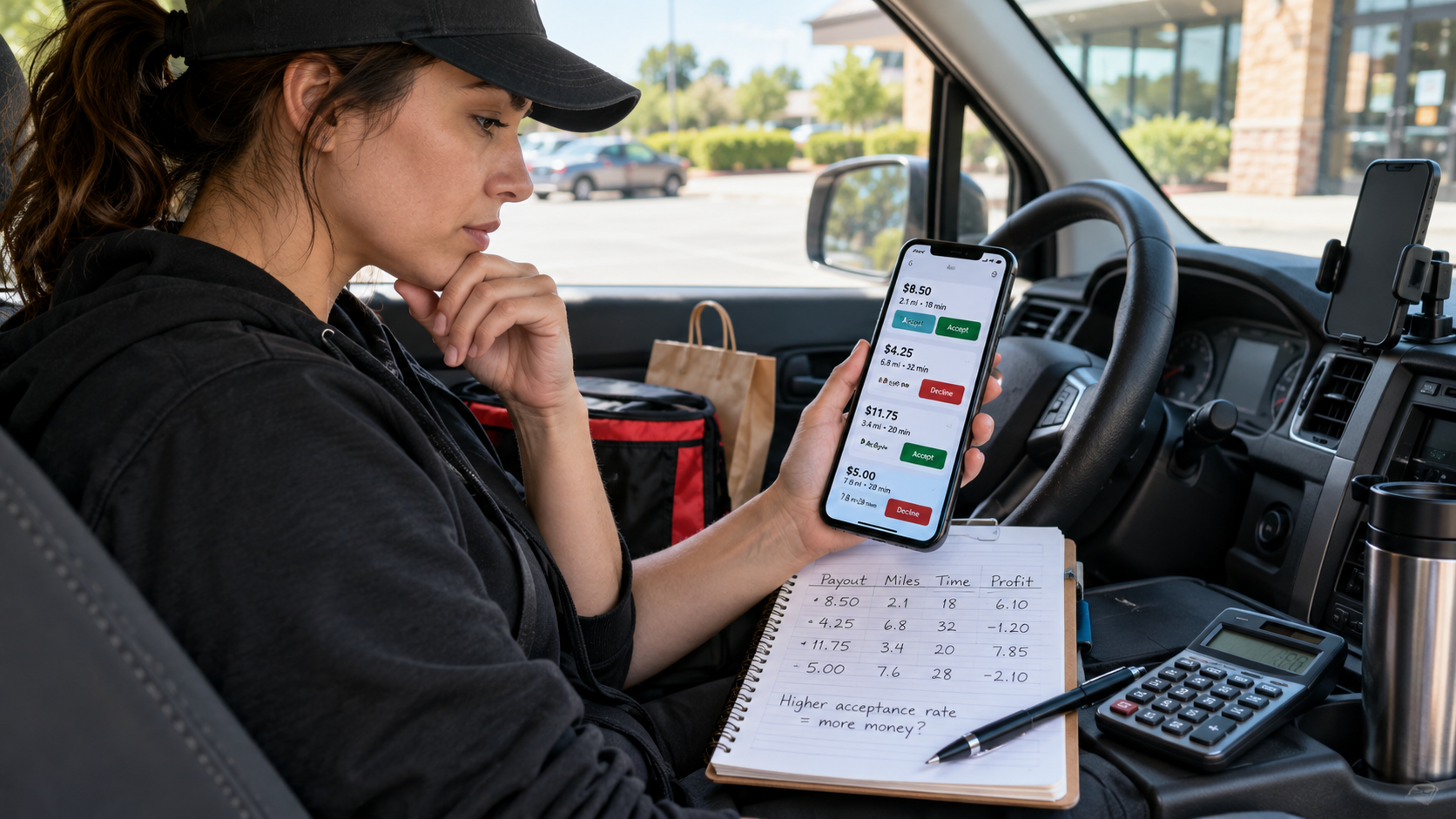
Delivery drivers hear a lot about acceptance rate.
Some drivers try to keep it high.
Others decline aggressively and wait for better offers.
That raises an important question:
Does a higher acceptance rate actually make delivery drivers more money?
Not necessarily.
Accepting more offers can increase the number of deliveries you complete.
But completing more deliveries is not the same thing as keeping more profit.
The quality of the offers matters.
So do the miles, time, vehicle costs, waiting, and where each delivery leaves you afterward.
Acceptance Rate Measures Decisions, Not Profit
Acceptance rate generally tells you how often you accept the offers shown to you.
It does not tell you whether those offers were profitable.
A driver can have a very high acceptance rate and still accept:
- Low-paying offers
- High-mileage trips
- Long waits
- Difficult drop-offs
- Expensive return drives
- Orders that take too much time
Another driver may accept fewer offers but choose trips that produce stronger profit.
More Accepted Offers Do Not Automatically Mean More Money
Imagine two drivers work the same five-hour period.
Driver A accepts nearly everything and completes 10 deliveries.
Driver B completes six deliveries.
At first glance, Driver A may appear more productive.
But what if Driver A drove twice as many miles and accepted several weak-paying orders?
Driver B could finish with fewer deliveries and still produce more TRUE profit.
The number of accepted offers does not tell the whole story.
Gross Earnings Can Hide the Difference
A high acceptance rate may help keep a driver busy.
Being busy can increase gross earnings.
But gross earnings are only the money coming in.
They do not account for what it cost to earn that money.
Compare What You Keep
Suppose Driver A earns $180.
Driver B earns $160.
Driver A looks ahead by $20.
But Driver A also drives considerably more miles and spends more time working.
After fuel and vehicle costs, the difference may disappear.
Driver B could even finish with more TRUE profit despite earning less gross income.
That is why acceptance rate should not be judged by gross earnings alone.
Mileage Can Turn Activity Into Expense
Every additional accepted offer can create more driving.
That may include:
- Driving to pickup
- Driving to the customer
- Returning from the delivery
- Repositioning afterward
Those miles use fuel and vehicle life.
A Weak Offer Still Costs Money to Complete
Suppose an offer pays $8.
If it requires very little mileage and takes only a short amount of time, it may work.
But another $8 offer could require a long drive, a slow pickup, and several unpaid miles afterward.
The payout is identical.
The cost is not.
Accepting both just to maintain a higher acceptance rate does not make the two offers equally valuable.
Time Matters Just as Much as Mileage
Some offers do not look terrible based on distance.
The problem is time.
A delivery might involve:
- A long pickup wait
- Heavy traffic
- Apartment access
- Difficult parking
- Multiple stops
- A slow return to your delivery area
A Delivery Can Be Profitable Per Mile but Weak Per Hour
Imagine a short-mileage offer that pays $10.
The mileage looks excellent.
But the delivery takes 45 minutes because of a long wait.
That order may have strong payout per mile while producing weak profit per hour.
This is why offer quality cannot be judged by acceptance rate or mileage alone.
Declining an Offer Also Has a Cost
There is another side to the decision.
Declining every mediocre offer does not automatically create more profit either.
If you decline repeatedly and then sit for 30 minutes without another useful offer, that waiting time affects your workday.
The Next Offer Is Not Guaranteed
When you decline an offer, you are making a tradeoff.
You are giving up the current opportunity in hopes that a better one appears.
Sometimes that is the right choice.
Sometimes the next offer is worse.
Sometimes nothing arrives.
That is why extreme rules can be difficult.
Accept everything can hurt profit.
Decline almost everything can also leave you sitting too long.
The better approach is to evaluate the actual offer.
Your Delivery Area Changes the Answer
Acceptance strategy can work differently depending on where you drive.
A busy area with frequent offers gives drivers more opportunities to be selective.
A smaller or slower area may provide fewer choices.
Offer Frequency Matters
Suppose Driver A receives another offer almost immediately after declining one.
Driver B may wait 15 or 20 minutes for the next opportunity.
The cost of declining is different for those two drivers.
This is one reason another driver's acceptance strategy may not work in your area.
Your own results matter more.
Different Times of Day Can Require Different Strategies
Offer quality and frequency can change throughout the day.
Lunch may behave differently from mid-afternoon.
Dinner may behave differently from late night.
Weekends may behave differently from weekdays.
A Strategy That Works During Busy Hours May Fail During Slow Hours
During a strong period, you may be able to decline weak offers because better opportunities arrive quickly.
During a slower period, being too selective may create long stretches of unpaid waiting.
The best strategy may change throughout the workday.
High-Paying Offers Can Still Be Bad Offers
A large payout can make almost any offer look tempting.
But high payout does not automatically mean high profit.
Suppose you see a $25 offer.
Before accepting, consider:
- Total mileage
- Time
- Pickup distance
- Expected wait
- Number of stops
- Destination
- Return miles
- Vehicle cost
The Full Trip Determines the Result
A $25 offer that takes 90 minutes and leaves you far outside your delivery area may be weaker than a $16 offer that takes 30 minutes and keeps you near your next pickup.
Acceptance rate cannot tell you which one was better.
Profit can.
Low-Paying Offers Are Not Automatically Bad Either
It is also possible to dismiss an offer simply because the payout looks small.
That can be a mistake.
A smaller offer could be:
- Very short
- Very fast
- Near your current location
- Easy to complete
- Close to another pickup
- Strong in profit per mile
- Strong in profit per hour
Judge the Whole Offer
The payout matters.
But it is only one part of the decision.
What you keep after the trip matters more.
Return Miles Can Change Acceptance Decisions
Where a delivery ends can be just as important as where it begins.
An offer may take you far from your next useful pickup area.
That can create several unpaid miles after the delivery.
The Offer Screen Does Not Always Show the Whole Workday
If you accept a trip that sends you far away, your work may not end when the order is delivered.
You may still need to drive back.
That return time and mileage can reduce profit.
A higher acceptance rate that repeatedly sends you into weak locations can make your entire shift less efficient.
Chasing a Percentage Can Distract From the Real Goal
Drivers naturally notice numbers shown in their apps.
Acceptance rate is easy to see.
Profit is harder to see.
That can make acceptance rate feel more important than it actually is to your bottom line.
Your Goal Is Not Just to Improve a Percentage
The goal is to produce a worthwhile result from your time and vehicle.
A percentage on a screen does not pay for:
Fuel.
Tires.
Brakes.
Maintenance.
Repairs.
Vehicle depreciation.
Your time.
Profit does.
Platform Programs Can Change
Delivery platforms may use acceptance-related programs, tiers, rewards, or access rules.
Those programs can differ by platform, area, and time.
Drivers should always check the current rules inside the platforms they use.
A Program Benefit Still Has to Be Worth the Cost
Even if maintaining a certain acceptance rate provides some type of benefit, the important question remains:
What does it cost you to maintain it?
If reaching or keeping a percentage requires repeatedly accepting unprofitable trips, the benefit needs to outweigh those losses.
That is something each driver should measure with their own results.
Measure Acceptance Strategy With Real Numbers
Instead of guessing whether a higher acceptance rate helps you, compare your own shifts.
Track periods where you accept more offers.
Then compare them with periods where you are more selective.
Look at More Than Acceptance Rate
Compare:
- Gross earnings
- TRUE profit
- Total miles
- Total hours
- Fuel cost
- Vehicle cost
- Profit per mile
- Profit per hour
- Waiting time
- Return miles
That gives you a much stronger answer.
Watch for Weak Offers That Repeat
One bad delivery may not destroy a shift.
But repeatedly accepting weak offers can.
A few extra miles here.
A long wait there.
A low payout.
Another return trip.
Over an entire workday, those small losses can add up.
Patterns Matter More Than One Order
This is why reviewing an entire shift or week is useful.
You may discover that certain types of offers consistently reduce your results.
Once you recognize those patterns, future decisions become easier.
Do Not Confuse Activity With Productivity
A high acceptance rate can make you feel busy.
Your phone keeps sending you somewhere.
You are constantly picking up and dropping off.
The workday feels active.
But activity does not automatically equal profit.
A Better Shift Can Sometimes Be Less Busy
A driver who completes fewer, stronger offers may:
Drive fewer miles.
Use less fuel.
Put less wear on the vehicle.
Spend less time working.
Keep more money.
That is the result worth measuring.
Your Minimum Should Come From Your Numbers
Instead of accepting or declining based only on acceptance rate, it helps to know your own minimum.
That minimum may consider:
- Required payout
- Total mileage
- Expected time
- Vehicle cost
- Profit goal
- Destination
One Driver's Minimum May Not Work for Another
A driver with a fuel-efficient car has different costs from a driver with a larger vehicle.
A driver in a dense city has different conditions from a driver covering rural distances.
That is why universal acceptance rules are difficult.
Your numbers should guide your decisions.
Profit Per Hour Can Reveal a Bad Acceptance Strategy
Suppose your gross earnings increase after accepting more offers.
That sounds good.
Now look at profit per hour.
If the additional deliveries require much more time and mileage, your TRUE profit per hour may actually fall.
More Earnings Can Still Produce a Worse Workday
If you work two additional hours to make another $30 but create significant vehicle costs along the way, those extra hours may not have improved the day very much.
Gross earnings alone would not reveal that.
Profit per hour can.
Profit Per Mile Shows What Your Vehicle Is Producing
Profit per mile helps show how efficiently your vehicle is being used.
If raising your acceptance rate causes your mileage to climb much faster than your profit, that is important information.
Protect the Tool That Makes the Income Possible
Your vehicle is one of the biggest tools in delivery work.
Using it more should ideally produce enough additional profit to justify the extra mileage.
If it does not, accepting more offers may not be helping.
So, Does a Higher Acceptance Rate Make More Money?
It can.
But it can also do the opposite.
A higher acceptance rate may help when the additional offers are profitable and keep your workday efficient.
It may hurt when maintaining that rate requires accepting low-paying, high-mileage, slow, or poorly positioned deliveries.
The percentage itself does not provide the answer.
Your results do.
Focus on the Numbers That Affect Your Pocket
Acceptance rate is one number.
It can be useful information.
But it should not replace the numbers that show what your work actually produced.
Pay attention to:
TRUE profit.
Profit per mile.
Profit per hour.
Total mileage.
Total time.
Vehicle costs.
Waiting.
Return miles.
Those measurements tell you much more about whether your delivery strategy is working.
TRUE Driver Profit is designed to help drivers evaluate the complete trip instead of relying on one number from an offer screen.
Because accepting more work only makes sense when the additional work is actually worth doing.
Related reading