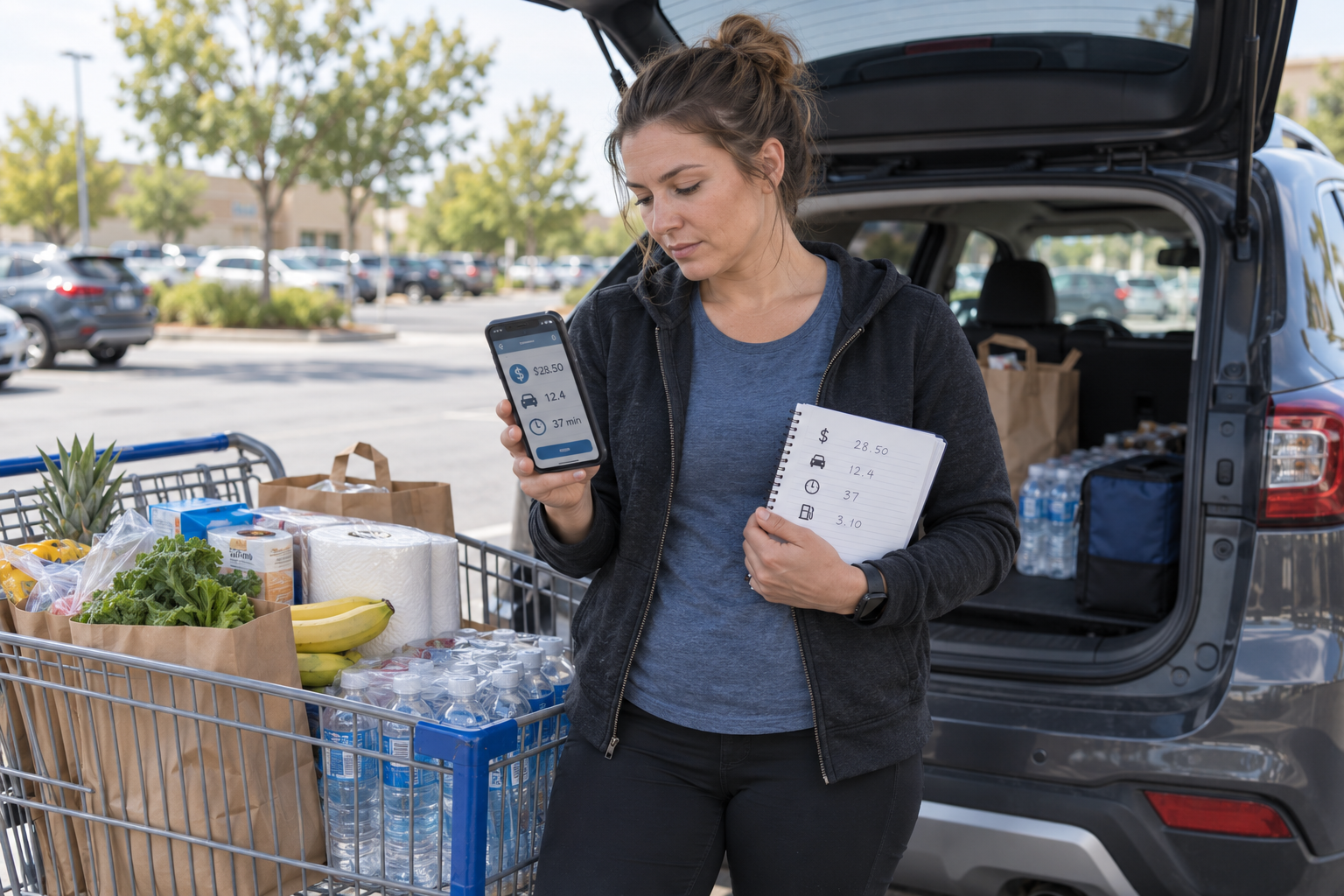
Shop and deliver orders can look attractive because they often show larger payouts than simple pickup orders. However, the payout alone does not tell you whether the order is worth taking.
You may need to find dozens of products, communicate about substitutions, wait in a checkout line, load the vehicle, complete the drive, and carry everything to the customer.
A profitable decision requires looking at the entire order, not just the amount displayed on the offer screen.
Why shop and deliver orders are different
A normal pickup order usually has three main parts:
- Drive to the pickup
- Wait for the order
- Deliver it to the customer
A shop and deliver order adds another major responsibility. You must enter the store and complete the shopping yourself.
This creates several additional factors:
- Number of products
- Number of total units
- Store layout
- Product availability
- Substitutions
- Customer response time
- Checkout delays
- Heavy or bulky items
These factors can make two orders with similar payouts produce very different results.
Start with the complete payout
The payout is still important. It is the money available to cover your time, fuel, vehicle costs, and profit.
Before accepting, look at how much of the displayed amount is guaranteed and how much may depend on an estimated tip.
A large estimated tip can make an order appear stronger than its guaranteed payout. Consider how the order would perform if the final tip changes.
You should also consider whether the payout is enough to cover both the shopping and delivery portions of the work.
Estimate the real time required
Shopping time is only one part of the order. You need to estimate the complete time from acceptance until you are ready for another profitable delivery.
Driving to the store
The miles and minutes required to reach the store belong in your decision.
An order with a nearby customer can still take too long if you are far from the pickup location.
Shopping for the order
Item count can provide a starting point, but it does not reveal everything.
Ten familiar products in one section of a store may be easier than five products scattered across the entire building.
Consider:
- How well you know the store
- Whether products are easy to locate
- How crowded the store may be
- Whether locked cases require employee assistance
- How likely substitutions may be
- Whether the customer responds quickly
Checking out and loading
The shopping is not finished when the final product enters the cart.
You may still need to:
- Wait in a checkout line
- Scan and pay for the order
- Bag the products
- Verify the receipt
- Move the cart to your vehicle
- Load everything safely
A crowded checkout area can add significant unpaid time.
Driving and completing the drop-off
The delivery portion still includes mileage, traffic, parking, unloading, and the final walk to the customer.
Apartments, stairs, gates, long driveways, and difficult parking can make a large grocery order take much longer than expected.
Item count does not tell the whole story
A twenty-item order is not automatically worse than a ten-item order.
The type of products matters just as much as the number shown.
Unique products versus total units
An order may list ten products but include several units of each one.
Finding ten unique products is different from transporting forty total units.
Repeated units may be easy to shop for, but they can increase cart space, loading time, and the number of trips required at the drop-off.
Heavy and bulky products
Cases of water, large bags of pet food, soda, and other heavy products add physical effort and unloading time.
They can also create problems when:
- The order is going upstairs
- Parking is far from the entrance
- The customer has a long walkway
- Several trips are required
- Your vehicle has limited cargo space
The payout should reflect the complete work required.
Substitutions and unavailable products
Out-of-stock products can slow down an otherwise simple order.
You may need to search nearby shelves, locate an employee, send substitution choices, and wait for the customer to respond.
One difficult product can take longer than several easy ones.
Mileage still matters
A larger shopping payout can make drivers overlook the mileage attached to the order.
Count the complete route:
- Your location to the store
- The store to the customer
- Any likely return or repositioning miles
- The distance required to reach your next useful pickup area
An order that ends far outside your normal delivery area may create a long unpaid return drive.
Those miles use fuel and add wear to your vehicle even when the delivery app is no longer paying you.
Compare profit per hour and profit per mile
Shop and deliver orders should be measured with the same profit standards as every other delivery.
Profit per hour helps you judge whether the complete order paid enough for your time.
Profit per mile helps you judge whether the order paid enough for the distance and vehicle use.
Suppose a shop and deliver order pays $30 but takes 75 minutes and requires 16 total business miles.
The $30 is not your final profit. Fuel and vehicle costs still need to be removed. You also need to decide whether the remaining amount meets your hourly and mileage goals.
A larger payout can still be a weak order when the shopping time or total mileage becomes excessive.
Store familiarity can improve your results
Experience inside a store can make a major difference.
When you know the layout, you may be able to:
- Find products faster
- Plan an efficient path through the store
- Recognize common substitutions
- Avoid unnecessary backtracking
- Choose faster checkout options
- Estimate shopping time more accurately
This does not make every order profitable. It simply helps you make a more realistic decision.
A strong order at a familiar store may become a frustrating order at an unfamiliar location.
When a shop and deliver order may be worth taking
A shop and deliver order may be a good opportunity when:
- The payout covers the complete work
- The store is nearby
- The product list is manageable
- The items are familiar and easy to locate
- The store is not unusually crowded
- The delivery distance is reasonable
- The drop-off appears manageable
- The destination leaves you near more opportunities
- The expected profit meets your goals
No single factor guarantees a good result. The entire combination matters.
Warning signs to consider
A shop and deliver order may deserve extra caution when:
- The payout is low for the product count
- The store is far from your current location
- The order includes many unique products
- Several products are heavy or bulky
- The store frequently has inventory problems
- The customer is far from the store
- The destination requires a long return drive
- The drop-off may require several trips
- The estimated time would produce weak profit per hour
A large payout should not distract you from difficult details.
Review the actual result after delivery
Your estimate will not always be perfect. Reviewing the completed order helps improve future decisions.
After the delivery, record:
- Final payout
- Confirmed tip
- Total business miles
- Shopping time
- Checkout and loading time
- Delivery time
- Fuel and vehicle costs
- Profit per hour
- Profit per mile
- Any unusual difficulties
Over time, these records can reveal which stores, order sizes, delivery distances, and working hours produce your strongest results.
Are shop and deliver orders worth it?
Shop and deliver orders can be profitable, but they are not automatically better because they offer larger payouts.
The right order should compensate you for shopping, waiting, driving, vehicle use, and the difficulty of the drop-off.
Look beyond the displayed payout. Estimate the complete time, count the complete mileage, consider the products, and calculate what you are likely to keep.
A shop and deliver order is worth taking when the complete job meets your personal profit goals.
Related reading