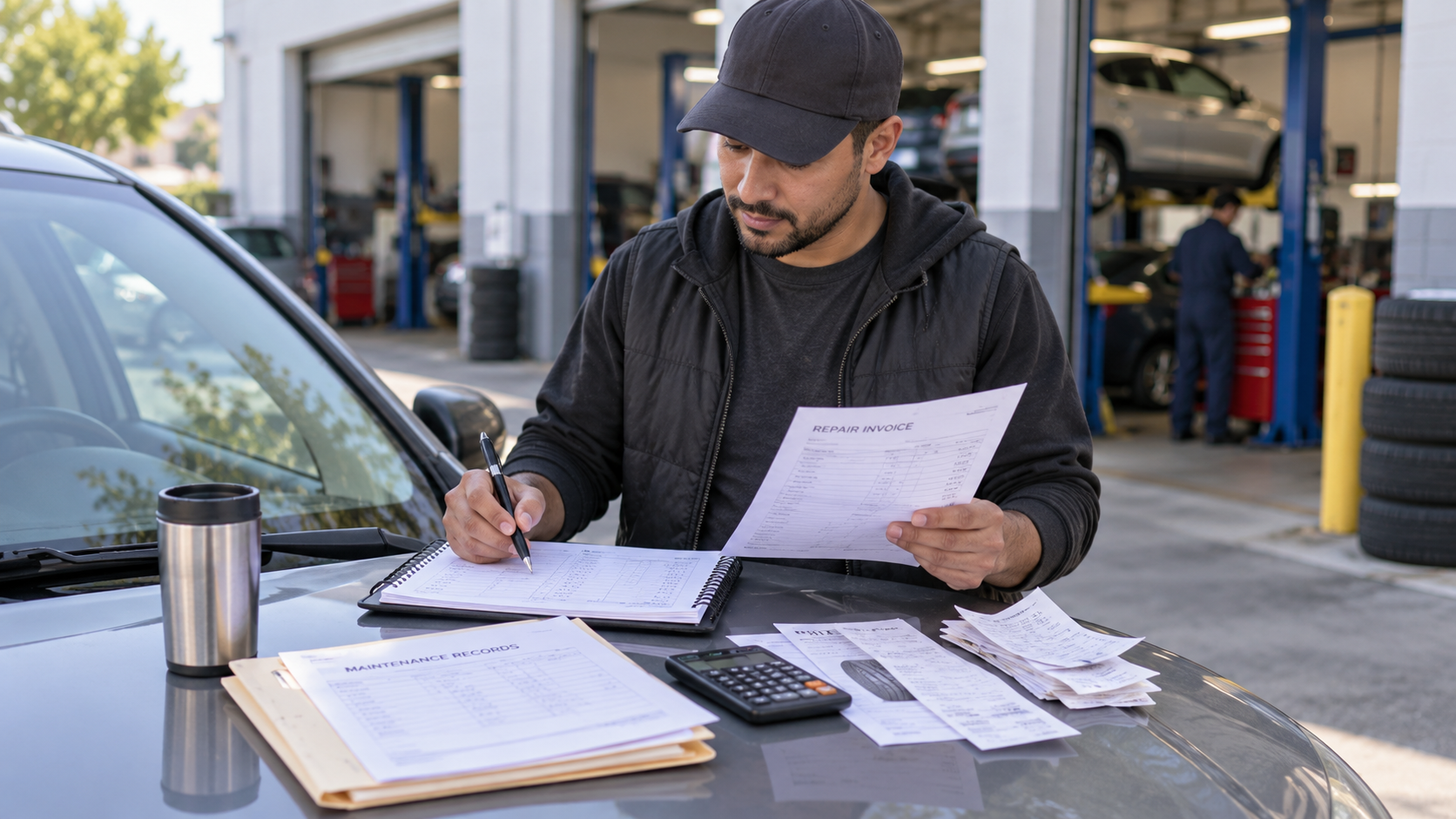
Delivery drivers put more wear on their vehicles than many ordinary drivers.
Oil changes come faster.
Tires wear out sooner.
Brakes may need attention more often.
Repairs can show up when you least expect them.
That makes one question especially important:
Can delivery drivers deduct car repairs and maintenance?
The answer depends on which vehicle-expense method you use and how much of the vehicle is used for business.
Can delivery drivers deduct car repairs and maintenance?
Possibly.
If you use the actual-expense method, the business-use portion of eligible repairs and maintenance may generally be included as vehicle expenses.
If you use the standard mileage method, those costs are generally already represented in the mileage rate.
That means you usually cannot take the standard mileage deduction and then add repairs and maintenance separately on top of it.
The deduction method matters
This is the same basic rule that applies to fuel, insurance, tires, and other vehicle costs.
You generally use either:
- Standard mileage
- Actual vehicle expenses
The method you use determines how those costs are handled for tax purposes.
What counts as repairs and maintenance?
Repairs and maintenance can include many of the normal costs of keeping a vehicle safe and operating properly.
Possible expenses can include:
- Oil changes
- Brake service
- Tire replacement
- Tire repair
- Battery replacement
- Alignment
- Belts and hoses
- Filters
- Wiper blades
- Suspension repairs
- Engine repairs
- Transmission repairs
- Diagnostic work
Routine maintenance and major repairs are different costs
An oil change may cost relatively little.
A transmission repair may cost thousands of dollars.
Both can affect your delivery business.
That is one reason drivers should track actual vehicle costs even if they use standard mileage for taxes.
Are repairs included in the standard mileage rate?
Yes.
The standard mileage rate is designed to account for many of the costs of owning and operating a vehicle.
That includes maintenance and repairs.
Do not deduct the same cost twice
If you use the standard mileage method, you generally do not add separate deductions for:
- Oil changes
- Repairs
- Tires
- Insurance
- Fuel
- Depreciation
Those costs are already reflected in the mileage rate.
Trying to claim both can result in counting the same vehicle cost twice.
How does the actual-expense method work?
With the actual-expense method, you track what you actually spent on the vehicle.
You then determine what percentage of that use was business-related.
Eligible vehicle costs may include:
- Gas
- Insurance
- Repairs
- Maintenance
- Tires
- Registration
- Depreciation
- Lease payments when applicable
Business-use percentage matters
If the vehicle is used for both delivery work and personal driving, you generally cannot treat the entire repair bill as a business expense.
Suppose your car is used 70% for business and 30% for personal driving.
The business portion of an eligible repair may generally be based on that business-use percentage.
Accurate mileage records help support the calculation.
What if the repair happened because of delivery driving?
A repair may feel completely business-related because delivery work caused a lot of the wear.
But tax treatment still depends on how the vehicle is used overall.
Wear caused by delivery work still has to fit the tax method
High-mileage delivery work can absolutely increase repair costs.
That does not automatically mean the entire repair becomes deductible if the vehicle is also used personally.
The business-use percentage still matters when using actual expenses.
Can delivery drivers deduct oil changes?
Under the actual-expense method, the business-use portion of oil changes may generally be included as a vehicle expense.
If you use the standard mileage method, oil changes are already built into the mileage rate.
Oil changes come faster for high-mileage drivers
A driver who puts thousands of business miles on a vehicle each month may need oil changes much more often than someone who drives mostly for personal use.
That makes oil changes a very real cost of delivery work.
Even if you use mileage for taxes, track those actual costs for TRUE profit.
Can delivery drivers deduct tires?
Tires may generally be included as an actual vehicle expense when using the actual-expense method.
Again, business-use percentage matters if the vehicle is also used personally.
Tire costs can be significant
Delivery driving can wear tires quickly, especially when you deal with:
- High annual mileage
- Rough roads
- Potholes
- Gravel roads
- Frequent stops
- Heavy loads
- Poor alignment
Tires are easy to overlook until replacement time arrives.
That is why it is smart to treat them as an ongoing vehicle cost.
What about brakes?
Brake service can also be part of actual vehicle expenses.
Delivery driving often involves more stopping and starting than highway driving.
That can increase brake wear.
Stop-and-go driving adds cost
A driver completing dozens of stops in a shift may put much more stress on brake pads and rotors than someone driving long highway miles.
That wear is part of the real cost of doing the work.
Can major repairs be deducted?
Major repair costs may also be part of actual vehicle expenses, depending on the nature of the repair and applicable tax rules.
Some repairs may be treated differently if they substantially improve the vehicle rather than simply maintaining or restoring it.
Repairs and improvements are not always the same
Fixing a broken part is different from making a major improvement that increases the vehicle's value or extends its useful life.
That distinction can matter for tax treatment.
Large repairs are a good reason to keep detailed invoices and talk with a qualified tax professional if the classification is unclear.
What records should delivery drivers keep?
Good records make it much easier to understand both tax deductions and TRUE profit.
Keep documents such as:
- Repair invoices
- Maintenance receipts
- Tire receipts
- Parts receipts
- Service records
- Mileage logs
- Odometer readings
- Payment records
Keep the details
A receipt that simply shows a total may not be as useful as an invoice that lists the work performed.
Try to keep records showing:
- Date
- Vehicle
- Work performed
- Cost
- Shop or service provider
That makes it easier to understand what the expense was for later.
What if you do your own repairs?
If you perform your own maintenance or repairs, the cost of parts and supplies may be relevant.
Your own labor is generally not treated the same as an amount paid to someone else.
Keep receipts for parts and supplies
If you buy:
- Oil
- Filters
- Brake pads
- Wiper blades
- Batteries
- Tools or supplies
Keep the receipts.
Whether each item qualifies and how it should be treated can depend on the circumstances.
What if you repair the vehicle after an accident?
Accident-related repairs can involve additional tax and insurance questions.
Insurance reimbursements may affect how the expense is treated.
Insurance payments matter
If an insurance company pays for part of a repair, you generally cannot treat the full repair amount as though you personally paid all of it.
Keep records showing:
- Repair cost
- Insurance reimbursement
- Deductible paid
- Amount you personally paid
Accident-related situations can become more complicated than routine maintenance.
Does maintenance still matter if you use standard mileage?
Absolutely.
For tax purposes, standard mileage may already account for maintenance.
But for your business decisions, the actual cost still matters.
TRUE profit is based on real costs
Suppose you use standard mileage for your tax deduction.
You still pay real money when:
- Tires need replacing
- Brakes wear out
- The battery dies
- The alternator fails
- The transmission needs repair
Those costs reduce what you actually keep from delivery work.
Why maintenance reserves matter
One of the biggest mistakes drivers make is treating every payout as spendable income.
Vehicle repairs do not arrive evenly.
You may go months with very little expense and then suddenly face a large repair bill.
Save before something breaks
A maintenance reserve can help spread that cost over time.
Instead of waiting for a $1,200 repair to become an emergency, set aside part of your delivery income regularly.
The amount you need depends on your vehicle, mileage, age, condition, and driving environment.
Older vehicles can change the math
An older vehicle may have no car payment.
That can look very attractive for delivery work.
But older vehicles may also need more repairs.
No payment does not mean no vehicle cost
A paid-off car can still cost money through:
- Repairs
- Maintenance
- Tires
- Fuel
- Insurance
- Depreciation
- Downtime
You need the whole picture before deciding whether a vehicle is inexpensive to operate.
Newer vehicles have costs too
A newer vehicle may need fewer repairs.
But it can have higher:
- Payments
- Insurance
- Depreciation
- Registration costs
There is always a tradeoff.
Compare total vehicle cost
Do not judge a delivery vehicle by one expense.
Look at:
- Payment
- Fuel
- Insurance
- Repairs
- Maintenance
- Tires
- Depreciation
- Reliability
The best delivery vehicle is not always the cheapest one to buy.
It is the one that produces the best overall cost for the work you actually do.
Downtime is also a cost
When your vehicle is in the shop, you may lose the ability to earn money.
That lost earning opportunity can matter just as much as the repair bill.
Reliability has value
A cheaper vehicle that breaks down frequently may cost more in the long run than a more reliable vehicle with slightly higher fixed costs.
That is especially true if delivery work is an important part of your income.
Maintenance affects which offers are really profitable
Every delivery adds wear to the vehicle.
That wear may not show up as a bill today.
But it still exists.
A high-mile offer has more than a fuel cost
When you evaluate a delivery offer, consider more than gas.
Additional miles can contribute to:
- Tire wear
- Brake wear
- Oil changes
- Suspension wear
- Future repairs
- Depreciation
That is why mileage matters so much when judging whether an offer is actually worth taking.
The bottom line
Delivery drivers may generally include the business-use portion of eligible repairs and maintenance when using the actual-expense method.
If you use the standard mileage method, those costs are generally already represented in the mileage rate and should not be deducted separately.
But the tax method is only part of the picture.
Repairs and maintenance still reduce your real earnings.
Track them.
Plan for them.
And include them when thinking about your TRUE vehicle cost.
The more miles you drive, the more important it becomes to understand what keeping that vehicle on the road is really costing you.
Related reading
This article is for general educational information and is not tax advice. Vehicle-expense rules can depend on the deduction method, business-use percentage, type of repair, insurance reimbursements, and individual circumstances. Review current IRS guidance or speak with a qualified tax professional about your situation.