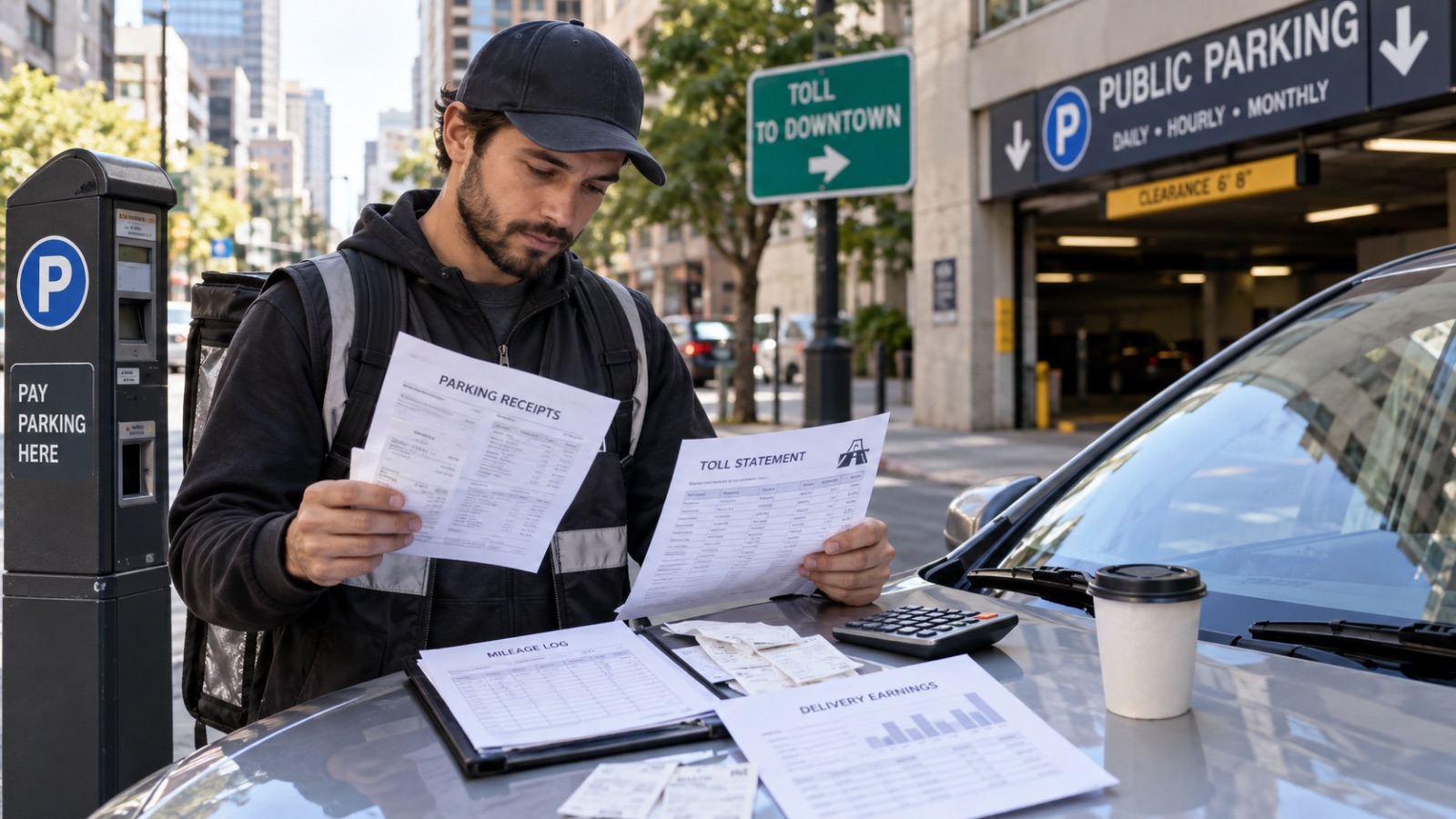
Delivery drivers sometimes pay expenses that are easy to overlook.
Parking meters.
Parking garages.
Bridge tolls.
Toll roads.
These costs may be small individually, but they can add up over a year.
So can delivery drivers deduct parking fees and tolls?
In many cases, qualifying business parking fees and tolls may be deductible when they are directly connected to your delivery work.
Can delivery drivers deduct parking fees?
Possibly.
Parking fees paid while conducting business may generally qualify as business expenses.
That can include parking required to complete delivery-related activity.
Business purpose matters
The key question is why you paid for the parking.
If you pay to park while completing a delivery, picking up an order, or handling another legitimate business task, the expense may be connected to your delivery business.
Personal parking is different.
Can delivery drivers deduct tolls?
Qualifying tolls paid while driving for business may also generally be deductible.
That can include toll roads, bridges, tunnels, and other toll facilities used during business driving.
Tolls can be separate from mileage
One useful thing for delivery drivers to understand is that qualifying business tolls may generally be deducted separately even when you use the standard mileage method.
That makes toll records worth keeping.
Are parking fees included in the standard mileage rate?
Not all parking fees are included in the mileage rate.
Qualifying business parking fees can generally be deducted separately from the standard mileage deduction.
This is different from fuel and repairs
Fuel, insurance, maintenance, repairs, and depreciation are generally built into the standard mileage rate.
Business parking fees and tolls are treated differently.
That is why they can often be added separately when they qualify.
What parking fees can count?
Examples may include:
- Parking meters
- Parking garages
- Paid business parking lots
- Airport parking for qualifying business activity
- Short-term parking required to complete a delivery
The expense should have a clear business connection.
Personal parking does not become deductible
Paying to park while shopping for yourself, going to dinner, attending a personal event, or handling another personal activity is not a business expense.
The parking has to be connected to delivery work or another legitimate business purpose.
What tolls can count?
Business tolls may include fees paid for:
- Toll roads
- Bridges
- Tunnels
- Express lanes
- Turnpikes
- Other tolled routes used for delivery work
The route should be business-related
If you use a toll road while completing a delivery, driving between delivery-related locations, or handling another business trip, that toll may be business-related.
A toll paid during a personal trip is not.
What if you use an electronic toll pass?
Electronic toll systems can actually make recordkeeping easier.
Instead of relying on paper receipts, you may have a detailed online statement showing your toll activity.
Keep the statements
Electronic toll records can show:
- Date
- Time
- Toll amount
- Location
- Vehicle
- Route
Those details can make it much easier to separate business tolls from personal tolls.
What if one toll account is used for both business and personal driving?
That is common.
You simply need to separate the business-related tolls from the personal ones.
Review the account regularly
Do not wait until tax season to sort through an entire year of toll records.
Review them monthly or weekly.
Mark which tolls were connected to delivery work while you still remember the trips.
What if parking is paid through an app?
Many cities now use mobile parking apps.
Those apps can provide useful digital records.
Save the transaction history
Parking-app records may show:
- Date
- Time
- Location
- Amount paid
- Duration
Those records can be much easier to organize than paper meter receipts.
Can delivery drivers deduct parking tickets?
No.
Parking tickets and other fines are generally not deductible business expenses.
A fine is different from a parking fee
Paying $5 to legally park while making a delivery is not the same as receiving a $50 ticket for illegal parking.
The first may be a business expense.
The second is a penalty.
That distinction matters.
Can delivery drivers deduct speeding tickets or traffic fines?
Generally, no.
Fines and penalties paid for breaking the law are not typically deductible business expenses.
That includes things such as:
- Speeding tickets
- Parking tickets
- Red-light violations
- Other traffic fines
Business use does not make a fine deductible
It does not matter that you were making a delivery when the ticket happened.
The fact that the violation occurred during work generally does not turn the penalty into a deductible expense.
What about parking at a pickup location?
If you must pay to park while picking up an order, that fee may be directly connected to the delivery.
Keep the receipt when possible
A receipt or digital record can help show the amount and location.
You may also want to make a quick note identifying the delivery or business purpose.
That makes the record easier to understand later.
What about parking at the customer location?
The same principle applies.
If paid parking is required to complete the delivery, the expense may be business-related.
Short-term fees still add up
A $2 or $3 parking charge may not seem important.
But if you pay several each week, the total can become significant over a year.
Small expenses are easy to ignore.
That does not mean they are not real business costs.
What about airport deliveries?
Airport pickups and deliveries can create parking and toll expenses.
If the expense is directly connected to your delivery work, it may potentially qualify as a business expense.
Airports can create multiple costs
A single airport trip might involve:
- Toll roads
- Parking
- Entry fees
- Additional mileage
- Extra waiting time
Those costs can quickly change whether an order was actually profitable.
Parking and tolls affect TRUE profit too
Taxes are only one part of the picture.
Even if a parking fee or toll is deductible, you still paid the money.
That expense reduces what you actually earned from the order.
A delivery can look better before hidden fees
Imagine a delivery that pays $18.
You pay:
- $3 in parking
- $2.50 in tolls
You have already lost $5.50 of the payout before considering fuel, vehicle wear, and time.
The delivery is no longer an $18 job in practical terms.
Drivers should think about toll routes before accepting offers
Some routes may require tolls or make toll roads much faster than free alternatives.
That can affect whether the offer is worth taking.
Time and money can trade places
You may have two choices:
A free route that adds 20 minutes.
Or a toll route that costs $4 but saves significant time.
Neither option is automatically better.
The better choice depends on:
- Payout
- Mileage
- Toll cost
- Time saved
- Traffic
- Where the delivery ends
- Your next earning opportunity
Keep parking and toll records organized
A simple recordkeeping system can make tax time much easier.
Useful records may include:
- Paper receipts
- Parking-app history
- Toll-pass statements
- Bank transactions
- Credit-card statements
- Delivery notes
Add the business purpose
When the reason is not obvious, add a short note.
For example:
"Parking for customer delivery."
"Toll road to pickup."
"Garage fee for downtown drop-off."
That can help you remember why the expense occurred.
Should drivers track small parking fees?
Yes.
Small expenses add up.
Ignoring them gives you an incomplete picture of what delivery work actually costs.
Profit can leak away in small amounts
A few dollars here and there may not feel important.
But over hundreds of deliveries, those little costs can become hundreds of dollars.
That matters for both business records and TRUE profit.
Parking and tolls are different from vehicle operating costs
Fuel, repairs, tires, insurance, and depreciation relate to operating the vehicle itself.
Parking and tolls are more closely tied to specific trips and routes.
That makes them useful offer-level costs
When a particular delivery requires a toll or paid parking, you can often connect that expense directly to the order.
That makes it easier to see how much that specific delivery really earned.
Do not ignore costs just because they may be deductible
A tax deduction does not erase the cost.
If you spend $6 on tolls, you are still $6 out of pocket.
Tax savings are not the same as reimbursement
A deduction can reduce taxable income.
It does not normally return the full amount you spent.
That is why tolls and parking still need to be considered when evaluating profitability.
The bottom line
Delivery drivers may generally be able to deduct qualifying business parking fees and tolls.
These expenses can often be deducted separately even when using the standard mileage method.
The key is business purpose and good records.
Keep parking receipts.
Save toll statements.
Separate personal expenses from business expenses.
And remember that every toll and parking fee affects your TRUE profit whether or not you eventually deduct it on your tax return.
Related reading
This article is for general educational information and is not tax advice. Parking and toll deductions depend on business purpose and individual circumstances. Review current IRS guidance or speak with a qualified tax professional about your situation.