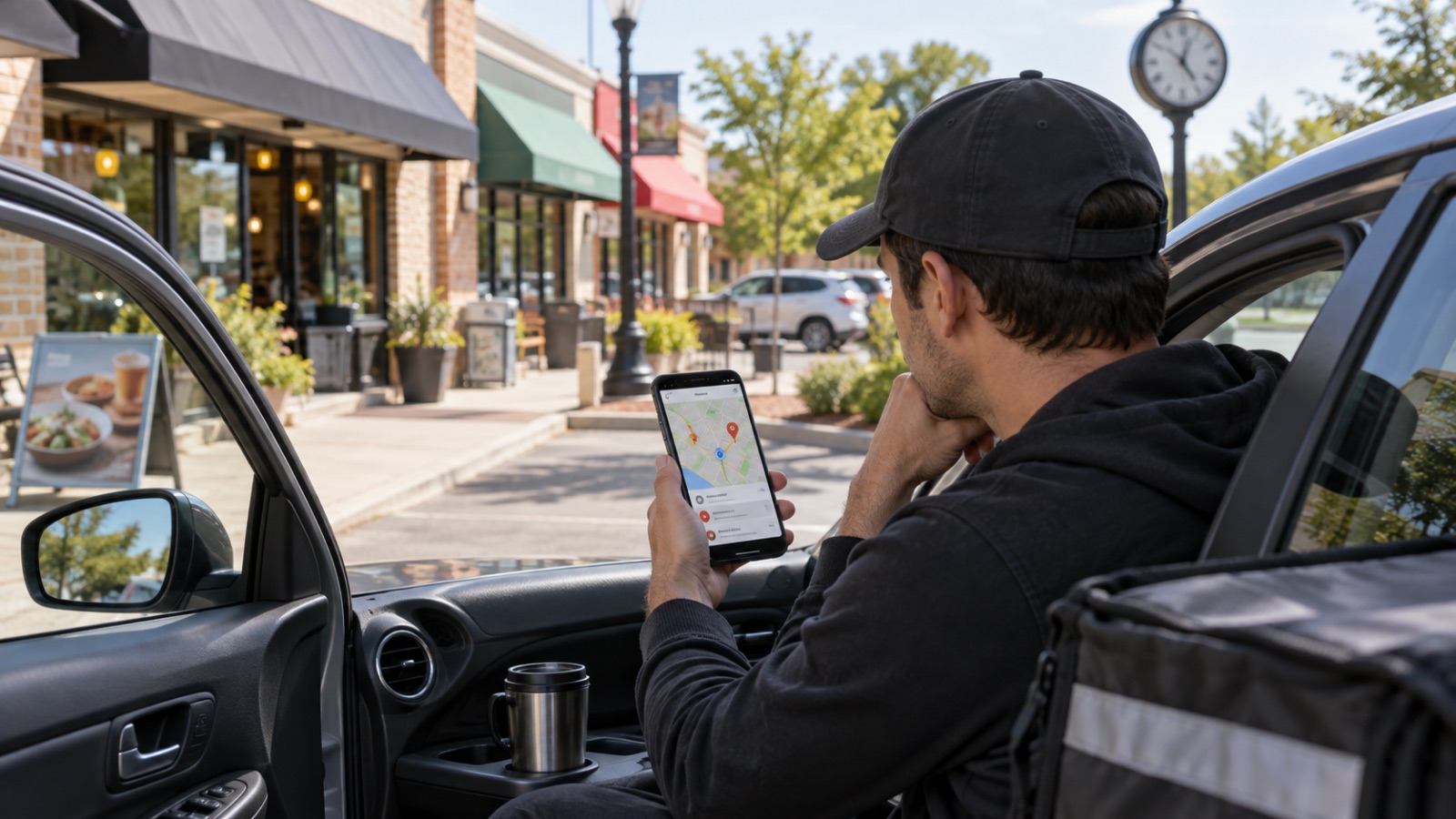
Finishing a delivery creates a decision that drivers make dozens of times.
Do you stay where you are and wait for another order?
Or do you start driving toward another pickup area?
Waiting too long can waste valuable working time.
But moving too quickly can be just as expensive because you may burn fuel, add vehicle miles, and still end up waiting somewhere else.
There is no single number of minutes that works for every driver.
The better question is:
How do you know when staying put is still reasonable and when it may be time to move?
There is no universal waiting limit
You may hear drivers say things like:
"I leave after 10 minutes."
"I never wait more than 15."
"I stay until I get something."
Those rules may work for that driver in that location.
They are not universal.
Your situation changes the answer
How long you should wait can depend on:
- Time of day
- Day of the week
- Your current location
- Nearby pickup locations
- Recent order activity
- The quality of offers you are receiving
- Traffic
- Distance to another useful area
- Fuel and vehicle costs
- How much working time you have left
A reasonable decision at noon on Saturday may be a poor decision at 2:30 on Tuesday afternoon.
Waiting is not always the problem
Sitting still can feel unproductive.
You are not completing an order.
You are not seeing earnings increase.
That can create pressure to start driving.
But staying parked for a few minutes may actually be cheaper than driving around without an order.
Parked miles cost less than empty driving miles
If you are parked safely with the vehicle off, you are not adding road miles while you wait.
The moment you start driving toward another area, your vehicle begins using:
- Fuel
- Tires
- Maintenance
- Vehicle life
And there is still no guarantee another order will appear.
That is why "doing something" is not automatically better than waiting.
Look at where the last delivery left you
One of the biggest factors is your current location.
Some deliveries end near restaurants, stores, shopping areas, or other places where you regularly receive orders.
Others leave you far away from useful pickup areas.
A good drop-off location may be worth waiting in
Suppose your delivery ends one mile from several places where you commonly receive worthwhile orders.
It may make sense to stay nearby for a short period rather than immediately driving somewhere else.
A poor drop-off location changes the decision
Now suppose the delivery ends eight miles into a rural area with few or no nearby pickup opportunities.
Waiting there may not accomplish much.
In that situation, beginning the return drive may make more sense because you already know you need to reposition.
Where the order ends should be part of the decision before you accept it.
Recent order activity can tell you something
Think about what has happened during the last 30 to 60 minutes.
Have you been receiving frequent offers?
Did several reasonable orders appear recently?
Or has the app been almost silent?
A sudden slowdown may be temporary
A short quiet period during an otherwise active dinner rush does not necessarily mean you should leave your location immediately.
Demand can come in waves.
Giving the area a few minutes may prevent unnecessary driving.
A longer pattern of weak activity matters more
If you have already spent a long period receiving few or poor offers, the evidence is different.
Continuing to sit in the same location simply because it was good earlier may not be the best use of your time.
Offer quality matters, not just offer frequency
Receiving lots of offers does not automatically mean you are in a good place.
You might receive several orders that are:
- Too low-paying
- Too far away
- Too time-consuming
- Likely to leave you in a bad area
- Poor after return miles
Busy does not always mean profitable
A location can generate constant offers without generating offers you actually want to accept.
That is an important distinction.
Instead of asking:
"Am I getting orders?"
Ask:
"Am I getting orders that meet my goals?"
If the answer is consistently no, moving may become more reasonable.
Do not chase every busy-looking area
Drivers sometimes see another shopping area on the map or remember that another part of town is usually busy.
The temptation is to drive there immediately.
That can create a pattern of constantly chasing possible demand.
Demand may move before you arrive
Imagine driving six miles to another area because you think it will be busier.
By the time you arrive:
- The rush may have slowed
- Other drivers may already be there
- You may still receive no order
- You have added six unpaid miles
Then you may be tempted to move again.
That is how a slow hour can become a high-mileage slow hour.
Set a reasonable observation window
You do not need a rigid universal timer.
But having a personal observation window can stop emotional decision-making.
Give yourself enough time to learn something
For example, after finishing an order in a reasonable pickup area, you might stay parked long enough to observe:
- Whether offers continue appearing
- Whether their quality is acceptable
- Whether demand appears to be slowing
- Whether another nearby area is clearly stronger
The exact time may change depending on the hour and location.
The important part is making a deliberate decision rather than moving every few minutes out of frustration.
Time of day should influence the decision
Delivery demand often changes throughout the day.
During a strong meal period
If you are in a productive area during lunch or dinner, a short quiet period may be worth riding out.
You know there is still a reasonable chance another wave of orders will appear.
During a slow period
The same waiting strategy may not make sense in the middle of a traditionally weak period.
If demand has already faded, staying indefinitely may simply consume your remaining working time.
Knowing your own local patterns can help.
Consider how far the next area actually is
Relocating three blocks is different from relocating eight miles.
Before moving, estimate the real cost of getting there.
Ask yourself:
How many miles will I drive?
How long will it take?
Will traffic slow me down?
Is there a real reason to believe the next area will be better?
If the next area is 15 minutes away, you are committing a meaningful amount of unpaid time before you even have another offer.
Sometimes the best move is toward home
Not every slowdown needs to trigger another search for orders.
If you are near the end of your planned shift, moving toward home can sometimes be the better decision.
You can still evaluate offers along the way
If worthwhile offers appear while you are heading toward home, you can decide whether they fit your goals.
If nothing appears, at least your unpaid movement was taking you somewhere you already needed to go.
That can be better than driving in the opposite direction chasing uncertain demand.
Avoid the frustration-driving trap
A common mistake happens when a driver gets impatient.
Five quiet minutes pass.
Then ten.
The driver becomes frustrated and starts driving around hoping movement will create an order.
But driving itself does not create demand.
Movement can feel productive without being productive
You may feel better because you are no longer sitting still.
But financially, you may now be:
- Using fuel
- Adding mileage
- Increasing vehicle wear
- Spending the same amount of time without an order
The decision to move should be based on evidence, not boredom.
Compare waiting time with repositioning time
Imagine two choices.
Choice A
Wait parked for another 10 minutes.
No extra driving miles.
Choice B
Drive 10 minutes to another area.
Add several unpaid miles.
Still no guarantee of an order.
Both choices use 10 minutes.
But the second choice also costs vehicle mileage.
That does not mean waiting is always better.
It means moving should have a reason behind it.
Learn which areas connect well
Over time, drivers often discover that some drop-off areas connect naturally to other useful pickup areas.
You may finish a delivery and already be positioned near another cluster.
Other locations may consistently require a long drive back.
This can improve offer decisions before you accept
Knowing where an order ends helps you evaluate more than just the immediate payout.
A delivery into an area where you can easily receive another worthwhile order may be more useful than a similar-paying delivery that leaves you isolated.
That is part of looking at the whole trip.
Keep notes about slow periods
You do not need a complicated system.
Simple observations can help.
You might notice:
- Mondays slow sharply after lunch
- Friday dinner stays active later
- A certain shopping area dies after 8 PM
- A particular zone produces many offers but few profitable ones
- One area gives you better follow-up orders after deliveries
Your own history can beat assumptions
Instead of relying on what other drivers say should happen, pay attention to what repeatedly happens during your own shifts.
That can help you decide when waiting is reasonable and when relocating has historically worked better.
Do not confuse a bad hour with a bad day
A slow stretch does not necessarily mean the whole day is lost.
Sometimes demand improves later.
Other times the best decision may be to stop for a while and return during a stronger period.
More hours are not always better hours
If you spend two weak hours waiting and repositioning for poor offers, those hours can reduce your overall profit per hour for the day.
Working fewer but stronger hours can sometimes produce a better result.
Have a stop rule too
Drivers often think about when to start working.
It is just as useful to know when you are willing to stop.
Your rule might consider:
- How long demand has been weak
- Whether worthwhile offers are still appearing
- How far you are from home
- Whether a stronger period is coming later
- Your profit for the day
- Your remaining energy and time
You do not have to force a bad shift
Sometimes there simply are not enough good orders.
Driving more miles does not fix that.
Recognizing a weak period and ending the shift can protect both your time and your vehicle.
The best decision balances time and miles
The stay-or-move decision is really about two resources:
Your time.
Your vehicle.
Waiting uses time.
Moving uses time and miles.
Neither is automatically wrong.
The goal is deciding which choice gives you the better chance of reaching your profit goals without creating unnecessary costs.
The bottom line
There is no perfect number of minutes that every delivery driver should wait between orders.
The better approach is to look at your situation.
Consider:
- Where the last order left you
- Whether nearby pickup opportunities exist
- How strong recent demand has been
- Whether recent offers are actually worth taking
- How far another area is
- What the repositioning miles will cost
- How much of your shift remains
Do not move just because sitting still feels unproductive.
And do not stay indefinitely in an area that has clearly stopped working.
A deliberate decision between waiting and moving can reduce unnecessary miles, protect your time, and help you keep more of what you earn.
Related reading
\n