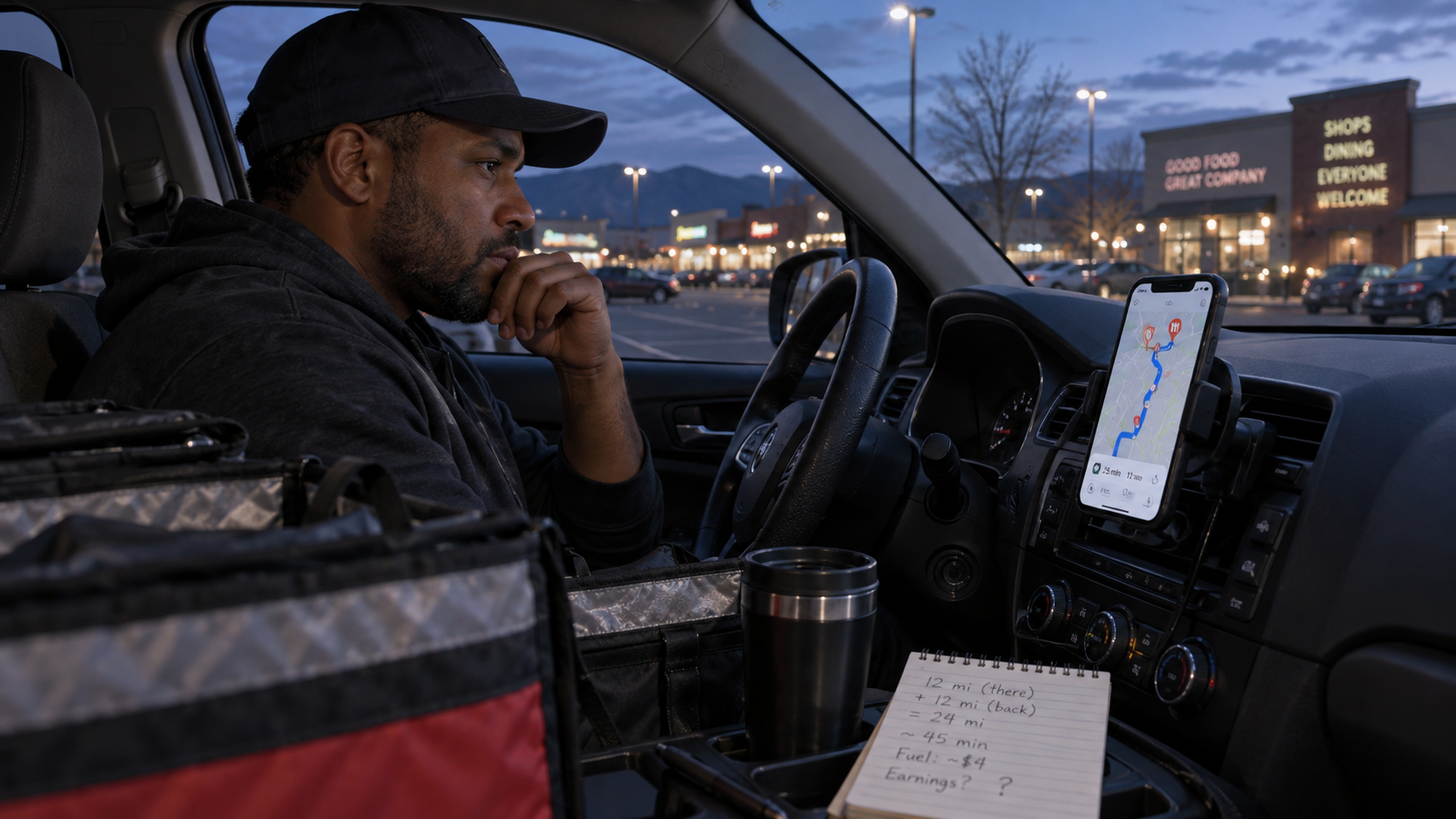
A busy delivery area can look like the obvious place to go.
You see stores, restaurants, or pickup locations grouped together.
Maybe the app shows higher activity.
Maybe you have had good orders there before.
So you start driving toward it.
But until you actually receive and accept a worthwhile offer, every mile you drive toward that area is unpaid.
That does not automatically make repositioning a bad decision.
It does mean the cost of getting there should be part of the decision.
Busy does not mean guaranteed
A delivery area can be active without guaranteeing that you will receive a profitable order.
There may be plenty of drivers nearby.
The available offers may be weak.
The busiest part of the day may already be ending.
You may arrive just as demand slows down.
The problem is that your mileage begins before you know what will happen.
You are spending before you start earning
Suppose you drive 8 miles to reach a busier group of pickup locations.
You have not accepted an order yet.
Those 8 miles already used:
- Fuel
- Vehicle wear
- Your time
- Part of your maintenance life
- Part of your tire life
If you immediately receive a profitable offer, the move may work out well.
If you sit for 30 minutes afterward, the result looks very different.
Repositioning miles are real business miles
Drivers often focus on the miles attached to an accepted offer.
But repositioning can create significant mileage over the course of a shift.
Maybe you move from one shopping area to another.
Maybe you return toward the center of your delivery area after a distant drop-off.
Maybe you drive toward a location that usually produces stronger orders.
Those miles are connected to your workday even though there may not be a payout attached to them.
Small repositioning trips add up
Driving three or four miles may not feel significant.
But imagine doing it several times during a shift.
Four miles here.
Five miles there.
Another six miles later.
Before long, you may have added 15 or 20 unpaid miles.
That can change the profit of the entire day.
The first offer has to overcome the cost of getting there
Suppose you drive 10 miles to a busier area.
Once you arrive, you receive a $12 offer.
At first glance, that order may look fine.
But you should not evaluate it as though you began the trip from the pickup location.
You already invested time and mileage reaching that area.
The order did not really start at the store
From a whole-shift perspective, part of the cost of that $12 order began before the offer appeared.
That does not mean every repositioning mile should be assigned to one specific delivery.
It means your shift-level profit needs to account for those miles somewhere.
Otherwise, your results can look stronger than they really were.
Waiting after repositioning makes the cost bigger
Driving to a busy area is only one part of the risk.
The next question is how long you wait after arriving.
Imagine you spend 15 minutes driving there.
Then you wait 25 minutes before receiving an acceptable offer.
You have already committed 40 minutes before the delivery even begins.
That time matters.
A good order can still produce a weak hour
Suppose the offer pays $18 and takes another 30 minutes to complete.
The order itself may look strong.
But from the time you decided to reposition until the delivery ends, more than an hour has passed.
That changes the real value of the decision.
This is why looking only at active-order time can be misleading.
Hot areas can attract more drivers
A location that looks attractive to you may also look attractive to everyone else.
More drivers can mean more competition for the available orders.
That can reduce the number of useful offers you receive.
You may arrive expecting strong demand and find yourself sitting with several other drivers waiting for the same work.
More demand does not always mean more opportunity for you
A busy area can have many orders and still produce poor results for an individual driver.
If there are enough drivers competing for those orders, your personal wait time may still be long.
The important question is not simply whether the area is busy.
It is whether that area is producing profitable work for you.
Chasing activity can create a cycle
One of the biggest risks is constantly moving toward wherever you think the next good order might be.
You leave one area because it feels slow.
You drive to another.
Nothing appears.
Then you move again.
By the time you finally receive an order, you may have spent a significant amount of time and mileage chasing activity.
Movement can feel productive when it is not
Driving gives you the feeling that you are doing something.
Sitting still can feel like wasting time.
But moving is not automatically better.
Sometimes staying in a proven location is cheaper than driving several miles based on a guess.
The important thing is whether the move improves your actual results.
Your own history should guide repositioning
Instead of assuming that a busy area is always worth driving to, look at your own results.
Ask:
How often do I get a useful offer after moving there?
How long do I normally wait?
How many miles does it take to get there?
What kinds of offers usually come from that area?
Where do those deliveries tend to leave me?
Your own experience can help you decide whether the move is consistently worthwhile.
A proven area is different from a hopeful area
If your history shows that a location regularly produces profitable orders at a certain time, driving there may be a reasonable strategy.
That is different from driving across town because an area simply looks busy.
One decision is based on your own results.
The other is based mostly on hope.
Time of day can completely change the answer
A repositioning move that works at 5:30 p.m. may make no sense at 3:00 p.m.
Demand changes throughout the day.
Restaurant areas may perform differently at lunch and dinner.
Grocery activity may change by weekday or weekend.
Package and retail demand can follow different patterns.
The value of driving to another area depends heavily on timing.
Know what you are driving toward
Before moving, ask yourself why you expect the destination to be better.
Is a busy delivery period beginning?
Do you regularly see good offers there at this time?
Are you simply frustrated with your current location?
Having a reason does not guarantee success.
But it helps separate a strategy from a reaction.
Consider how far the next delivery may take you
Even if repositioning works and you receive an order, the delivery may send you farther away again.
That can create another layer of unpaid mileage.
For example:
You drive 8 miles to reach a busy pickup area.
You accept an order that travels another 10 miles.
The drop-off leaves you 9 miles away from your next useful pickup location.
The offer may only show one part of that chain.
Your vehicle experiences all of it.
The cheapest move may sometimes be no move
Drivers do not always need to reposition immediately.
Sometimes the smartest decision is to stay where you are for a short period and see what happens.
That is especially true if you are already near proven pickup locations.
Sitting still has a cost, but driving has two
Waiting costs time.
Driving costs time and vehicle mileage.
That does not mean waiting is always better.
It means moving should have enough potential benefit to justify the additional cost.
Compare the move before you make it
Before driving to another area, consider:
How many miles away is it?
How long will it take to get there?
What does your history say about that location?
What time of day is it?
How long are you willing to wait after arriving?
What will you do if the area is slow?
Thinking through those questions can prevent unnecessary repositioning.
Set a limit on how far you will chase activity
It can help to have a personal rule for repositioning.
You might decide that you are comfortable moving a few miles to a proven pickup area.
But driving 12 or 15 miles without an order may be too much.
Your limit will depend on your vehicle, area, fuel cost, and strategy.
A limit protects you from emotional decisions
When a shift gets slow, frustration can make a distant area look more attractive than it really is.
Having a limit in advance can help you avoid chasing orders farther and farther from your original plan.
Track repositioning at the shift level
One repositioning trip may not seem important.
The pattern across an entire day is what matters.
At the end of the shift, look at:
- Total miles driven
- Miles attached to deliveries
- Return miles
- Repositioning miles
- Total work time
- Waiting time
- TRUE profit
- Profit per mile
- Profit per hour
That helps you see whether moving between areas is helping or hurting your results.
A busier area is only better if it improves your profit
The goal is not to spend your day in the busiest possible location.
The goal is to put yourself where your time and vehicle can produce the best result.
Sometimes that means moving.
Sometimes it means staying put.
Sometimes it means ending the shift.
The right decision depends on what the move is likely to cost and what it is realistically likely to return.
Count the miles before the order too
Delivery profitability does not begin only when you tap Accept.
Your workday includes the driving and waiting that happen while you are trying to get into position for the next profitable order.
TRUE Driver Profit is designed to help drivers look at the whole workday, not just the miles shown on individual offers.
Because driving toward opportunity still has a cost.
And until a worthwhile order appears, you are the one paying it.
Related reading