How to Find Your Most Profitable Delivery App
The delivery app that works best for you may change by time, area, and delivery type. Use your own results to identify which app produces the strongest profit.
By TRUE Driver Profit · September 12, 2026
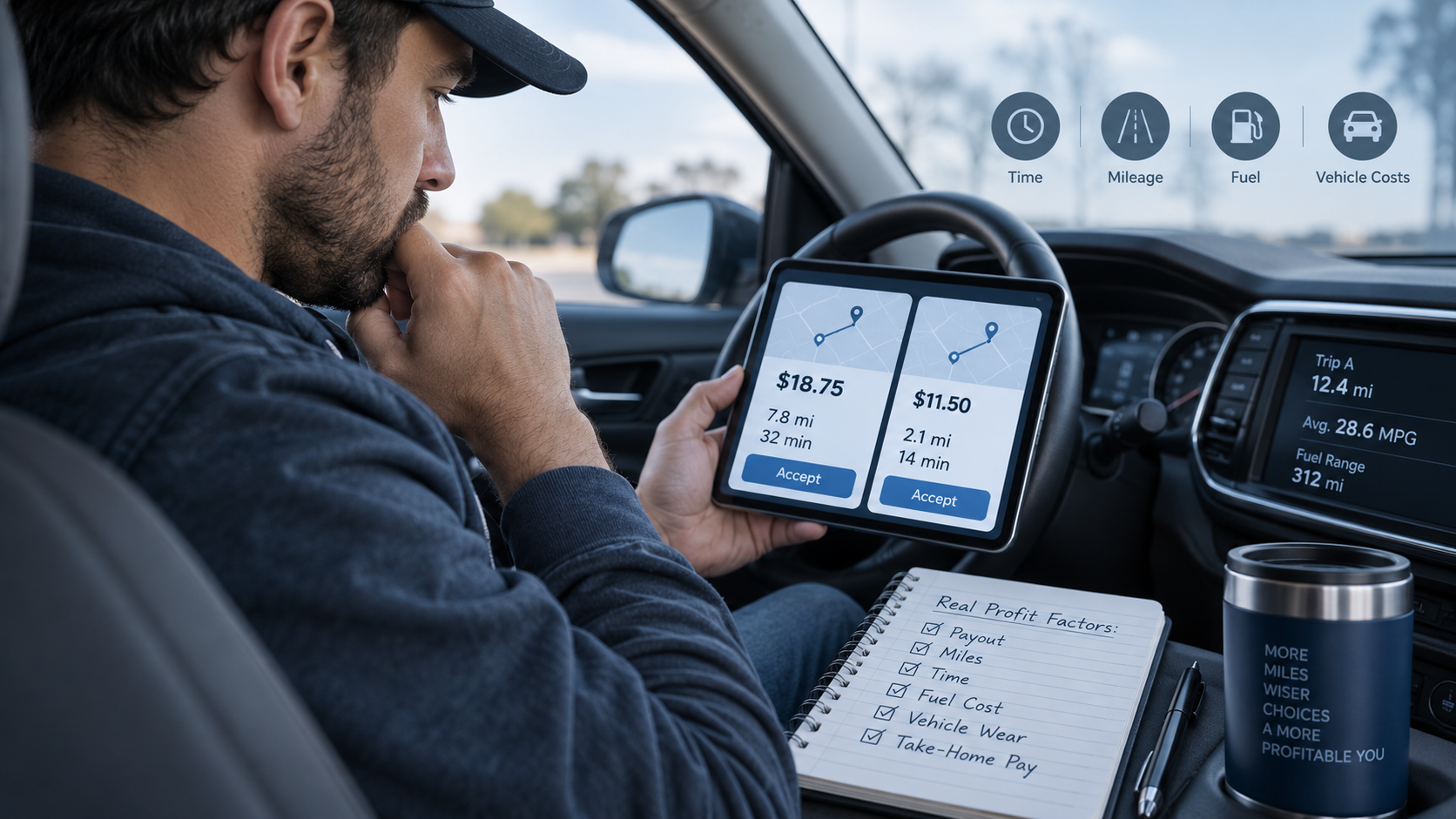
A driver can ask five people which delivery app pays the most and receive five different answers.
One driver may do well with restaurant orders. Another may earn more from grocery deliveries. Someone in a larger city may have results that look nothing like those of a driver working in a small town.
Instead of relying on another driver’s earnings screenshot, you can test your own apps and find out which one produces the best results for you.
The goal is not simply to identify the app with the largest payouts. It is to find the one that repeatedly leaves you with the strongest profit for your time and mileage.
Start With a Fair Comparison
It is difficult to compare two delivery apps when you use one during busy dinner hours and the other during a slow afternoon.
Try to compare similar working conditions whenever possible.
That does not mean every shift must be identical. It means you should avoid judging an app from one unusually good or bad day.
Compare Similar Days and Hours
Track each app during comparable periods, such as:
- Weekday lunch
- Weekday dinner
- Friday evening
- Saturday afternoon
- Sunday morning
An app that performs well during dinner may be weak during the afternoon. Another may produce its best opportunities on weekends.
Comparing similar hours helps you see whether the app made the difference or whether you simply worked during a stronger time.
Test Each App Across Several Shifts
One shift is not enough information to name a winner.
A large order, temporary bonus, unusual tip, bad pickup delay, or slow restaurant can make one day look much better or worse than normal.
Try to collect results from several shifts before deciding.
Look for Repeatable Results
You are trying to find patterns that continue beyond a single day.
Ask yourself:
- Does this app regularly provide useful offers?
- Are the pickup times usually reasonable?
- Does it keep me near places where another order may begin?
- Are the delivery distances predictable?
- Does it produce steady profit without excessive mileage?
A dependable app may be more valuable than one that occasionally produces a great order but performs poorly the rest of the time.
Record the Same Numbers for Every App
Use the same measurements for every app you test. Otherwise, the comparison will not be fair.
Do not count full working time for one app while counting only active delivery time for another. Do not include return miles for one platform and ignore them for the next.
Track Your Total Earnings
Record the money you actually received during the test period, including confirmed tips and bonuses.
Do not let one unusually large tip decide which app wins. Look at the complete group of deliveries.
Track Your Complete Business Mileage
Count the driving connected to the work, not only the mileage shown on the offer screen.
Your actual mileage may include:
- Driving toward the pickup
- Driving from pickup to the customer
- Traveling between delivery areas
- Repositioning while waiting
- Returning after a distant drop-off
An app may show attractive payouts while quietly adding more unpaid driving to your day.
Track Your Complete Working Time
Include the time required to earn the money.
That may include:
- Waiting for an offer
- Driving to the pickup
- Waiting at a restaurant or store
- Shopping or loading
- Driving to the customer
- Completing the drop-off
- Returning to an active area
If you track only the time spent on an accepted order, an app can appear more efficient than it really is.
Compare TRUE Profit, Not Just Earnings
Gross earnings tell you how much the app paid. They do not tell you how much you kept.
Fuel and vehicle costs can change the outcome, especially when one app requires significantly more driving.
Review Profit Per Hour
Profit per hour helps you understand how effectively an app uses your working time.
An app may offer larger orders but create long pickup delays. Another may have smaller payouts but allow you to complete deliveries more consistently.
The second app could produce a better hourly result even though its individual offers look less impressive.
Review Profit Per Mile
Profit per mile shows how efficiently you are using your vehicle.
One app may help you earn more money while requiring far more mileage. Another may produce slightly lower earnings while keeping deliveries closer together.
That difference matters because every additional mile uses fuel and contributes to maintenance, tires, depreciation, and future repairs.
Consider Total Profit Too
Profit per hour and profit per mile are useful, but you should also examine total profit.
An app with excellent profit per mile may not provide enough orders to meet your income goal. An app with strong profit per hour may place too many miles on your vehicle.
The best result usually comes from looking at all three measurements together:
- Total profit
- Profit per hour
- Profit per mile
Pay Attention to Waiting
Waiting is one of the easiest costs to overlook.
You may wait for an offer, wait at the pickup, wait for an employee, wait in a checkout line, or wait after a distant delivery for another useful opportunity.
Separate Pickup Delays From Offer Waiting
These two types of waiting can reveal different problems.
Long pickup delays may mean certain stores or restaurants are reducing an app’s profitability.
Long periods without useful offers may mean the app does not have enough demand during that time of day.
Tracking both can help you identify why an app is underperforming.
Watch Where Each App Leaves You
The destination can affect what happens after the delivery.
An order that ends near another active pickup area may help you continue working quickly. An order that sends you far outside your normal area may require an unpaid return drive.
Count Repositioning and Return Miles
The original delivery may be profitable by itself and still create a weak overall result.
If you must drive several miles back before receiving another useful offer, that return trip uses time and your vehicle without adding another payout.
Apps that consistently keep you near active pickup locations may perform better than their offer amounts suggest.
Compare Different Delivery Types
Restaurant, grocery, shopping, curbside, and package deliveries do not use your time in the same way.
A shopping order may offer a larger payout but require extra time inside the store. A restaurant order may be shorter but involve an unpredictable wait. A package route may provide a known payment while requiring many miles and a long drive home.
Identify the Work That Fits You Best
Your vehicle, experience, physical ability, delivery area, and schedule can all affect the result.
A delivery type that works well for another driver may not be the strongest option for you.
Your comparison should reflect the work you actually want and are able to complete consistently.
Review Bonuses Separately
Bonuses can improve your results, but they can also make an app look stronger than it normally is.
Record bonuses, but review the app both with and without them.
Ask Whether the Bonus Changed Your Decisions
A bonus may encourage you to work longer, drive farther, or accept orders you would normally skip.
Ask:
- Did I complete extra low-profit deliveries to earn it?
- Did I drive more miles than usual?
- Did I work during hours that normally perform poorly?
- Was the final bonus worth the additional work?
A bonus is helpful only when the complete group of deliveries remains profitable.
Build a Simple Weekly Comparison
At the end of the week, place the results from each app side by side.
Compare:
- Total earnings
- Total business miles
- Total working time
- Pickup waiting
- Time waiting for offers
- Fuel and vehicle costs
- TRUE profit
- Profit per hour
- Profit per mile
- Number of completed deliveries
You do not need hundreds of deliveries to begin seeing useful patterns. You need consistent measurements collected over enough shifts to avoid judging an app from one unusual result.
Let Different Apps Win at Different Times
You may discover that there is no single winner.
One app may be strongest during weekday lunch. Another may perform better on weekend mornings. A third may be worth opening only when it offers a good bonus or when your usual app is slow.
Create Your Own Working Schedule
Your final strategy might look like this:
- App A during weekday lunch
- App B during dinner
- App C on weekend mornings
- Multiple apps monitored during slower hours
The purpose of comparing apps is not necessarily to choose one forever. It is to understand when each option works best for you.
Repeat the Test When Conditions Change
Delivery work changes over time.
Order volume, driver availability, store performance, fuel prices, traffic, weather, and bonuses can all affect your results.
An app that performs well today may not remain your strongest option several months from now.
Review your numbers again when you notice a change in payouts, mileage, waiting, or order availability.
Your Own Results Should Choose the Winner
No earnings screenshot, online ranking, or recommendation can account for your exact vehicle, area, schedule, costs, and delivery habits.
The most profitable delivery app for you is the one that repeatedly produces the strongest results after the complete work is counted.
Track several comparable shifts. Include all working time and business mileage. Account for fuel and vehicle costs. Then compare total profit, profit per hour, and profit per mile.
Your own history can give you a more useful answer than another driver’s biggest payout.