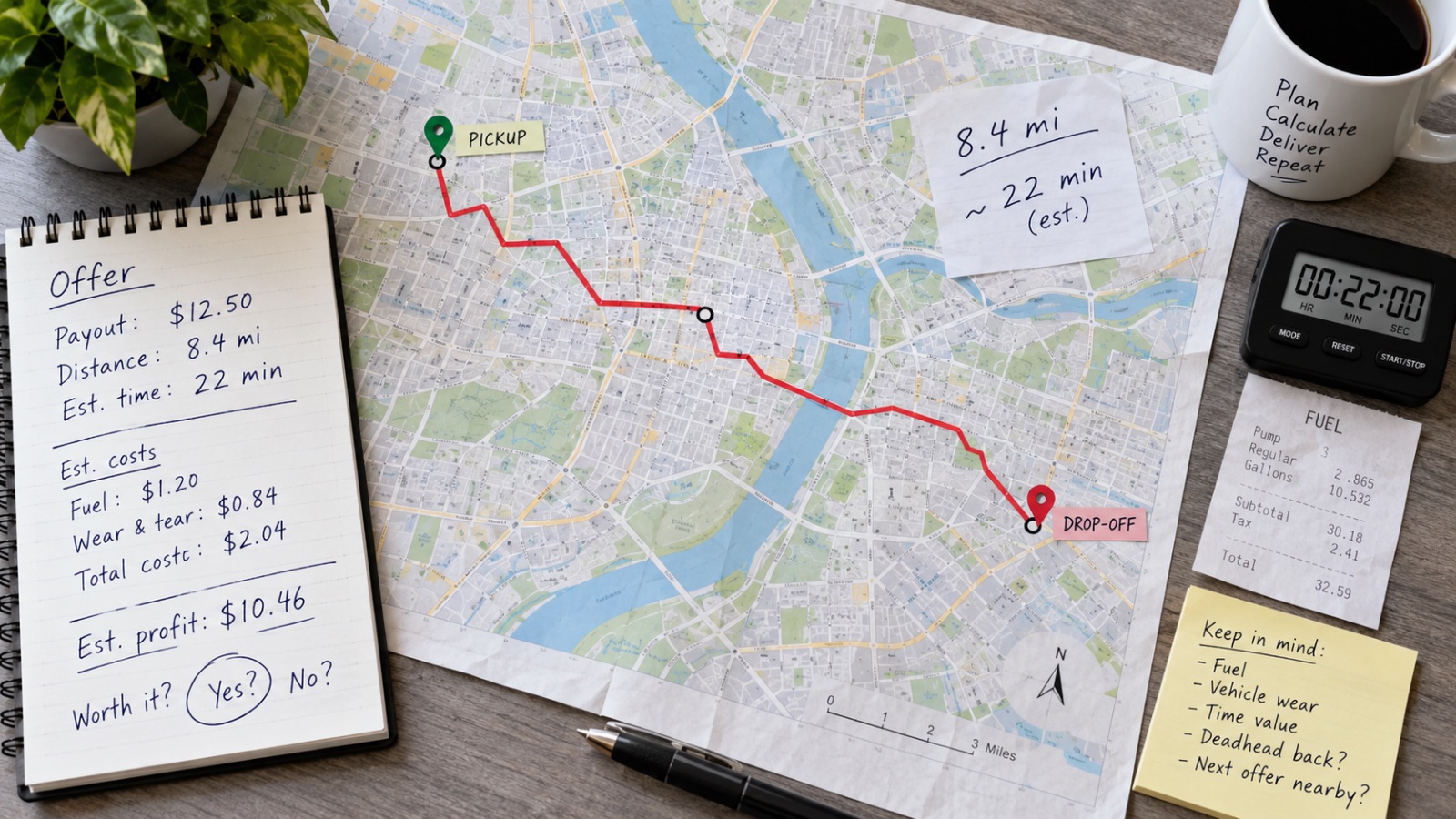
You worked all day.
You completed order after order.
Your earnings screen shows money coming in.
But when you look at your bank account, buy gas, or think about the miles you put on your vehicle, it does not feel like you made very much.
That leads to a frustrating question:
Why am I not making money doing delivery driving?
The answer is often not that you are earning nothing.
The problem may be that too much of what you earn is being consumed by mileage, vehicle costs, waiting, unpaid driving, and low-value orders.
Why am I not making money doing delivery driving?
There are several common reasons.
You may be:
- Driving too many miles for the payout
- Accepting offers that take too long
- Spending too much time waiting
- Driving back unpaid after deliveries
- Working during slow hours
- Ignoring vehicle costs
- Chasing gross earnings instead of profit
- Taking orders that leave you in poor locations
- Working more hours without improving efficiency
Sometimes several of these problems happen at the same time.
Gross earnings can hide the problem
A driver can gross $150 during a day and still feel like the money disappeared.
That is because gross earnings are only the amount paid to you before your business costs are considered.
The number that matters more is what remains.
You may be driving too many miles
Mileage is one of the biggest reasons a delivery day can look better than it actually was.
Suppose you gross $150.
Driver A travels 55 business miles.
Driver B travels 140 business miles.
They both earned the same amount.
But they did not create the same vehicle cost.
More miles create more than fuel expense
Every mile can contribute to:
- Fuel
- Tire wear
- Oil changes
- Maintenance
- Repairs
- Depreciation
You may not pay for all of those expenses today.
But the delivery work is still creating them.
Low-paying long-distance offers can drain your profit
An offer may put money on your earnings screen while still being a poor business decision.
For example:
$11 payout
14 miles
That $11 increases your gross earnings.
But it also requires a significant amount of driving.
The payout needs to justify the trip
You have to consider:
- Pickup distance
- Delivery distance
- Time
- Traffic
- Ending location
- Possible return miles
The advertised payout alone is not enough.
Return miles may be costing more than you realize
One of the easiest costs to overlook happens after the delivery.
You arrive at the customer.
You complete the order.
The app shows the delivery as finished.
But you may still be far from where you need to be.
The drive back is still real
Suppose an order takes you 10 miles outside your normal pickup area.
You complete the order and then drive 8 miles back before receiving another useful offer.
Those 8 miles did not disappear because the delivery was marked complete.
You still used:
- Fuel
- Vehicle life
- Time
That can turn a good-looking offer into a weak one.
You may be waiting too long at pickup
Waiting is another quiet profit killer.
Five minutes may not seem important.
Neither does ten.
But those minutes add up across an entire shift.
Waiting reduces how many orders you can complete
Imagine accepting a $12 delivery that should take 25 minutes.
You arrive at pickup and wait another 25 minutes.
Now the order takes about 50 minutes.
The payout did not increase.
Your time commitment did.
Some pickup locations may be hurting your entire shift
You may notice that certain locations consistently run late.
One bad wait does not necessarily mean you should avoid a location forever.
But repeated patterns matter.
Your own history can help you decide
If one location repeatedly creates 20-minute waits, you may need a higher payout before accepting offers from there.
Knowing that before accepting can protect your time.
You may be accepting too many weak offers
Staying busy can feel productive.
But being busy is not the same as being profitable.
A driver can accept nearly every offer and still finish with poor results.
Every order should earn its place in your day
Ask whether the offer provides enough value for:
- Mileage
- Time
- Vehicle cost
- Difficulty
- Ending location
An order does not become good just because it keeps you moving.
You may be focusing too much on acceptance
Some drivers feel pressure to accept offers because they do not want their acceptance rate to fall.
The importance of acceptance rate can vary depending on the platform and any programs or benefits tied to it.
But there is still a cost to completing weak offers.
A metric does not erase operating costs
No acceptance percentage changes:
- Fuel prices
- Tire costs
- Maintenance
- Depreciation
- Your time
Understand the rules of the delivery services you use, but continue looking at what the work costs you.
You may be working the wrong hours
More hours do not automatically produce more profit.
Delivery demand can change dramatically throughout the day.
You may have several strong hours followed by several weak ones.
Slow hours can pull down the entire day
Suppose you make strong profit during lunch.
Then you remain online for three slow afternoon hours.
During those hours you:
- Wait for orders
- Drive around looking for activity
- Accept weaker offers
- Use fuel while idling
Your total earnings may rise slightly while your overall profit per hour falls.
Your best hours may matter more than your longest days
Tracking your results over several weeks can reveal when you perform best.
You might discover that your strongest time is:
- Morning
- Lunch
- Dinner
- Weekend afternoons
- Certain weekdays
Another driver may have completely different results.
Your own data matters more than general advice
People online may say a certain time is always best.
That does not mean it is best where you drive.
Use your own results.
Driving around looking for orders may be costing you
When orders are slow, it is tempting to drive from one area to another hoping something appears.
That can create miles without guaranteed income.
Movement feels productive even when it is not
Driving 10 miles to another group of stores costs money.
If no worthwhile order appears, you paid to relocate without earning anything from the trip.
Sometimes waiting in a reasonable location can cost less than constantly chasing activity.
You may be chasing high payouts instead of good offers
A $30 offer gets attention.
But it is not automatically better than a $15 offer.
The $30 offer may require:
- 25 miles
- Multiple stops
- A long shopping list
- Heavy items
- A remote drop-off
- A long return trip
Higher payout does not guarantee higher profit
A smaller offer with fewer miles and less time can sometimes produce a better result.
Always look beyond the dollar amount.
You may be ignoring where the delivery ends
Pickup location matters.
Drop-off location matters too.
A route that ends near active pickup locations may allow you to continue working quickly.
A route that ends in a remote area can create unpaid miles.
Two identical payouts can have different value
Imagine two $18 offers.
The first ends near several stores.
The second ends 11 miles outside the area where you normally receive orders.
Those are not equal offers.
The ending location changes what happens next.
You may be underestimating vehicle expenses
Fuel is easy to see because you pay for it regularly.
Other vehicle expenses are easier to ignore.
Repairs arrive later
Your car may operate normally for months.
Then you suddenly need:
- Tires
- Brakes
- Suspension work
- Battery replacement
- Repairs
- Major maintenance
Those bills may feel unexpected.
But the miles that contributed to them were accumulating throughout your delivery work.
Fuel is not your only cost per mile
A driver may calculate:
"I made $100 and only spent $15 on gas, so I made $85."
That calculation leaves out other vehicle costs.
Your vehicle is being consumed while you work
The vehicle you use today will eventually need maintenance, repairs, and replacement.
Delivery mileage accelerates that process.
Your TRUE cost should consider more than the fuel pump.
You may be confusing cash flow with profit
Cash flow is the money moving through your account.
Profit looks at what remains after business expenses.
They are related, but they are not the same thing.
A strong payout week can still create future costs
Imagine making $800 in one week.
That feels good.
But during the week you also added hundreds of miles to your vehicle.
Some of the cost of those miles may not appear until later.
That is why simply looking at deposits can be misleading.
You may not be tracking enough information
It is difficult to improve what you cannot see.
If you only track total earnings, you may never discover why some days work and others do not.
Useful numbers include
- Gross earnings
- Total business miles
- Working hours
- Completed orders
- Fuel cost
- Vehicle cost
- Profit per hour
- Profit per mile
- TRUE profit
Those numbers help explain where your earnings are going.
One bad order can hurt more than that one order
A weak offer can affect the rest of your shift.
Suppose you accept a long delivery that takes you far away.
You spend 45 minutes completing it.
Then you spend another 25 minutes returning.
The real impact may be more than the payout
You lost:
- Time
- Mileage
- Vehicle use
- Access to other offers
One poor decision can sometimes affect more than an hour of the day.
Apartment and difficult drop-offs can consume time
A delivery may show only a few miles.
But the drop-off can take much longer than expected.
You may encounter:
- Gate codes
- Parking problems
- Long hallways
- Elevators
- Multiple buildings
- Difficult house numbers
- Customer delays
Low mileage does not guarantee a good order
Time matters just as much.
A 3-mile delivery that takes 50 minutes may be worse than a longer route that takes half the time.
Shopping orders can be deceptive
Shop-and-deliver offers can have attractive payouts.
But they also require work before you ever leave the store.
You may spend time:
- Finding products
- Handling substitutions
- Contacting customers
- Waiting at checkout
- Loading groceries
Estimate the whole job
Do not compare a shopping order to a pickup order using payout alone.
Look at the total expected time.
Multi-stop routes can hide a lot of work
A multi-stop route may show a larger payout.
But each stop creates another opportunity for delay.
More stops can mean:
- More parking
- More walking
- More unloading
- More navigation
- More customer interaction
Count the full route
The payout may look strong until you consider how long the route will actually take.
You may be working toward a gross goal instead of a profit goal
Daily earnings goals can be motivating.
But they can also encourage bad decisions.
Suppose your goal is $200.
You reach $185 and the available offers become weak.
Chasing the last dollars can hurt the day
You may accept a poor order just to make the earnings screen reach $200.
But after extra mileage and time, you may have been better off stopping at $185.
The bigger gross number does not automatically mean more profit.
You may simply be working in a slow period
Not every poor day means your strategy is wrong.
Delivery work changes.
Demand can rise and fall.
Look for patterns before making big conclusions
One slow Tuesday does not tell you much.
Several weeks of Tuesday results may tell you a lot.
Track enough days to identify patterns instead of reacting to one shift.
Compare profitable days with unprofitable days
When you have enough records, compare your strongest and weakest days.
Ask:
How many hours did I work?
How many miles did I drive?
What types of orders did I take?
How much time did I spend waiting?
Where did the deliveries end?
Look for what changed
You may discover that profitable days usually involve:
- Fewer miles
- Shorter waits
- Better ending locations
- Stronger time periods
- More selective offers
That gives you something useful to repeat.
Stop measuring success by how busy you were
A driver who stays moving all day can feel successful.
But constant movement creates mileage.
The question is whether the movement produced enough profit.
A quieter day can sometimes be better
You might complete fewer orders while being more selective.
If those orders require fewer miles and produce stronger profit, the slower-looking day may actually be better.
How can delivery drivers make more profit?
There are two basic ways.
Earn more.
Or spend less to earn the same amount.
Often the second option is overlooked.
Reduce waste
Look for ways to reduce:
- Dead miles
- Long waits
- Weak offers
- Unnecessary driving
- Slow working periods
- Poor ending locations
If you gross the same amount with fewer miles and less wasted time, your profit improves.
Know your minimums
A personal minimum can help you make decisions faster.
You might set goals for:
- Minimum payout
- Profit per mile
- Profit per hour
- Maximum pickup distance
- Acceptable wait time
Your minimum should come from your own numbers
Do not copy another driver's rules blindly.
Their costs and location may be completely different.
Build rules around what works for you.
Review the entire workday
At the end of a shift, do not stop at the earnings total.
Review:
- Earnings
- Miles
- Hours
- Costs
- Orders
- TRUE profit
Ask whether the day was worth the work
A $200 day might have been excellent.
Or it might have required so much time and mileage that a shorter $150 day would have been better.
The numbers tell the story.
The bottom line
If you are doing delivery work but not feeling like you are making money, the problem may not be your gross earnings.
The money may be disappearing through:
- Excessive mileage
- Weak offers
- Long waits
- Return trips
- Slow hours
- Vehicle costs
- Poor positioning
Do not assume that working more is always the answer.
First find out where your money is going.
Track your total miles.
Track your time.
Track your vehicle costs.
Look at what happens after the delivery.
Then compare what you earned with what it actually cost you to earn it.
Once you can see the difference between gross earnings and TRUE profit, it becomes much easier to identify what needs to change.
Related reading