Why Short Delivery Offers Are Not Always the Best Offers
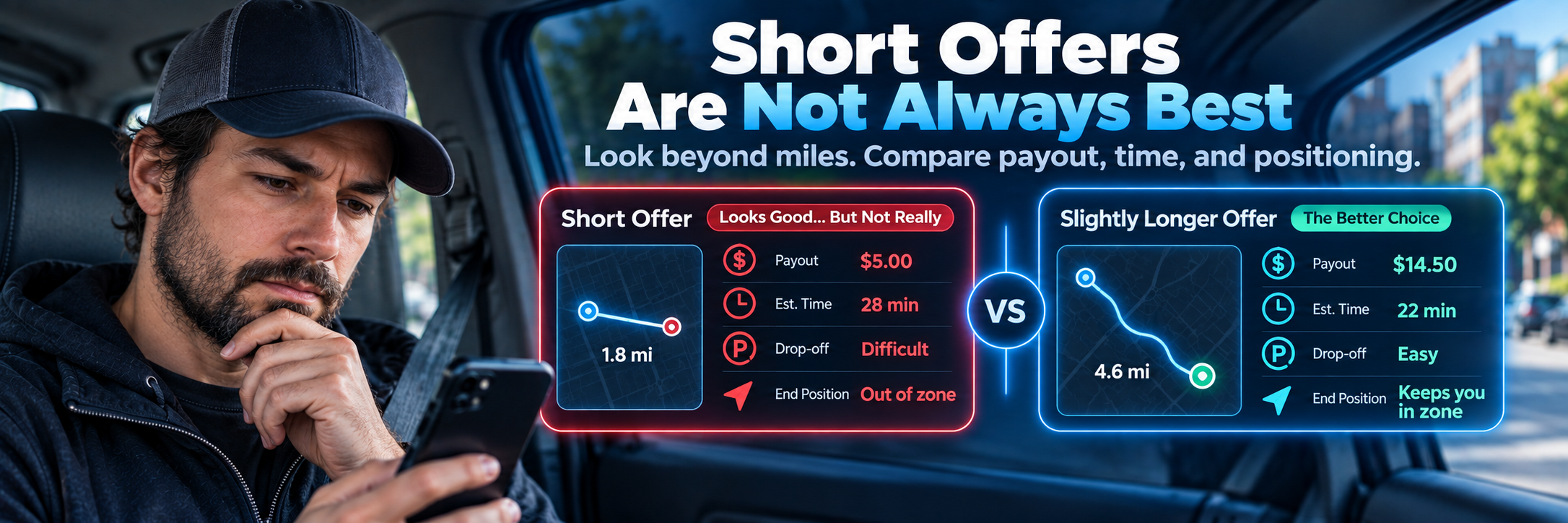
A short delivery can look efficient, but low payout, long waits, difficult drop-offs, or poor positioning can still make it less profitable than a slightly longer trip.
By TRUE Driver Profit · September 12, 2026
Why Short Delivery Offers Are Not Always the Best Offers
Short delivery offers can look like the safest choice.
The mileage is low.
The trip may seem quick.
The vehicle cost should be smaller.
At first glance, a short delivery can seem automatically better than a longer one.
But short does not always mean profitable.
A low-mileage offer can still produce weak results if the payout is too small, the pickup takes too long, the drop-off is difficult, or the delivery leaves you in a poor position for the next order.
The better question is not:
How short is this delivery?
The better question is:
What does this delivery actually produce after time, mileage, vehicle costs, and positioning are counted?
The mileage may look attractive, but you still have to:
Drive to the pickup
Wait for the order
Load the order
Drive to the customer
Complete the drop-off
Get back into position for another offer
If the total time is too high, the short mileage does not save the offer.
The payout has to support the whole trip.
10 minutes waiting at pickup
5 minutes loading
5 minutes driving
5 minutes completing the drop-off
5 minutes repositioning
That short trip may only involve a few miles, but the total time can still be significant.
This is why profit per hour matters.
Apartment parking
A gated entrance
Stairs
A long walk
A hard-to-find building
An elevator wait
Customer delays
Those extra minutes can turn a simple-looking delivery into a much longer job.
The distance may be short, but the work may not be.
If you need to drive several unpaid miles after the drop-off, the original delivery is no longer as short as it first appeared.
That extra driving still uses:
Fuel
Time
Vehicle wear
Maintenance
A short paid trip followed by a long unpaid repositioning drive can be less profitable than a slightly longer delivery that ends in a better area.
A stronger payout
Little or no wait time
Easy pickup
Simple drop-off
Better positioning
Less return driving
If those factors work together, the longer offer may produce better profit per hour and profit per mile.
The extra distance may be worth it.
But low mileage alone does not guarantee a good result.
Driving to pickup if applicable
Delivery mileage
Return miles
Repositioning miles
Any other unpaid driving connected to the trip
A delivery may look excellent based only on the paid route and much weaker once the full driving picture is included.
That can include:
Waiting
Loading
Parking
Walking
Finding addresses
Customer interaction
Returning to a useful area
If the order ties up too much time for the amount of profit it produces, the short mileage does not help enough.
But several weak short deliveries can shape the entire day.
Low payout
Several minutes of waiting
Slow drop-offs
Short unpaid repositioning drives
Individually, they may seem manageable.
Across several hours, those small losses can reduce your total profit and profit per hour.
A busy shift can still be a weak shift.
Some short offers can be very strong.
Strong payout for the distance
Minimal wait time
Simple pickup
Easy drop-off
Low vehicle cost
Good positioning afterward
Strong profit per hour
Strong profit per mile
When those pieces line up, short mileage can be a major advantage.
Payout
Total miles
Expected time
Wait time
Drop-off difficulty
Vehicle cost
Return driving
Destination
Profit per hour
Profit per mile
The strongest offer is not always the shortest one.
It is the one that produces the best overall result for your time and vehicle.
Average payout
Average mileage
Average time
Wait time
TRUE profit
Profit per hour
Profit per mile
Where deliveries ended
You may discover that some slightly longer offers consistently outperform shorter ones.
You may also find certain short offers that are among your most profitable.
The numbers can help separate assumptions from actual results.
But distance alone does not determine profitability.
A low-mileage offer can still perform poorly because of low payout, long waits, difficult drop-offs, or unpaid driving afterward.
A slightly longer offer can sometimes produce better results when the payout, time, route, and destination work together.
TRUE Driver Profit is designed to help delivery drivers look beyond one number and understand the complete trip.
When you compare payout, mileage, time, vehicle costs, return driving, and real profit, you can decide whether a short offer is actually a strong offer or simply looks like one.
Short delivery offers can look like the safest choice.
The mileage is low.
The trip may seem quick.
The vehicle cost should be smaller.
At first glance, a short delivery can seem automatically better than a longer one.
But short does not always mean profitable.
A low-mileage offer can still produce weak results if the payout is too small, the pickup takes too long, the drop-off is difficult, or the delivery leaves you in a poor position for the next order.
The better question is not:
How short is this delivery?
The better question is:
What does this delivery actually produce after time, mileage, vehicle costs, and positioning are counted?
Short Miles Can Still Come With a Low Payout
A delivery may only require a few miles, but the payout still needs to support the work.Low Mileage Does Not Guarantee Good Profit
Imagine an offer that pays $5 for a short trip.The mileage may look attractive, but you still have to:
Drive to the pickup
Wait for the order
Load the order
Drive to the customer
Complete the drop-off
Get back into position for another offer
If the total time is too high, the short mileage does not save the offer.
The payout has to support the whole trip.
Wait Time Can Destroy a Short Offer
One of the biggest problems with short deliveries is that drivers may focus so much on the mileage that they overlook the pickup time.A Five-Minute Drive Can Still Become a Thirty-Minute Order
A short delivery can lose value quickly if you spend:10 minutes waiting at pickup
5 minutes loading
5 minutes driving
5 minutes completing the drop-off
5 minutes repositioning
That short trip may only involve a few miles, but the total time can still be significant.
This is why profit per hour matters.
Difficult Drop-Offs Can Add Hidden Time
A short route can still be inefficient if the final delivery is difficult.Low Mileage Does Not Mean Easy
A two-mile delivery might include:Apartment parking
A gated entrance
Stairs
A long walk
A hard-to-find building
An elevator wait
Customer delays
Those extra minutes can turn a simple-looking delivery into a much longer job.
The distance may be short, but the work may not be.
Poor Positioning Can Make a Short Offer Worse
Where the delivery ends matters too.The Next Move Counts
A short trip may leave you in an area with few useful pickup opportunities.If you need to drive several unpaid miles after the drop-off, the original delivery is no longer as short as it first appeared.
That extra driving still uses:
Fuel
Time
Vehicle wear
Maintenance
A short paid trip followed by a long unpaid repositioning drive can be less profitable than a slightly longer delivery that ends in a better area.
Slightly Longer Offers Can Sometimes Be More Efficient
Longer mileage does not automatically mean a worse offer.Compare the Whole Trip
A slightly longer delivery may have:A stronger payout
Little or no wait time
Easy pickup
Simple drop-off
Better positioning
Less return driving
If those factors work together, the longer offer may produce better profit per hour and profit per mile.
The extra distance may be worth it.
Profit Per Mile Still Matters
Short trips can help profit per mile when the payout is strong enough.But low mileage alone does not guarantee a good result.
Use Profit Per Mile With the Full Route
When judging a short offer, include:Driving to pickup if applicable
Delivery mileage
Return miles
Repositioning miles
Any other unpaid driving connected to the trip
A delivery may look excellent based only on the paid route and much weaker once the full driving picture is included.
Profit Per Hour Can Reveal Weak Short Offers
Profit per hour is especially useful when comparing short trips.Time Is Often the Hidden Cost
A low-mileage delivery may still require a lot of non-driving time.That can include:
Waiting
Loading
Parking
Walking
Finding addresses
Customer interaction
Returning to a useful area
If the order ties up too much time for the amount of profit it produces, the short mileage does not help enough.
Repeated Small Orders Can Add Up to a Weak Shift
One short delivery may not seem like a problem.But several weak short deliveries can shape the entire day.
Small Inefficiencies Add Up
Imagine accepting a series of low-mileage offers that each include:Low payout
Several minutes of waiting
Slow drop-offs
Short unpaid repositioning drives
Individually, they may seem manageable.
Across several hours, those small losses can reduce your total profit and profit per hour.
A busy shift can still be a weak shift.
Short Offers Can Be Excellent When the Numbers Work
The goal is not to avoid short deliveries.Some short offers can be very strong.
Strong Short Offers Often Have Several Things in Common
A good short delivery may include:Strong payout for the distance
Minimal wait time
Simple pickup
Easy drop-off
Low vehicle cost
Good positioning afterward
Strong profit per hour
Strong profit per mile
When those pieces line up, short mileage can be a major advantage.
Do Not Use Distance as the Only Filter
Mileage is important, but it should not be the only number used to judge an offer.Look at the Complete Delivery
Before accepting, consider:Payout
Total miles
Expected time
Wait time
Drop-off difficulty
Vehicle cost
Return driving
Destination
Profit per hour
Profit per mile
The strongest offer is not always the shortest one.
It is the one that produces the best overall result for your time and vehicle.
Compare Short and Longer Offers Using Real Results
Your own driving history can help you understand which offers work best for you.Look for Patterns
After several shifts, compare:Average payout
Average mileage
Average time
Wait time
TRUE profit
Profit per hour
Profit per mile
Where deliveries ended
You may discover that some slightly longer offers consistently outperform shorter ones.
You may also find certain short offers that are among your most profitable.
The numbers can help separate assumptions from actual results.
Shorter Is Only Better When the Whole Offer Works
A short delivery can be attractive.But distance alone does not determine profitability.
A low-mileage offer can still perform poorly because of low payout, long waits, difficult drop-offs, or unpaid driving afterward.
A slightly longer offer can sometimes produce better results when the payout, time, route, and destination work together.
TRUE Driver Profit is designed to help delivery drivers look beyond one number and understand the complete trip.
When you compare payout, mileage, time, vehicle costs, return driving, and real profit, you can decide whether a short offer is actually a strong offer or simply looks like one.