Why Two Drivers Make Different Profit
Two drivers can take the same delivery offer and end up with different profit. Fuel economy, vehicle costs, mileage, and time can change what each driver actually keeps.
By TRUE Driver Profit · September 10, 2026
Why Two Drivers Make Different Profit
Two drivers can accept the exact same delivery offer and still end up with different profit.
The payout may be identical.
The miles may be identical.
The delivery may even take the same amount of time.
But the cost of completing that delivery can be very different from one driver to another.
That is because every vehicle has its own operating costs.
At first glance, the opportunity looks exactly the same for both drivers.
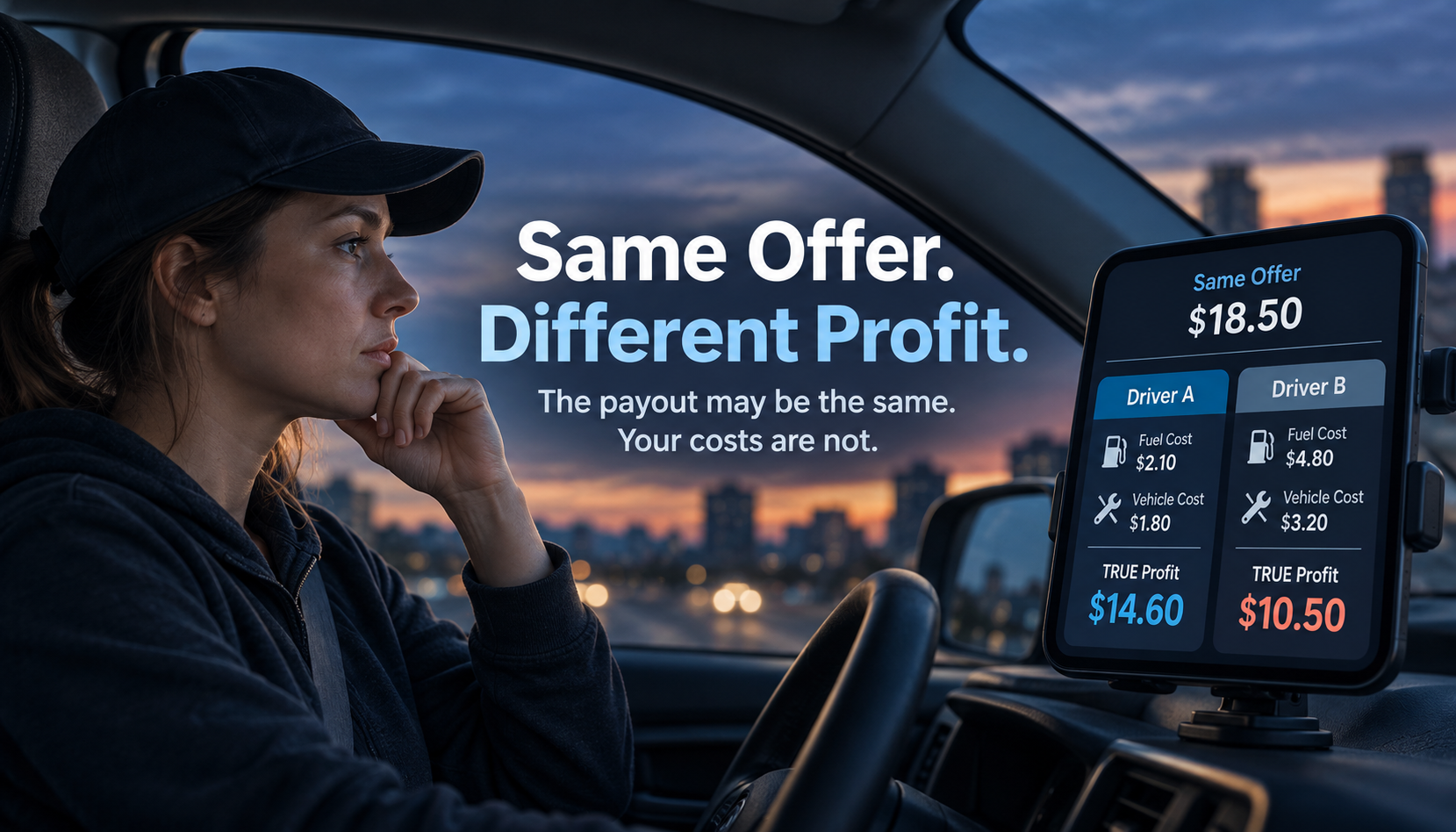
But now look at their vehicles.
Driver A has a fuel-efficient car with lower fuel and maintenance costs.
Driver B drives a larger vehicle that uses more fuel and costs more to operate.
The offer still pays $18.50.
The amount each driver keeps can be different.
A driver getting 35 miles per gallon will spend less on fuel than a driver getting 18 miles per gallon for the same trip.
That difference may look small on one delivery.
Over dozens of deliveries, it can add up.
Gas prices matter too.
Two drivers in different areas may pay different fuel prices even if their vehicles are similar.
Vehicle wear is easier to overlook.
Every delivery contributes to costs such as:
Oil changes
Tires
Brakes
Repairs
Maintenance
Depreciation
Those costs are not identical for every vehicle.
A heavier or more expensive vehicle may cost more to maintain than a smaller, more efficient car.
That means the same mileage can create different costs for different drivers.
One driver may already live near the delivery area.
Another may need to drive several miles back toward a pickup location.
Those return miles increase fuel use, vehicle wear, and time.
The original offer did not change.
The total trip did.
Time can create another difference
One driver may know the area well and complete the delivery quickly.
Another may deal with traffic, parking, a difficult apartment complex, or a long walk to the customer.
That extra time affects profit per hour.
The same payout can produce very different hourly results depending on how long the delivery actually takes.
That point depends partly on operating costs.
A driver with low fuel and vehicle costs may be able to profit from an offer that another driver should avoid.
That does not mean one driver is making a better decision than the other.
It means their numbers are different.
That is why generic rules can be misleading
You have probably heard rules such as:
Never take less than a certain dollar amount per mile.
Only accept offers above a certain payout.
Avoid anything over a certain distance.
Those rules can be useful as quick guidelines.
But they do not know your vehicle.
They do not know your fuel cost.
They do not know your maintenance cost.
They do not know your return miles.
They do not know how long the order will actually take.
A rule that works well for one driver may not work for another.
That includes things like:
Your vehicle type
Your MPG
Your gas price
Your Wear & Tear rate
Your typical return miles
Your time
Once those numbers are part of the calculation, you can evaluate an offer based on your situation instead of someone else's.
Profit can change without the payout changing
This is one of the most important ideas for delivery drivers to understand.
The app may show the same payout to everyone.
That does not mean everyone earns the same profit.
A driver with lower costs keeps more of that payout.
A driver with higher costs gives up more of it just to complete the delivery.
The difference may only be a few dollars on one order.
Across an entire week, it can become significant.
TRUE Driver Profit is built around your numbers
TRUE Driver Profit is designed to help drivers evaluate offers using their own vehicle and cost information.
Instead of treating every driver the same, the calculation can account for your fuel economy, gas price, vehicle cost, mileage, return driving, and time.
That helps show:
TRUE profit
Profit per mile
Profit per hour
The goal is not to tell every driver to make the same decision.
The goal is to help each driver see what the offer means for them.
Because the same delivery offer can appear on two phones.
The payout can be identical.
But the profit does not have to be.
Two drivers can accept the exact same delivery offer and still end up with different profit.
The payout may be identical.
The miles may be identical.
The delivery may even take the same amount of time.
But the cost of completing that delivery can be very different from one driver to another.
That is because every vehicle has its own operating costs.
The payout is only one part of the picture
Suppose two drivers both accept an $18.50 delivery offer.At first glance, the opportunity looks exactly the same for both drivers.
But now look at their vehicles.
Driver A has a fuel-efficient car with lower fuel and maintenance costs.
Driver B drives a larger vehicle that uses more fuel and costs more to operate.
The offer still pays $18.50.
The amount each driver keeps can be different.
Fuel economy changes the result
Miles per gallon can make a noticeable difference, especially on longer deliveries.A driver getting 35 miles per gallon will spend less on fuel than a driver getting 18 miles per gallon for the same trip.
That difference may look small on one delivery.
Over dozens of deliveries, it can add up.
Gas prices matter too.
Two drivers in different areas may pay different fuel prices even if their vehicles are similar.
Vehicle costs go beyond gas
Fuel is easy to notice because drivers see the cost every time they fill up.Vehicle wear is easier to overlook.
Every delivery contributes to costs such as:
Oil changes
Tires
Brakes
Repairs
Maintenance
Depreciation
Those costs are not identical for every vehicle.
A heavier or more expensive vehicle may cost more to maintain than a smaller, more efficient car.
That means the same mileage can create different costs for different drivers.
Return miles can be different too
Even when two drivers accept the same offer, what happens after delivery may not be the same.One driver may already live near the delivery area.
Another may need to drive several miles back toward a pickup location.
Those return miles increase fuel use, vehicle wear, and time.
The original offer did not change.
The total trip did.
Time can create another difference
One driver may know the area well and complete the delivery quickly.
Another may deal with traffic, parking, a difficult apartment complex, or a long walk to the customer.
That extra time affects profit per hour.
The same payout can produce very different hourly results depending on how long the delivery actually takes.
Different vehicles create different break-even points
Every driver has a point where an offer stops being worthwhile.That point depends partly on operating costs.
A driver with low fuel and vehicle costs may be able to profit from an offer that another driver should avoid.
That does not mean one driver is making a better decision than the other.
It means their numbers are different.
That is why generic rules can be misleading
You have probably heard rules such as:
Never take less than a certain dollar amount per mile.
Only accept offers above a certain payout.
Avoid anything over a certain distance.
Those rules can be useful as quick guidelines.
But they do not know your vehicle.
They do not know your fuel cost.
They do not know your maintenance cost.
They do not know your return miles.
They do not know how long the order will actually take.
A rule that works well for one driver may not work for another.
Your own numbers matter most
The better approach is to understand your own costs.That includes things like:
Your vehicle type
Your MPG
Your gas price
Your Wear & Tear rate
Your typical return miles
Your time
Once those numbers are part of the calculation, you can evaluate an offer based on your situation instead of someone else's.
Profit can change without the payout changing
This is one of the most important ideas for delivery drivers to understand.
The app may show the same payout to everyone.
That does not mean everyone earns the same profit.
A driver with lower costs keeps more of that payout.
A driver with higher costs gives up more of it just to complete the delivery.
The difference may only be a few dollars on one order.
Across an entire week, it can become significant.
TRUE Driver Profit is built around your numbers
TRUE Driver Profit is designed to help drivers evaluate offers using their own vehicle and cost information.
Instead of treating every driver the same, the calculation can account for your fuel economy, gas price, vehicle cost, mileage, return driving, and time.
That helps show:
TRUE profit
Profit per mile
Profit per hour
The goal is not to tell every driver to make the same decision.
The goal is to help each driver see what the offer means for them.
Because the same delivery offer can appear on two phones.
The payout can be identical.
But the profit does not have to be.
Want to compare strategies with other delivery drivers? Join the conversation in our Facebook group.