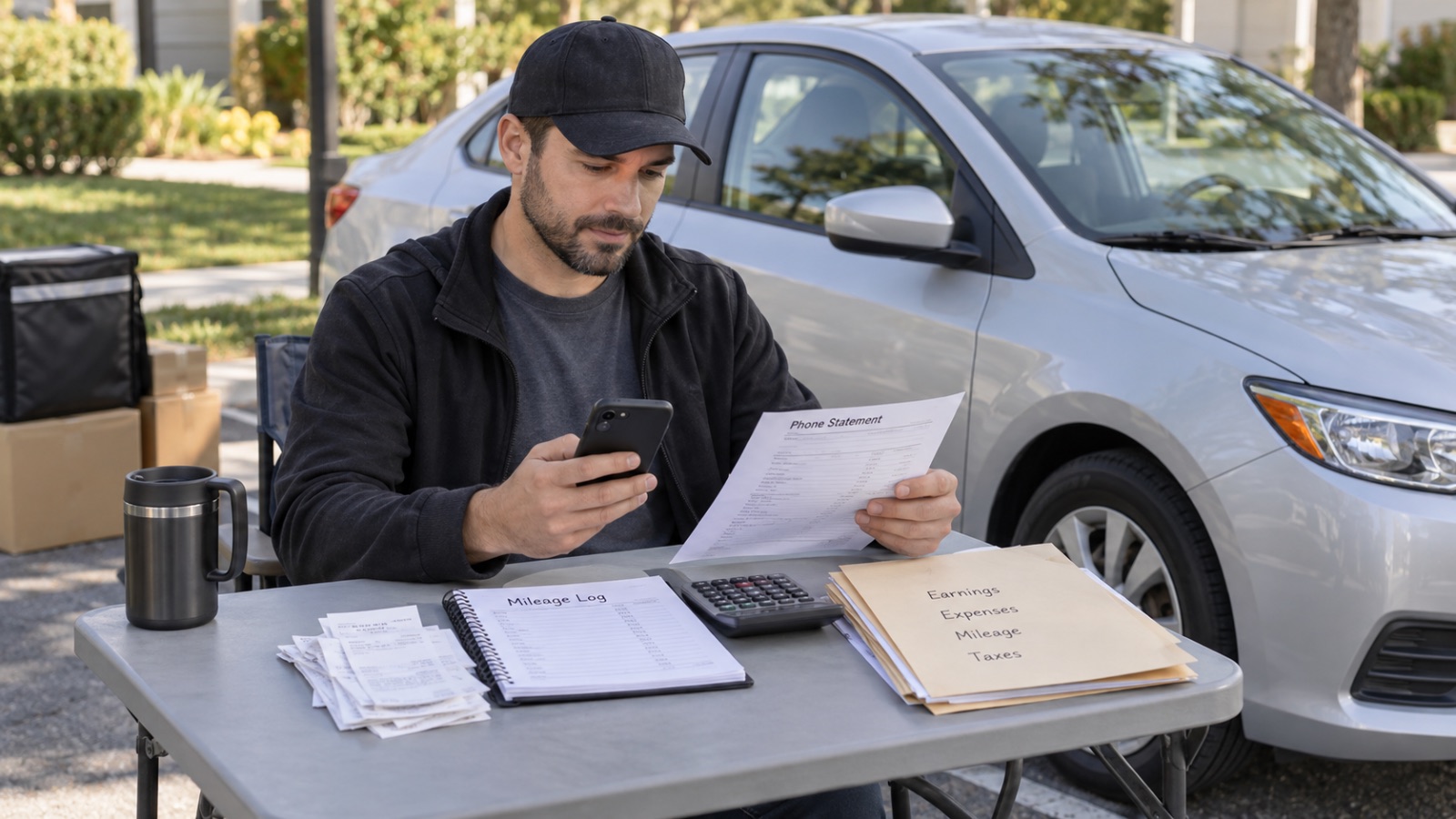
Delivery drivers depend heavily on their phones.
You use them to receive offers, navigate to pickups, contact customers, track mileage, manage earnings, and handle business records.
So it is reasonable to ask:
Can delivery drivers deduct their cell phone bill?
The answer is often yes, but generally only for the business-use portion of the expense.
Can delivery drivers deduct their cell phone bill?
Possibly.
If you use your phone for delivery work, the business-use portion of your phone service may generally qualify as a business expense.
The key is separating business use from personal use.
If the phone is used for both, you generally should not deduct the entire bill unless the phone is truly used only for business.
Business and personal use must be separated
Most drivers use one phone for everything.
That can include:
- Delivery apps
- Navigation
- Customer communication
- Banking
- Social media
- Personal calls
- Family messages
- Streaming
- Personal internet use
Because the phone serves both business and personal purposes, only the business portion is generally relevant as a business expense.
Why is a phone a business expense for delivery drivers?
A smartphone is often one of the main tools used to perform delivery work.
Without it, many drivers could not receive orders, navigate, communicate with customers, or manage delivery apps.
That makes business phone use directly connected to earning delivery income.
The expense still has to be ordinary and necessary
Business expenses generally need to be ordinary and necessary.
That means the expense should be common, appropriate, and connected to operating the business.
For delivery drivers, using a phone for work clearly fits many ordinary business activities.
How much of the phone bill can you deduct?
That depends on how much the phone is actually used for business.
Suppose your monthly phone bill is $100.
If you reasonably determine that 60% of the phone use is related to delivery work, the business portion would be $60 for that month.
You need a reasonable method
There is no single percentage that fits every driver.
Your business-use percentage should reflect your actual circumstances.
You might consider things such as:
- Time spent using delivery apps
- Navigation use
- Customer calls and messages
- Mileage-tracking apps
- Business banking
- Delivery-related email
- Work scheduling
- Business recordkeeping
The goal is to use a reasonable and supportable estimate.
What if you use the phone almost entirely for delivery work?
If a phone is genuinely dedicated to business use, the business percentage may be much higher.
Some drivers keep a separate phone just for delivery work.
That can make the calculation much easier.
A separate business phone creates cleaner records
If one phone is used only for business, it is easier to show that the expense relates to the business.
That does not mean every driver needs two phones.
It simply makes recordkeeping more straightforward.
Can you deduct the cost of the phone itself?
The cost of purchasing the phone may also have business implications.
How the phone is treated can depend on its cost, business-use percentage, and applicable tax rules.
The phone bill and the phone purchase are separate expenses
The monthly service bill is one expense.
The device itself is another.
A driver should keep records for both.
That includes:
- Purchase receipt
- Financing agreement
- Monthly service statements
- Business-use records
What if the phone is financed?
Many phones are paid for through monthly installment plans.
Part of your monthly wireless bill may represent the device payment, while another part is the service charge.
Keep the statement details
A detailed bill can help you see:
- Service cost
- Device payment
- Taxes and fees
- Insurance
- Add-on services
Those components may not all be treated exactly the same.
Good records make it easier to understand what you actually paid for.
Can delivery drivers deduct phone insurance?
If phone insurance is connected to a phone used for business, the business-use portion may potentially be part of the overall business expense.
Again, mixed personal and business use matters.
Protection still needs a business connection
If the phone is used partly for work, the business portion of related costs may generally follow that same business-use logic.
That can include service and certain related expenses.
What about unlimited-data plans?
An unlimited plan does not automatically make the full bill deductible.
Even if your delivery work uses a lot of data, you may still use the same plan personally.
The bill is still a mixed-use expense
The fact that the plan is unlimited does not remove the need to separate business and personal use.
What matters is how the phone is actually used.
What about navigation apps?
Navigation is a core part of delivery work.
Drivers use maps to reach pickups, customer locations, gas stations, and sometimes return areas.
Paid navigation tools may be business expenses
If you pay for a navigation app or other delivery-related software that is ordinary and necessary for your business, that cost may potentially qualify as a separate business expense.
Keep the subscription receipts and payment records.
What about mileage-tracking apps?
Mileage-tracking apps can be another business-related phone expense.
If you pay for an app specifically to track delivery mileage, the subscription may be a business expense.
Software and phone service are separate
The monthly phone service is one expense.
The mileage app subscription is another.
Tracking them separately can make your business records cleaner.
Can delivery drivers deduct mobile hotspot costs?
If you use a hotspot connection specifically for delivery work or business tasks, the business-use portion may also be relevant.
Some drivers use a dedicated hotspot or separate data plan.
Separate service can make allocation easier
A dedicated business hotspot can be easier to track than mixed-use phone data.
But the same principle applies:
Only the business-related portion should generally be treated as a business expense.
What records should delivery drivers keep?
Keep enough documentation to support what you paid and how the phone was used for business.
Useful records can include:
- Monthly phone bills
- Device purchase receipts
- Financing records
- App subscription receipts
- Business-use notes
- Delivery-app records
- Mileage-tracking subscriptions
You do not need to make recordkeeping impossible
The goal is not to document every second you touch your phone.
Use a reasonable method that reflects how you actually use it.
If your business use changes significantly during the year, update your estimate.
What if someone else pays the phone bill?
This can complicate the deduction.
Generally, you need to actually pay or incur the expense to deduct it.
If a family member pays the entire bill and you do not reimburse them, you may not have personally incurred the expense.
Reimbursement should be documented
If you reimburse someone for your share of the phone bill, keep records of that payment.
That helps show that you actually paid the expense.
What if your employer pays for the phone?
Most gig delivery drivers are independent contractors rather than employees.
But if another business reimburses you for the phone cost, you generally would not also treat the reimbursed amount as though you personally paid the full expense.
Avoid counting the same expense twice
The basic principle is simple:
Do not deduct an expense you were fully reimbursed for.
Keep records showing both the cost and any reimbursement.
Does a phone bill affect TRUE profit?
Absolutely.
Even if only part of the bill qualifies as a tax deduction, you still pay the full amount every month.
That makes the phone part of your real cost of doing delivery work.
Small monthly expenses add up
A $100 phone bill is $1,200 per year.
A mileage app might add another monthly charge.
A hotspot may add more.
These costs may look small next to fuel or vehicle repairs, but together they affect how much money you actually keep.
Should drivers include phone costs when evaluating delivery income?
Yes.
Phone costs are part of operating the business.
That does not mean you divide the entire monthly bill into every individual delivery.
But it does mean the cost belongs in your overall business picture.
Fixed costs still matter
The phone bill is often a fixed monthly cost.
You may pay the same amount whether you complete 20 deliveries or 200.
That still affects your total profitability.
Knowing your fixed expenses helps you understand how much you need to earn before the work becomes worthwhile.
What if you upgrade phones frequently?
Buying a new phone every year can significantly increase your business costs.
A newer phone may be faster and more reliable.
But that does not mean every upgrade is financially smart.
Reliability and cost both matter
A phone that crashes during deliveries can cost you time and missed orders.
But an expensive upgrade can also reduce your profit.
The best choice is usually the one that provides reliable service without adding unnecessary cost.
Do not buy a more expensive phone just for a deduction
A tax deduction does not make the phone free.
You still spend real money.
A deduction is not a reimbursement
If you spend an extra $500 on a more expensive phone, you still spent $500.
The possible tax deduction only affects taxable income.
It does not put the full purchase price back in your pocket.
That is why business purchases should make sense even before considering the tax benefit.
The bottom line
Delivery drivers may generally be able to deduct the business-use portion of their cell phone expenses when the phone is used for delivery work.
The important part is separating business use from personal use and keeping reasonable records.
Your phone is one of the tools that makes delivery work possible.
Track the service cost.
Track paid business apps.
Keep purchase records.
And remember that the phone affects your TRUE profit whether or not the entire bill qualifies as a tax deduction.
Related reading
This article is for general educational information and is not tax advice. Business-use percentages, device costs, reimbursements, and deductible expenses can depend on your individual circumstances. Review current IRS guidance or speak with a qualified tax professional about your situation.