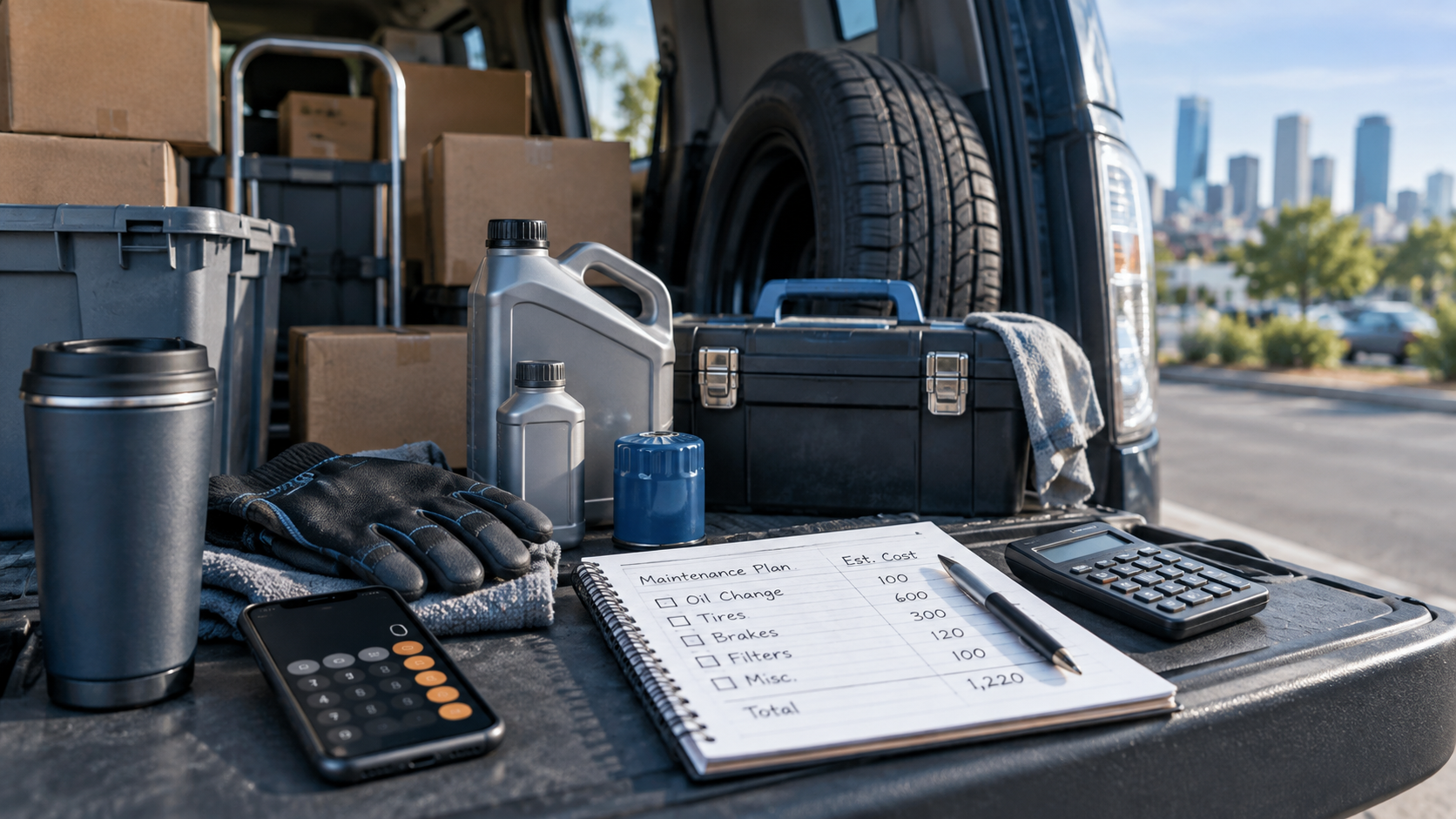
Delivery driving puts a lot of miles on a vehicle.
Those miles do more than burn fuel.
They also wear down tires, brakes, oil, suspension parts, fluids, belts, batteries, and other components that eventually need attention.
That is why vehicle maintenance should not be treated as an occasional surprise.
It is part of the cost of doing delivery work.
The real question is not whether maintenance will happen.
It is how much you should prepare for it.
There Is No Perfect Maintenance Number for Every Driver
A single dollar amount will not work for everyone.
Your maintenance cost depends on things like:
- Vehicle age
- Vehicle type
- Mileage
- Driving conditions
- Maintenance history
- Local repair costs
- Tire prices
- How many delivery miles you drive
- How aggressively the vehicle is used
A newer compact car may have very different costs than an older SUV or truck.
Your Vehicle Matters More Than a Generic Rule
Two drivers can drive the same number of miles and still have very different maintenance expenses.
One vehicle may need only routine oil changes and tires.
Another may need brakes, suspension work, cooling-system repairs, or other larger repairs.
That is why your own history is more useful than a number copied from someone else.
Delivery Miles Accelerate Wear
Delivery work usually involves more stopping, starting, parking, turning, idling, and short trips than ordinary highway driving.
Those conditions can increase wear.
Frequent Stops Can Affect Brakes and Tires
Urban and suburban delivery routes often involve repeated braking.
That can shorten brake-pad life compared with steady highway driving.
Frequent turns, curbs, parking lots, and uneven roads can also affect tires and suspension components.
Short Trips Can Be Hard on a Vehicle
Some delivery work involves repeated short trips.
Engines may spend more time warming up.
Batteries may experience more start cycles.
Oil and other fluids still age with use.
The cost may not appear immediately, but the wear is still happening.
Start by Looking at Your Real Maintenance History
One of the best ways to estimate future maintenance is to look backward.
Review what you have actually spent on the vehicle.
Include Routine Maintenance
Examples include:
- Oil changes
- Tire rotations
- Fluid services
- Air filters
- Wiper blades
- Brake service
- Alignment
These costs are relatively predictable.
Include Larger Repairs Too
Also include repairs that do not happen every month:
- Tires
- Battery
- Alternator
- Starter
- Suspension
- Wheel bearings
- Cooling-system work
- Sensors
- Belts and hoses
Large repairs can make one month look expensive, but they are part of long-term vehicle ownership.
Convert Annual Maintenance Into a Monthly Amount
Suppose you spent $1,800 on maintenance and repairs during the last 12 months.
Divide that by 12.
That is:
$1,800 ÷ 12 = $150 per month.
That gives you a simple monthly reserve target based on your actual history.
A Monthly Reserve Smooths Out Uneven Costs
You may not spend $150 every month.
One month may be zero.
Another month may be $600.
The reserve helps spread those irregular costs across the year.
You Can Also Think in Cost Per Mile
Mileage can be another useful way to estimate maintenance.
Suppose you drove 24,000 miles in a year and spent $1,800 on maintenance.
$1,800 ÷ 24,000 miles = $0.075 per mile.
That means your recent maintenance history averaged about 7.5 cents per mile.
Per-Mile Thinking Fits Delivery Work Well
Delivery drivers naturally accumulate vehicle cost as they drive.
A per-mile reserve can match that reality.
If you set aside a maintenance amount for every business mile, your reserve grows as your vehicle use increases.
Routine Maintenance Is Only Part of the Picture
It is easy to think maintenance means oil changes.
Oil is only one small part of the vehicle-cost picture.
Tires Can Be a Major Expense
A full set of tires may cost hundreds of dollars.
If delivery driving causes you to replace tires sooner, that cost should be considered part of the job.
Brakes Matter Too
Brake pads, rotors, and related work can become significant.
A driver who works in heavy stop-and-go traffic may go through brake components faster than someone driving mostly highway miles.
Repairs Become More Important as the Vehicle Ages
Older vehicles may need less depreciation but more repair spending.
That tradeoff matters.
A vehicle that is paid off is not necessarily cheap to operate.
Do Not Wait Until Something Breaks to Start Saving
If you begin saving only after a repair appears, the reserve is already too late.
Vehicle costs build gradually even when the repair bill arrives suddenly.
Maintenance Savings Should Grow During Good Weeks
A strong delivery week is a good time to add to the reserve.
Do not assume all of the extra money is available to spend.
Part of it may already belong to future vehicle costs.
Separate Maintenance Money From Daily Spending
It can help to keep maintenance money separate.
That does not require a complicated accounting system.
Use a Dedicated Savings Bucket
You could use:
- A separate savings account
- A budgeting category
- A digital savings bucket
- A simple spreadsheet balance
The important part is knowing that the money has a specific purpose.
How Much Should You Set Aside Per Week?
You can estimate a weekly amount from your monthly target.
Suppose your maintenance target is $150 per month.
A rough weekly target is around:
$150 × 12 ÷ 52 = about $35 per week.
That gives you a consistent contribution.
High-Mileage Drivers May Need More
A driver working full time and putting on large mileage may need a larger reserve than someone doing a few deliveries on weekends.
The vehicle is simply being used more.
How Much Should You Set Aside Per Mile?
You can also choose a per-mile reserve.
For example, if your history shows 8 cents per mile in maintenance costs, you could reserve that amount for every mile you drive.
At 1,000 miles:
1,000 × $0.08 = $80.
Your Number Should Come From Your Vehicle
Do not assume 8 cents is automatically right for you.
Your actual amount could be lower or higher.
The goal is to build a number based on your own experience.
Build Room for Unexpected Repairs
Historical averages are helpful, but vehicles do not break on schedule.
A major repair can exceed your normal monthly reserve.
Consider a Separate Emergency Repair Cushion
In addition to routine maintenance savings, some drivers may want an extra emergency vehicle reserve.
This can help with:
- Major mechanical repairs
- Unexpected towing
- Tire damage
- Battery failure
- Cooling-system problems
A repair emergency is especially serious for a delivery driver because the vehicle is also the income-producing tool.
Do Not Confuse Maintenance With Fuel
Fuel is a separate operating cost.
It is paid continuously.
Maintenance often appears later.
Both Costs Reduce TRUE Profit
A delivery may look profitable after fuel but still be weak after vehicle wear is included.
That is why looking only at gas can be misleading.
Maintenance Costs Affect Offer Decisions
If you know your vehicle costs more to operate, your minimum acceptable offer may need to be higher.
A Low-Paying Offer Still Adds Wear
Every mile has a cost.
Even when the payout looks like easy money, the vehicle is still being used.
That is especially important on high-mileage offers.
Return Miles Add Maintenance Cost Too
The vehicle does not stop wearing out after the delivery is completed.
If you drive back to a useful area, those miles count too.
Unpaid Miles Still Wear the Vehicle
Return miles use:
- Tires
- Brakes
- Oil
- Suspension
- Engine life
- Vehicle value
That is another reason whole-trip mileage matters.
Track Maintenance Over Time
One month is not enough to understand vehicle cost.
A longer history is more useful.
Review at Least Several Months
Look for patterns in:
- Total maintenance spending
- Miles driven
- Cost per mile
- Large repair frequency
- Tire replacement
- Brake replacement
- Oil-change frequency
The more history you have, the better your estimate becomes.
Your Maintenance Reserve Should Change When Your Vehicle Changes
A maintenance target is not permanent.
Update It After Major Changes
Revisit your number if:
- You buy a different vehicle
- Mileage increases significantly
- Repair frequency changes
- Tire prices change
- You start driving more hours
- Your delivery area becomes harder on the vehicle
Your reserve should reflect current reality.
Newer Vehicles Still Need a Reserve
A newer car may need fewer repairs.
That does not mean the maintenance cost is zero.
Wear Is Still Happening
Newer vehicles still need:
- Oil
- Tires
- Brakes
- Filters
- Fluids
- Scheduled services
And higher mileage can affect resale value and depreciation.
Older Vehicles May Need a Larger Cushion
An older vehicle can be inexpensive to own when it is reliable.
But repair risk usually increases with age and mileage.
Average Cost Can Hide Timing Risk
An older car may cost only $100 per month on average.
But one repair could cost $1,200.
That is why cash reserve size matters in addition to average cost.
Do Not Base Your Reserve on Your Best Month
A month with no repairs does not mean the vehicle cost nothing.
Wear accumulated during that month.
Think Long Term
Vehicle costs make more sense over six months, one year, or longer.
That smooths out unusually good or bad months.
Compare Maintenance With Delivery Profit
Your maintenance reserve should come from the work the vehicle helps produce.
Watch What You Keep After Vehicle Costs
Suppose a driver earns $1,000 in gross delivery pay.
If fuel, maintenance, tires, and other vehicle costs consume a large portion of that amount, the gross income does not tell the full story.
The useful number is what remains.
Should Maintenance Money Be Included in Every Offer?
You do not have to transfer money into savings after every delivery.
But your offer decisions should still recognize vehicle cost.
Use a Per-Mile Vehicle Cost Assumption
A per-mile vehicle-cost estimate can help you evaluate offers quickly.
That way, the cost is included before you accept the work instead of becoming a surprise later.
TRUE Driver Profit Uses Wear and Tear as a Vehicle Cost Input
TRUE Driver Profit lets drivers use their own Wear & Tear per-mile value.
That helps represent vehicle cost when evaluating delivery profitability.
Your Wear & Tear Number Should Be Realistic
It should reflect the reality of your own vehicle rather than an arbitrary number.
Maintenance history can help you improve that estimate over time.
A Simple Way to Get Started
If you have never tracked vehicle maintenance before, start simple.
Step 1
Add up your last 12 months of maintenance and repair spending.
Step 2
Divide it by the total miles you drove during that period.
Step 3
Use that as a starting maintenance-cost-per-mile estimate.
Step 4
Create a monthly or weekly maintenance reserve.
Step 5
Review the number every few months.
You do not need perfect data on day one.
You need a useful starting point that improves over time.
What If You Do Not Have a Full Year of Records?
Start with what you have.
Three months is better than nothing.
Keep Updating the Average
As more maintenance history becomes available, recalculate.
Your estimate will become more accurate.
Do Not Forget Planned Maintenance
Some expenses can be predicted before they happen.
If your tires have 10,000 miles left, you already know a future expense is coming.
Future Costs Can Be Spread Across Current Miles
Suppose a new set of tires will cost $800 and you expect them to last another 40,000 miles.
$800 ÷ 40,000 miles = $0.02 per mile.
That gives you a rough tire reserve of 2 cents per mile.
You can do the same thing with other predictable maintenance.
Maintenance Savings Protect Your Work
For a delivery driver, vehicle downtime can mean lost income.
That makes maintenance planning more important than it is for someone who uses a car only for personal errands.
The Vehicle Is Part of the Business
If the car cannot move, the driver may not be able to earn.
A maintenance reserve protects both the vehicle and the ability to keep working.
So, How Much Should Delivery Drivers Set Aside?
There is no single correct amount.
A useful target should be based on:
- Your real maintenance history
- Your mileage
- Your vehicle age and condition
- Your driving environment
- Expected future maintenance
- Your repair risk
For some drivers, that may be a modest weekly amount.
For others, especially high-mileage or older-vehicle drivers, it may need to be much larger.
The important part is not guessing perfectly.
It is recognizing that maintenance is a real delivery cost and preparing for it before the repair bill arrives.
Measure the Cost Before It Becomes a Surprise
Delivery profit is stronger when vehicle costs are planned instead of ignored.
Track your maintenance.
Track your miles.
Calculate your cost per mile.
Build a reserve.
Then use those numbers when evaluating the work you accept.
TRUE Driver Profit is designed to help drivers include vehicle costs in the profitability picture so the money they keep is not confused with the money that will eventually have to go back into the vehicle.
Because a profitable delivery should help pay for the vehicle doing the work.
Related reading