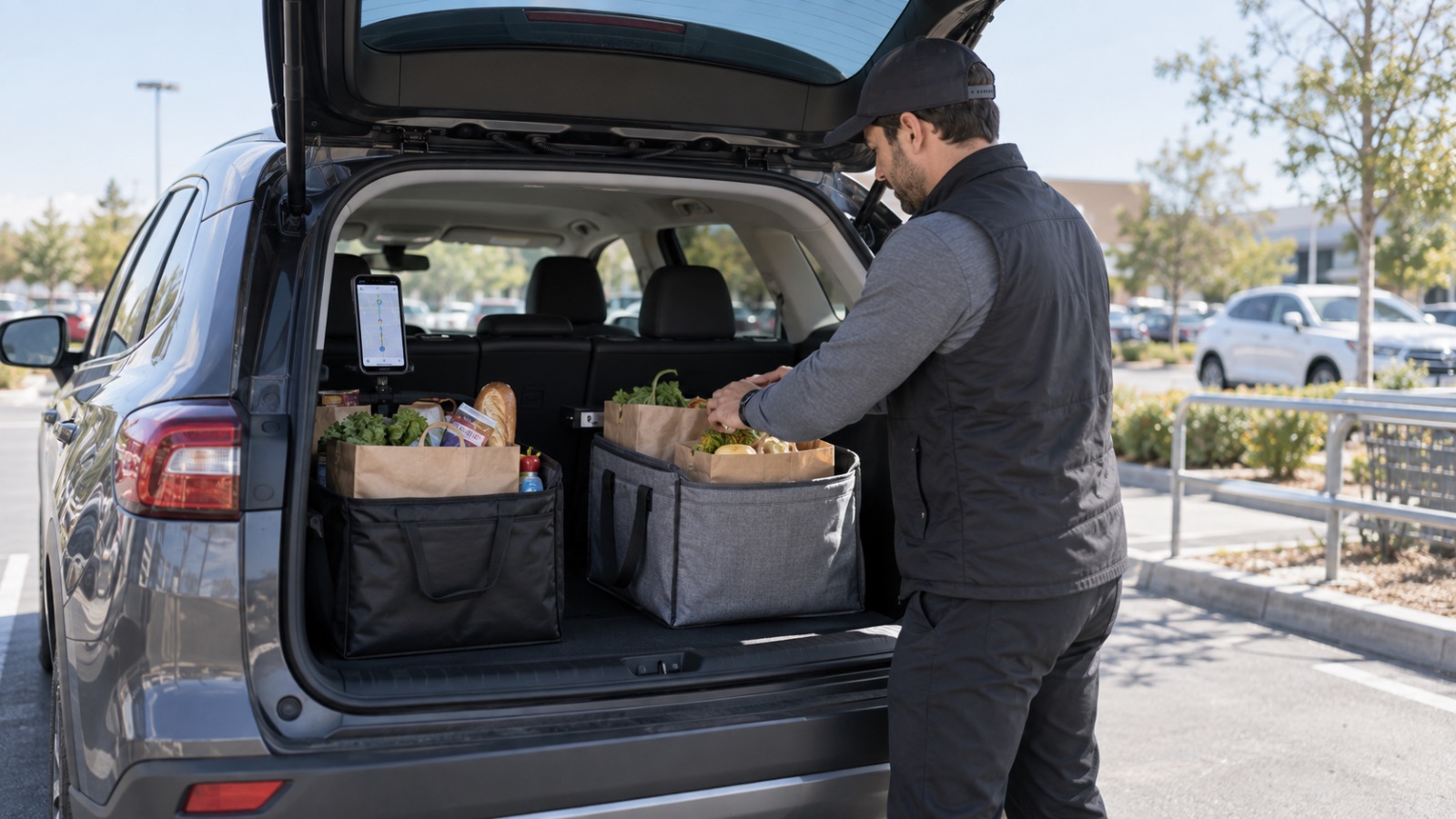
Handling more than one customer order at the same time creates a problem that has little to do with payout.
Organization.
When several bags, drinks, grocery items, or packages share the same vehicle, a small mistake can create a large headache at the next stop.
The wrong bag can go to the wrong customer.
A drink can be buried behind another order.
The first delivery can be loaded behind the second.
A few minutes of organization before driving can prevent those problems.
Keep each customer order physically separate
The simplest rule is also the most important.
Do not allow separate customer orders to blend together.
Use different areas of the vehicle whenever practical.
For example:
- Customer A in the left cargo area
- Customer B in the right cargo area
- Drinks in a dedicated carrier
- Small items in a clearly assigned bin
The exact system does not matter as much as using the same system consistently.
Load in delivery order when possible
If you know which customer will be delivered first, keep that order easy to reach.
Do not bury the first stop behind the final stop.
Think like a route, not a storage closet
The goal is to open the door or hatch and immediately reach the correct order.
Every time you have to unload one customer’s items to reach another customer’s order, you add time and increase the chance of a mix-up.
Use insulated bags as order boundaries
Insulated bags can do more than control temperature.
They can also create clear separation between customer orders.
If two orders fit into separate bags, keep each customer’s items together from pickup through delivery.
That reduces sorting later.
Be careful when one order has several bags
A larger grocery order may not fit into one container.
In that case, use a consistent grouping method.
For example, keep all bags for one customer on one side of the cargo area and all bags for the other customer on the opposite side.
Avoid mixing identical-looking paper or plastic bags in the same pile.
Give drinks their own system
Drinks are easy to forget because they may not sit with the food bags.
Use a stable drink carrier or one dedicated area of the vehicle.
Before leaving each pickup, confirm which drinks belong to which customer.
Check again before each drop-off
A quick order check at the vehicle can prevent a return trip after you reach the customer’s door.
Confirm the bags, drinks, and any loose items before walking away from the vehicle.
Do not rely on memory alone
When you are working quickly, two similar orders can be easy to confuse.
Use the order information available in the delivery app to verify the customer and items at each stop.
Do not create your own labels containing unnecessary personal information.
Use only what you need to keep the orders safely separated.
Keep loose items under control
Small items can roll, slide, or disappear under seats during driving.
Use a bin, tote, or other stable container for loose items when appropriate.
The goal is to know exactly where every part of the order is when you arrive.
Secure groceries before driving
Organization does not help if the bags tip over during the first turn.
Place heavier items low and stable.
Keep fragile groceries protected.
Avoid stacking heavy items on top of bread, produce, or other easily damaged products.
Separate hot and cold items when practical
If the order includes both hot food and cold items, keeping them appropriately separated can help preserve quality during the route.
This becomes more important when another customer stop adds time before delivery.
Leave yourself enough room to verify orders
A cargo area packed so tightly that you cannot see or reach anything is harder to manage.
If the load is large, take an extra moment at pickup to create a clear layout.
That small investment can save time at every stop.
Recheck after the first delivery
Once Customer A’s order is removed, take a quick look at what remains.
Confirm that Customer B’s complete order is still together before driving away.
This is especially useful when multiple bags looked similar at pickup.
Keep the vehicle ready for the next route
An organized cargo area is easier to use when it starts clear.
Remove old receipts, empty drink carriers, personal items, and other clutter that can get mixed in with active deliveries.
You do not need a complicated setup.
You need enough clear space to separate customer orders reliably.
Build a repeatable loading routine
The best organization system is one you can use without thinking much about it.
For example:
1. Verify each customer at pickup.
2. Assign each order a separate vehicle area.
3. Secure drinks and loose items.
4. Put the first delivery within easiest reach.
5. Recheck the order before each drop-off.
6. Confirm what remains after each stop.
A routine reduces the number of decisions you need to make during a busy shift.
Organization can protect your time
A mixed-up order does not only create a customer problem.
It can cost the driver time.
You may need to:
- Walk back to the vehicle
- Contact support
- Return to a prior location
- Sort through bags again
- Correct a preventable mistake
Avoiding one mix-up can save more time than the few seconds spent organizing at pickup.
The bottom line
Multiple customer orders create a different kind of delivery challenge.
The key is not speed.
It is keeping every order clear, secure, and easy to reach.
Separate customers physically, load with the route in mind, give drinks and loose items a consistent place, and verify each order before leaving the vehicle.
A simple repeatable system can reduce mistakes, protect the customer’s order, and keep a multi-order route moving smoothly.
Related reading