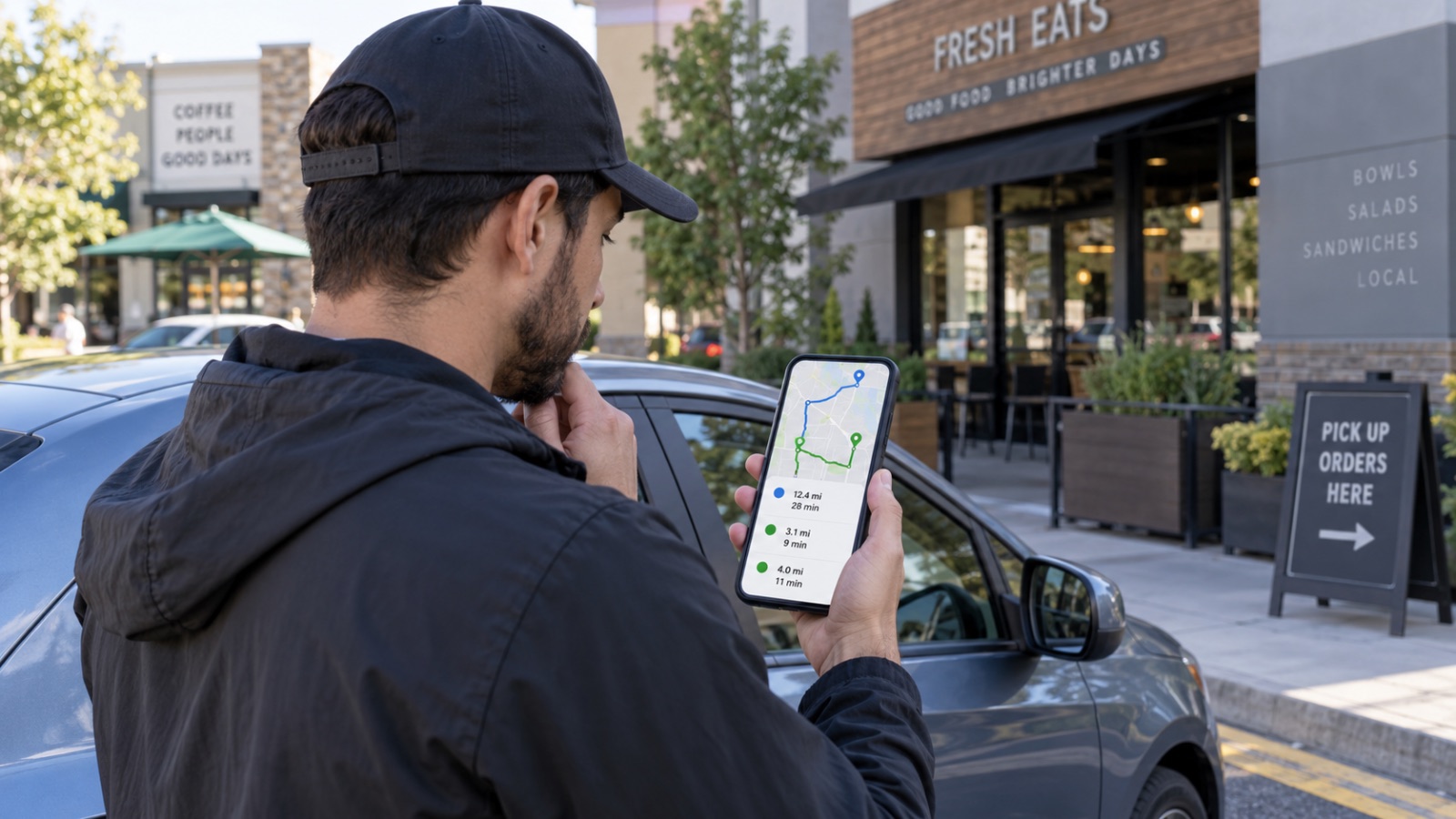
Delivery drivers make this kind of decision all the time.
One offer pays more but takes you farther away.
Another option is to stay nearby and hope to complete two shorter deliveries in roughly the same amount of time.
Which is better?
At first, two deliveries may sound better than one.
More orders can mean more chances to earn.
But one strong long-distance delivery can sometimes outperform two short orders.
The answer depends on much more than the number of deliveries.
One delivery versus two is really a time-and-cost question
Imagine you have one hour available.
You could accept one $24 delivery that takes most of the hour.
Or you could try to complete two $12 deliveries.
Both options appear to offer the same $24 in gross earnings.
But the real results may be completely different.
You still need to consider:
- Pickup time
- Total mileage
- Waiting
- Return miles
- Where each delivery ends
- Vehicle costs
- Whether the second short order actually appears
That last point matters more than it may seem.
Two short deliveries are not guaranteed
When drivers compare one known long offer with two short deliveries, there is often an assumption hidden inside the comparison.
The first short order exists.
The second one may not.
You may complete the first delivery and then wait 10 or 20 minutes before another worthwhile offer appears.
Expected orders are not the same as actual orders
Suppose you reject a $24 long delivery because you believe you can complete two $12 orders instead.
You complete the first $12 delivery in 20 minutes.
Then nothing worthwhile appears for the next 25 minutes.
Now the comparison has changed.
The long delivery would have produced $24.
The short-order strategy produced $12 plus waiting.
That does not mean you should always take the long order.
It means the second order should never be treated as guaranteed income.
One long delivery can be very efficient
Longer deliveries sometimes get rejected simply because the mileage number looks large.
That can be reasonable.
But mileage should be considered together with payout and time.
A longer route can still be strong
Imagine an offer that pays $30 and requires 16 total miles.
If the pickup is ready, traffic is light, and the trip takes 40 minutes, the result may be quite good.
Now compare two shorter deliveries paying $11 each.
The first requires 5 miles.
The second requires 6 miles.
Together they pay $22 and require 11 miles.
The shorter orders used fewer miles.
But the longer order produced $8 more gross income.
Which option is stronger depends on the vehicle cost, time, and what happens after each delivery.
Short orders can contain more waiting
Two deliveries usually mean two pickups.
That means two opportunities for something to slow you down.
You may encounter:
- Two parking situations
- Two pickup lines
- Two order delays
- Two loading processes
- Two customer drop-offs
- Two sets of traffic lights and local turns
A short route does not guarantee a short order
A delivery showing three miles might still take 30 minutes if the pickup is slow.
Two of those orders can consume an entire hour.
Meanwhile, one longer highway delivery might be finished more smoothly.
This is why miles alone cannot tell you which option is better.
Pickup reliability can change the answer
Some pickup locations are consistently fast.
Others are unpredictable.
If you know a short order comes from a location where you frequently wait 15 minutes, the short mileage loses some of its advantage.
Time at the pickup has value
Consider two $10 short deliveries.
Each one requires:
5 minutes driving to pickup
10 minutes waiting
10 minutes driving to customer
5 minutes completing the drop-off
That is roughly 30 minutes per order.
Two orders can consume an hour for $20.
A single $24 delivery completed in 45 minutes may produce the stronger result even if it travels farther.
Where the long delivery ends matters
A long delivery can look profitable until you examine the destination.
If it takes you far outside your useful delivery area, you may need to drive back without an order.
That return trip changes the calculation.
The displayed miles may not be the whole trip
Suppose a $30 delivery shows 15 miles.
But the customer lives 10 miles outside your normal pickup area.
If you need to drive those 10 miles back, the real work may be closer to 25 miles.
Now the offer looks different.
A pair of shorter deliveries that keeps you near active pickup locations may be much stronger.
Short deliveries can keep you better positioned
One advantage of shorter orders is that they may keep you close to places where additional offers are available.
That can reduce unpaid repositioning.
Location after the delivery has value
Imagine two possible outcomes.
Option A ends 18 miles from your normal delivery area.
Option B consists of two short orders that both finish near several pickup locations.
Even if gross earnings are similar, Option B may leave you in a much stronger position for the next order.
The value of an offer does not stop at the customer's driveway.
But two short deliveries can also send you in opposite directions
Short orders are not automatically efficient.
You could finish one delivery on the east side of town, then receive another pickup six miles west.
Now you are adding unpaid approach miles before the second order even begins.
Look at the entire sequence
Drivers sometimes imagine two short orders as if they fit together perfectly.
Real delivery work is rarely that predictable.
The second pickup may be:
- Far away
- Slow
- Low-paying
- Going in the wrong direction
- Unavailable altogether
The long order is known.
The second short order is often only a possibility.
Compare total miles, not just offer miles
If you are comparing different strategies, count all the driving each option is likely to require.
That may include:
- Miles to the pickup
- Miles to the customer
- Miles between orders
- Return miles
- Repositioning miles
The shorter-looking option can still create more driving
Suppose two orders each show four miles.
You might think the pair equals eight miles.
But if you drive three miles to the first pickup and four miles between the first drop-off and second pickup, your real mileage could be closer to 15.
One longer delivery showing 12 miles might actually require less total driving.
Compare the full time too
Mileage is only part of the decision.
You also need to estimate how long each option will occupy you.
For two short deliveries, include:
- Both pickups
- Both waits
- Both loading periods
- Both drives
- Both drop-offs
- Time between the orders
For the longer delivery, include the same real-world factors.
A faster option can free you for another order
Suppose the long order takes 45 minutes.
You may still have time to receive another offer during the hour.
If two short deliveries take a full 60 minutes, the expected advantage from completing more orders disappears.
Payout per mile does not settle the question
Drivers often compare offers using dollars per mile.
That can be useful.
But it does not capture everything.
A $2-per-mile order can still be weak if it requires a long wait.
A $1.50-per-mile order can sometimes be stronger if it is fast, predictable, and ends in a useful area.
Use more than one measurement
When comparing one long delivery with two short ones, look at:
- Expected TRUE profit
- Profit per hour
- Profit per mile
- Total miles
- Expected total time
- Destination quality
Together, those numbers tell a much more complete story.
One strong order can reduce uncertainty
There is another advantage to having a good offer already on your screen.
You know what it pays.
You know the destination.
You can estimate the time and mileage.
When you reject it in hopes of receiving multiple future orders, you are trading a known opportunity for an unknown one.
Sometimes that trade is worthwhile
If the long order is weak, rejecting it can be the right choice.
But if it is already profitable and meets your goals, rejecting it simply because you hope for two better orders introduces additional uncertainty.
That uncertainty should be part of the decision.
Two short deliveries can be better during strong demand
There are times when short orders become especially attractive.
During a strong lunch or dinner period, new offers may arrive quickly.
If you can complete a short order and return immediately to a busy pickup area, the probability of another worthwhile order may be high.
Strong demand reduces the risk of waiting
That can make two shorter deliveries more realistic.
The same strategy may not work during a slow afternoon when another order could take 30 minutes to appear.
Time of day matters.
Long deliveries can make more sense during slower periods
During a slower period, a strong longer offer can provide guaranteed productive work.
Instead of sitting and hoping for several smaller orders, you may lock in one worthwhile trip.
That can be especially valuable when order frequency is low.
Do not reject good work just because it takes longer
A longer order is not automatically bad.
If the numbers work and the destination does not create a costly return trip, it may be exactly the right order for a slow period.
Vehicle costs still matter
Longer deliveries usually create more mileage.
That means more:
- Fuel use
- Tire wear
- Maintenance
- Vehicle depreciation
But two short deliveries also create vehicle costs.
The important number is the total cost of completing the entire option.
Compare the finished result
If one long order produces $20 in TRUE profit and two short ones produce $16, the long order was stronger.
If the two short deliveries produce $22 while keeping you in a good area, the short-order strategy wins.
There is no rule saying one format is always better.
Do not judge an order by length alone
A driver can get into trouble with rigid rules such as:
"Never take anything over 10 miles."
Or:
"Short orders are always better."
Those rules ignore too many variables.
A long delivery can be excellent.
A short delivery can be terrible.
Judge the whole trip
What matters is what the order asks from you compared with what it pays back.
That includes:
- Money
- Miles
- Time
- Waiting
- Vehicle cost
- Destination
Your own history can reveal which works better
Over time, compare your completed deliveries.
Look at long orders and short orders separately.
You may discover patterns.
Perhaps your longer highway deliveries are surprisingly efficient.
Maybe your short downtown orders lose too much time to parking.
Maybe two quick restaurant deliveries during dinner consistently outperform one longer trip.
Your own numbers are more useful than a universal rule
Different areas produce different results.
Your delivery history can show what actually works for you.
The bottom line
One long delivery is not automatically better than two short ones.
And two short deliveries are not automatically better than one long one.
The better choice depends on the complete picture.
Compare:
- Total payout
- Total miles
- Total time
- Pickup reliability
- Waiting
- Return miles
- Where the delivery ends
- Expected TRUE profit
Most importantly, remember that the long order on your screen is real.
The second short order you hope to receive is not guaranteed.
Choose the option that gives you the strongest realistic result, not simply the highest number of completed deliveries.
Related reading
\n