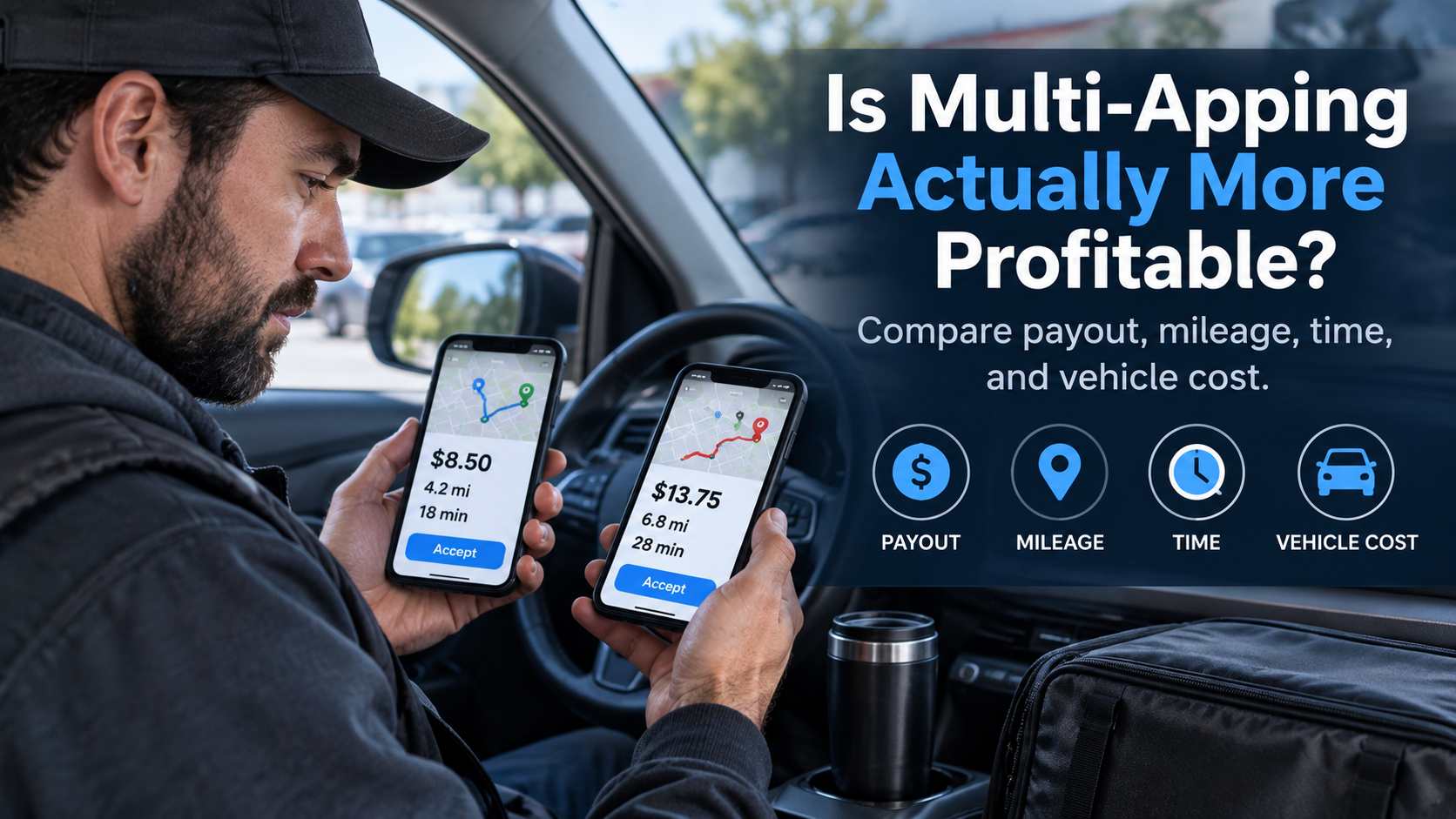
Using more than one delivery app can seem like an obvious way to make more money.
More apps can mean more offers.
More offers can mean more choices.
More choices can mean less waiting.
But that does not automatically mean more profit.
Multi-apping can improve a driver's results when it is managed carefully.
It can also create extra mileage, rushed decisions, overlapping orders, and unnecessary stress.
The question is not simply whether running multiple apps creates more opportunities.
The better question is whether those opportunities actually improve what you keep.
What Multi-Apping Really Means
Multi-apping generally means keeping more than one delivery platform available during the same work period.
A driver may watch several apps for offers and choose whichever opportunity looks best.
The goal is usually simple:
Reduce downtime and increase the chance of finding worthwhile work.
More Apps Can Create More Choices
If one app is slow, another may have an offer.
If one platform is showing poor trips, another may offer something better.
That can give drivers more control over what they accept.
But the extra choices only help when the driver still evaluates each offer carefully.
More Offers Do Not Automatically Mean More Profit
Seeing more opportunities can feel like progress.
But an offer is not valuable just because it exists.
Every delivery still needs to be evaluated based on:
- Payout
- Mileage
- Time
- Pickup distance
- Wait time
- Vehicle costs
- Destination
- Return miles
Opportunity and Profit Are Different
Suppose one app sends you five offers in an hour.
Another sends you three.
Now you have eight opportunities instead of five.
That sounds better.
But if most of those additional offers are high-mileage or low-paying, the extra volume may not improve your results.
More choices are useful.
More bad choices are not.
Multi-Apping Can Reduce Idle Time
One of the strongest arguments for using multiple apps is reducing unpaid waiting.
A driver may finish an order and receive nothing useful from the first platform.
Another app may have an offer available immediately.
That can help keep the workday moving.
Less Waiting Can Improve Profit Per Hour
Suppose a driver normally waits 20 minutes between useful orders.
If another app provides a profitable offer during that gap, the driver may convert unpaid waiting into productive time.
That can improve:
- Gross earnings
- TRUE profit
- Profit per hour
This is one of the situations where multi-apping can be genuinely valuable.
The Next Offer Still Has to Be Good
Reducing idle time does not mean accepting the first offer that appears.
A poor delivery is still a poor delivery.
Even if it arrives while another app is quiet.
Do Not Let Boredom Make the Decision
Drivers sometimes become less selective when they have been waiting.
An additional app can make that temptation stronger because something is almost always appearing on the screen.
But staying active is not the same thing as staying profitable.
The offer still needs to make sense.
Mileage Can Increase Quickly
Running multiple apps can lead to more driving if the driver begins chasing offers across different areas.
One platform may pull you east.
Another may send you west.
A third may offer something far from your current location.
More Opportunities Can Create More Repositioning
If you constantly drive toward whichever app looks busiest, you may add unpaid miles between orders.
Those miles still create:
- Fuel cost
- Tire wear
- Maintenance
- Depreciation
- Lost time
Multi-apping works best when the additional opportunities reduce wasted movement rather than create more of it.
Pickup Distance Matters
An offer may look strong based on the payout and delivery distance.
But if you are far from the pickup, the full trip can be much longer.
This becomes especially important when several apps are running.
Count the Drive to the Pickup
Suppose an offer pays $15 and shows six delivery miles.
You are four miles from the pickup.
Your real starting mileage is already different from what the offer screen suggests.
If another app has a $13 offer one mile away, the smaller payout may produce the better result.
Multi-apping gives you the ability to compare those opportunities.
You still have to count the whole trip.
Overlapping Orders Can Create Problems
The biggest risk with multi-apping is trying to do too much at once.
Accepting deliveries from multiple platforms at the same time can create:
- Late pickups
- Late deliveries
- Longer routes
- Customer frustration
- Extra driving
- Increased stress
It can also create problems with platform rules or service expectations.
More Orders Are Not Always Better
Two orders that look profitable separately may become inefficient when combined badly.
If the pickups are in opposite directions or the drop-offs do not line up, the route can become much longer than expected.
That extra time can reduce profit per hour.
The additional mileage can reduce profit per mile.
Platform Rules Matter
Each delivery platform has its own policies and expectations.
Those rules can change over time.
Drivers should understand the current requirements for the services they use.
Protect Your Accounts
Multi-apping should never depend on ignoring delivery expectations or creating unnecessary delays.
An extra order is not worth much if it creates account problems.
The safer approach is to use multiple apps to increase your choices, not to overload yourself with conflicting deliveries.
Multi-Apping Works Best as an Offer Comparison Tool
One of the most useful ways to multi-app is simply to keep several sources of offers available.
You do not have to accept orders from all of them at once.
Instead, compare what is available.
Choose the Strongest Opportunity
Imagine three offers appear:
Offer A pays $9 for seven miles.
Offer B pays $14 for five miles.
Offer C pays $12 for three miles.
Payout alone does not decide the winner.
You should also consider:
- Pickup distance
- Expected wait
- Total time
- Destination
- Return miles
- Vehicle cost
Multi-apping gives you choices.
Your numbers help you choose among them.
Multi-Apping Can Help in Slow Periods
Some delivery apps perform better at certain times than others.
One may be strong during lunch.
Another may have better dinner activity.
Another may provide opportunities during slower periods.
Different Apps Can Fill Different Gaps
If one platform consistently slows down at 2 p.m., another may help fill that time.
That can make a workday more efficient without extending your hours.
This is much different from driving longer simply because you have more apps available.
More Apps Can Also Create More Distraction
There is a practical limit to how many things a driver can monitor effectively.
Multiple notifications, maps, offer screens, and timers can become distracting.
Safety Comes Before Offer Comparison
Offer decisions should never interfere with safe driving.
If multiple apps create too much distraction, the extra opportunities are not worth it.
A profitable strategy still has to be manageable.
Compare Apps by Profit, Not Just Payout
One platform may appear to pay more per order.
Another may create shorter trips.
Another may have faster pickups.
Another may keep you closer to useful delivery areas.
Look at the Full Results
Compare each app over time using:
- Gross earnings
- Total mileage
- Total time
- Waiting
- Vehicle costs
- TRUE profit
- Profit per hour
- Profit per mile
This can reveal which platform actually performs better for you.
One App May Be Better in One Area and Worse in Another
Delivery conditions can vary greatly by location.
An app that performs well in one city may be weak somewhere else.
Even within the same city, different areas may behave differently.
Your Own History Matters Most
Online advice about the "best app" can only go so far.
Another driver may have:
- Different restaurants
- Different customers
- Different traffic
- Different delivery distances
- Different wait times
Your own records show what works where you actually drive.
Multi-Apping Can Help You Avoid Weak Offers
If you rely on only one app, declining a weak offer may mean waiting for the next one.
With multiple apps available, another opportunity may appear sooner.
That can make it easier to stay selective.
More Choice Can Protect Your Minimum
Suppose you have a personal minimum for payout, profit per mile, or profit per hour.
More available offers may increase your chances of finding one that meets that minimum.
This is one of the strongest potential advantages of multi-apping.
But More Choice Can Also Lower Your Standards
The opposite can happen too.
When offers constantly appear, drivers can start accepting simply because they feel pressure to keep moving.
Do Not Chase Activity
Being busy can feel productive.
But if the additional work produces weak profit, the extra activity is not helping.
Your standards should not disappear just because another app sends an offer.
Return Miles Still Matter
Multi-apping does not eliminate the problem of where deliveries end.
A trip may pay well but leave you far from useful pickup areas on every platform.
A Bad Destination Is Still a Bad Destination
If you have to drive several miles back before any app becomes useful again, those return miles matter.
The presence of multiple apps does not make those miles free.
Evaluate the destination before accepting.
Multi-Apping Can Improve Profit Per Hour
The biggest potential benefit is often time efficiency.
If multiple apps help reduce waiting between profitable deliveries, profit per hour can improve.
Measure the Difference
Compare a normal single-app shift with a similar multi-app shift.
Look at:
- Hours worked
- TRUE profit
- Waiting time
- Miles driven
- Profit per hour
If waiting falls and profit rises without a large increase in mileage, multi-apping may be helping.
Multi-Apping Can Hurt Profit Per Mile
The tradeoff may appear in vehicle use.
You may complete more orders and earn more per hour while also driving much farther.
That is why profit per mile matters too.
Watch Both Measurements
A strong multi-app strategy should ideally improve your time efficiency without destroying your vehicle efficiency.
If profit per hour improves but profit per mile falls sharply, you should understand why.
The extra income may still be worth it.
But you need the full picture.
Do Not Judge Multi-Apping by One Great Day
A single strong day can make any strategy look successful.
One unusual Saturday does not prove that multi-apping works better overall.
Compare Several Similar Shifts
Track multiple workdays.
Compare:
- Similar days of the week
- Similar hours
- Similar delivery areas
Then look at the averages.
Patterns are more useful than one exceptional result.
Know When to Pause the Other Apps
Once you accept a strong delivery, it may make sense to stop or pause other offers temporarily.
That can reduce distraction and prevent poor overlapping decisions.
You Do Not Have to Keep Everything Running Constantly
Multi-apping does not mean every app has to stay active every second.
The goal is to create better opportunities.
It is not to create chaos.
Keep the Strategy Simple
A complicated system is hard to use consistently.
You should be able to answer a few basic questions quickly:
Is this offer profitable?
How far am I from pickup?
Where will it leave me?
How long will it take?
Does another available offer look better?
Simple Decisions Are Easier to Repeat
The best strategy is one you can use during a real workday without slowing yourself down.
More information is useful only when it helps you make a better decision.
When Multi-Apping May Be Worth It
Multi-apping may help when:
- One app has frequent slow periods
- Other apps provide useful offers during downtime
- You remain selective
- You avoid conflicting deliveries
- Additional mileage stays controlled
- Waiting time decreases
- TRUE profit improves
- Profit per hour improves
In those situations, using multiple apps can make the workday more efficient.
When Multi-Apping May Not Be Worth It
It may hurt when:
- You accept too many overlapping orders
- You drive farther chasing offers
- Notifications become distracting
- You lower your offer standards
- Vehicle mileage rises too quickly
- Deliveries become late
- Stress increases
- TRUE profit does not improve
More apps are not automatically better.
So, Is Multi-Apping Actually More Profitable?
It can be.
But only when the additional choices improve the quality and efficiency of your work.
Multi-apping is most useful when it helps you:
Reduce waiting.
Find stronger offers.
Stay closer to profitable work.
Avoid weak trips.
Use your time more efficiently.
If it simply causes more driving, more distraction, and more weak deliveries, it may do the opposite.
Measure the Result Instead of Guessing
The best way to know whether multi-apping works for you is to compare your actual numbers.
Track:
- Earnings
- Miles
- Time
- Waiting
- Vehicle costs
- TRUE profit
- Profit per mile
- Profit per hour
Then compare those results with your single-app shifts.
TRUE Driver Profit is designed to help drivers measure the entire workday instead of judging success by the number of offers or apps on the screen.
Because more opportunities only matter when they lead to better profit.
Related reading